Information Technology
ElevenLabs Explained: A Practical Guide to AI Voice, Transcription and Audio Review
ElevenLabs offers tools and APIs for working with speech. Evaluating them well means separating the written content, the generated or recognised audio, and the listener's actual experience. This independent guide follows a fictional museum audio project to explain that process. It describes neither an ElevenLabs integration in Didloo or WeBot nor results from a paid benchmark. The exercises are original planning examples that a team can adapt to its own authorised material.
Begin with something a listener needs to understand
A fictional community museum, Lantern House, wants a short audio trail for visitors. Its first recording explains how a restored printing press operated. The goal is not simply to create a convincing voice. A visitor should understand which object is being discussed, hear the important distinction between two mechanisms and know where the next exhibit begins.
Write that listener outcome before choosing a voice. It determines what the script must contain, where explanation needs space and what a reviewer should check. A voice can sound impressive while explaining the wrong object. The project therefore needs a content decision as well as a generation decision. This starting point also helps a small team avoid spending its entire budget comparing performances of a script whose factual details have not yet been settled.
Separate text to speech from speech to text
ElevenLabs documents Text to Speech for producing spoken audio from text and Speech to Text for producing transcripts from recordings. These directions are different. A narration workflow starts with words the team wants spoken; a transcription workflow starts with something that was recorded. The relevant model, request and review process should follow that distinction.
Lantern House might use a written exhibit script for narration while separately transcribing an authorised interview with its curator. The transcript is not automatically an approved script. Spoken explanations can contain false starts, ambiguous references and corrections that make sense only within the interview. Likewise, a generated narration is not a transcript of a real curator speaking. Label project files so that editors can distinguish recorded source material, recognised text, approved narration copy and generated audio without guessing from filenames.
Read capability information for the selected model
The provider's Text to Speech overview presents different models and voice options. Capabilities and supported languages depend on the selection. Consult the current model documentation instead of treating a broad platform description as a guarantee that every model supports the same controls or delivers the same performance.
For the museum, make a small evaluation card identifying the model, voice, language and intended use. Add the date of the evaluation, since product options can change. A colleague should be able to understand which configuration produced the candidate recording. Avoid a vague note saying that the latest AI voice was used. If a future editor needs to regenerate one sentence, the configuration history is more useful than an enthusiastic description of how natural the original seemed during a demonstration.
Prepare a script that works when it is heard
Written exhibition labels can rely on layout, punctuation and a reader's ability to look backwards. Audio unfolds in time. Read a draft aloud before generating it and identify sentences whose meaning requires the listener to remember too many qualifications. A clean written script is the first practical audio control.
In the fictional printing-press explanation, replace a long sentence containing three machinery names with two shorter sentences that preserve the relationship between them. Keep necessary technical terms, then explain them. This is editorial work rather than a claim about a particular model's limitations. The question is whether a person walking through the gallery can follow the explanation without seeing the manuscript. Keep the approved facts intact while improving the spoken sequence, and let an exhibit editor review any substantive change.
Make numbers and abbreviations unambiguous
An editor should decide how dates, measurements and abbreviations are intended to sound. A written token can have several plausible readings. In a museum script, a catalogue reference may need separate characters while a year needs an ordinary year pronunciation. Leaving that distinction implicit makes evaluation harder.
Create a pronunciation note beside each important item before generating the recording. Lantern House could specify that a fictional label B-14 is an exhibit reference, while 1914 is a year. Neither should accidentally become a quantity or an unrelated word. Keep these notes separate from historical source material so that a pronunciation adjustment does not silently change a fact. During listening review, compare the actual spoken interpretation with the note, rather than checking only that the same characters remain in the script.
Use pronunciation controls with model awareness
ElevenLabs' speech best-practices documentation discusses pronunciation techniques, dictionaries and model-dependent controls. The applicable method should be checked for the model actually being used. Do not assume that a markup example for one model can be pasted unchanged into every other model.
For Lantern House, begin with one difficult exhibit name in a short candidate sentence. Evaluate the sound in its real context, not only in isolation. Keep the test phrase and the successful setting together. Then listen again when that phrase appears in the longer narration, because a correct short demonstration is not a review of the complete recording. This modest experiment gives the team a reproducible pronunciation decision without implying that any technique guarantees an identical outcome across all voices, languages or future model versions.
Treat voice selection as an editorial choice
The voice should serve the material and the audience. A dramatic delivery may suit one introduction and distract from an explanation that needs calm precision. Evaluate a candidate on the actual script, including a difficult term and an ordinary connecting sentence. A provider's sample shows a possibility; it does not settle suitability for the museum's own text.
Lantern House can give reviewers a brief such as clear, welcoming and unhurried. Ask each reviewer to identify a specific phrase that meets or misses the brief. This produces more actionable feedback than a vote for the nicest voice. The museum should also decide whether one voice carries the entire trail or whether different sections need distinct editorial roles. Keep those roles clear so that a change of speaker does not accidentally suggest a new historical source or a quoted witness.
Keep voice creation and voice cloning distinct
ElevenLabs' voice-cloning overview distinguishes Instant Voice Cloning from Professional Voice Cloning, with different approaches and input expectations. Check the current documentation for the workflow being considered. This guide does not offer a quality ranking or assume that either approach guarantees an exact reproduction of any individual.
For a museum project, first decide whether there is a reason to use a particular person's voice at all. An authorised project voice and a named historical figure are different editorial choices. Use material the team is authorised to use and keep the voice's identity and intended use clear in project records. A recognisable sound should not become evidence that the person actually recorded a new statement. These recommendations concern transparent production practice, not a claim that voice resemblance establishes authorship or approval.
Prepare source recordings for their intended task
If a project uses authorised recordings, listen to the source before evaluating its transformation. Note background sound, overlapping speakers, room echo and changes in recording position. Those observations help reviewers explain a problem rather than attributing every audible defect to the final tool.
Lantern House might receive a curator interview recorded beside a working ventilation unit. The content can still be valuable, but the team should document that environment. Keep a preserved source copy and work on an appropriately labelled editing copy. A later reviewer can then distinguish what was present originally from what changed during processing. This is a suggested production workflow, not a promise that a particular recording can be repaired automatically. When the material cannot support the intended result, revising the production plan can be more useful than repeatedly changing generation settings.
Build a short listening test before a long production
Choose a sample that represents the difficult parts of the project. For the printing-press trail, include a technical name, an ordinary explanation, a number and a transition to another exhibit. An easy opening paragraph alone does not test the material that is likely to need editorial attention.
Write down what the sample is intended to reveal. The museum could listen for whether the two machine parts remain distinguishable and whether the spoken exhibit reference matches the sign on the wall. Keep alternative takes labelled and change one relevant variable at a time. This makes it possible to learn from the comparison. A folder containing many anonymous audio files creates a selection chore without explaining why one candidate should be preferred or how it could be reproduced later.
Review content before judging performance
The first pass should ask whether the recording says what the approved script intends. Listen for missing words, altered names, changed numbers and shifts around negatives. A beautiful delivery cannot compensate for reversing a historical comparison or omitting the word that distinguishes an original part from a replacement.
Lantern House can divide review into a content pass and a performance pass. During the content pass, the reviewer follows the approved manuscript and records exact locations requiring attention. During the performance pass, the reviewer listens for pace, emphasis and transitions. Keeping the passes distinct helps avoid a common evaluation mistake: approving a convincing reading before checking whether it accurately conveys the text. It also makes revisions easier to assign, because a factual correction and a change in tone require different editorial decisions.
Evaluate pacing over a complete section
ElevenLabs' best-practices guidance includes delivery and pacing controls. Review the applicable guidance for the chosen model and test it against the actual passage. A parameter setting is a production input; whether the listener can comfortably follow the explanation is an evaluation outcome.
For the museum, listen to a complete exhibit section while imagining the visitor looking at the object. A phrase that sounds energetic in a short preview can become tiring across a longer explanation. Conversely, slowing everything may obscure which points deserve emphasis. Record the particular transition that feels rushed or the sentence whose pause interrupts meaning. Specific feedback gives the editor a useful target and reduces unnecessary regeneration of passages that already meet the brief.
Plan section boundaries before assembling the trail
A visitor may start playback midway through an exhibition or return to a previous item. Each section needs enough context to stand on its own without repeating the entire introduction. Plan the boundary between recordings as a listener experience rather than an arbitrary text-length division.
Lantern House could begin each exhibit with a concise object reference and end with a clear next step. When assembling the trail, listen to adjoining sections in order. Check that there is no abrupt change in volume, duplicated introduction or unfinished thought. This is an original editing recommendation, not a statement about the internal behaviour of an ElevenLabs endpoint. Keep the assembled version linked to its component versions so that replacing one exhibit does not accidentally restore an older neighbouring section.
Translate the explanation before producing another language
A second-language narration needs a complete, reviewed script. Translating while simultaneously judging the voice makes it difficult to locate the cause of a misunderstanding. Settle the intended meaning first, including references, dates and the relationship between technical terms. Then evaluate how the narration expresses that approved text.
For an English and Hindi museum trail, have reviewers compare the claim made in each language rather than looking for identical sentence length. An appropriate Hindi explanation may need a different sentence structure. Keep the historical distinction intact and choose natural wording for the listener. This is a proposed review method; it is not a claim that these fictional samples have been assessed by native speakers. Language availability in a product menu is separate from the quality of a particular translated script and recording.
Test mixed language phrases where they really occur
Names, borrowed terms and catalogue labels can make a passage different from a single-language sample. Include those combinations in the evaluation set. Avoid treating a correct standalone name as proof that every surrounding sentence will sound natural or preserve the intended emphasis.
Lantern House may use a Hindi explanation containing an English machinery name displayed on the exhibit. The team should decide whether the listener needs the original term, a translated explanation or both. Test that editorial decision in the full sentence. If a change improves intelligibility, record why it was made so that future exhibit recordings follow a consistent convention. Consistency here means a deliberate language policy and review process, not a promise that all generated audio will sound identical.
Treat transcription as a draft to be checked
ElevenLabs' Speech to Text documentation describes transcription and features such as timestamps and speaker-related information for supported models. Consult the current reference for the selected output. The presence of structured fields does not establish that every recognised word or speaker assignment is correct in a particular recording.
When transcribing the fictional curator interview, compare disputed passages against the source audio. Preserve uncertainty rather than silently replacing an unclear name with a plausible historical figure. A reviewer should be able to distinguish recognised text from an editor's correction. If the transcript will support a published exhibit claim, use the museum's ordinary factual review process as well. This keeps speech recognition in its useful role as an aid to working with recordings, rather than turning a fluent-looking transcript into an unquestioned authority.
Keep transcript speaker labels modest in meaning
A label identifying a speaker segment is not automatically a verified personal identity. In the museum's workflow, a transcript may need an editor to connect segments to known participants using authorised contextual information. Do not let a technical label become a new factual claim about who said something.
Imagine an interview in which the curator and a volunteer occasionally speak together. A useful review note could mark the overlap and request a second listen. Inventing a confident attribution would make the transcript appear cleaner while reducing its reliability. Keep the editorial correction history alongside the source reference. This is a general recommendation for transcript review, not an assertion of a specific error rate or a measured weakness in an ElevenLabs model. The purpose is to preserve what is known and make uncertainty easy to find.
Define an audio delivery format for the real player
A generated candidate still needs to work in the intended playback environment. Document what the project's player accepts and test the final exported file there. A successful API response and a visitor hearing the complete recording are different checkpoints. Use the actual endpoint reference for the available format options rather than assuming an example from another workflow applies.
Lantern House could test its final file on the exhibit device and a representative visitor phone. Check start, pause, resume and moving to the next item. If headphones are expected, test with that arrangement too. Preserve a known final version so that a later export can be compared with it. The article does not prescribe a universal codec or loudness target; those decisions should follow the museum's actual playback requirements and production expertise.
Keep API credentials out of visitor-facing code
ElevenLabs' authentication reference documents API keys and the xi-api-key request header. It explicitly treats the key as secret and describes access restrictions. Follow the current authentication approach for the selected endpoint. A visitor's browser should not receive a long-lived server credential merely because it needs to play an approved recording.
In a proposed museum architecture, separate generating a recording from distributing the approved audio. Staff production access and visitor playback access serve different purposes. Trace where configuration values can appear in logs, build output and support exports. Use placeholder values in documentation and screenshots. This is a design recommendation for a prospective project; no credential is created, no account is changed and no live generation is performed as part of this explanatory guide.
Record who owns the production configuration
ElevenLabs' workspace API-key documentation distinguishes user keys from service-account keys and describes their management. Check account eligibility and the current workspace guidance before designing around a particular option. The appropriate choice depends on the authorised team and its operational needs.
Lantern House should know who can maintain the production configuration when an editor leaves or responsibilities change. Document the responsible role, the recovery process and where the non-secret configuration history is kept. A production project should not become dependent on someone remembering which personal laptop generated the first demonstration. This is an organisational planning exercise. It does not assert that every account has the same administrative features or that a change of key alone transfers ownership of the museum's scripts, recordings and editorial decisions.
Estimate the work using revisions as well as output
An audio project includes writing, review, candidate generation and final assembly. Estimate those activities separately. If the team compares several takes, that evaluation effort should remain visible instead of disappearing into a simplistic cost per finished minute. Retrieve current plan and usage information from the provider when a real estimate is needed.
For a hypothetical museum budget, list how many exhibit scripts need factual approval, how many languages need review and which passages are likely to need another recording. Keep those figures labelled as planning assumptions. This article makes no price claim and reports no measured generation cost. A transparent worksheet helps the team see whether its main constraint is production usage, translation capacity or time available from the person who can approve the historical explanation.
Diagnose a disappointing result at the right stage
Begin with the approved text. Does it communicate the intended idea when read aloud by an editor? Next examine the selected configuration, the generated candidate and the final assembled file. Then check the playback environment. This sequence helps the team avoid changing a voice when the underlying problem is an ambiguous sentence or an incorrectly exported file.
For Lantern House, a visitor confusing two machine parts might indicate that the explanation needs a clearer comparison. An incorrect spoken label may need pronunciation work. A recording that stops early only on an exhibit device may require playback investigation. Record the observation before proposing the remedy. A clear problem statement gives the next test a purpose and keeps the project from cycling through settings without learning which part of the workflow actually changed the result.
Publish the recording with clear editorial context
Tell the listener enough to understand what the audio represents. A generated narration of an approved exhibit script should not be presented as an archival recording of a named person. Keep any source quotations distinguishable from the museum's explanatory narration. These choices make the audio easier to interpret and support ordinary editorial accountability.
Lantern House could label its audio trail as museum-written narration and identify the exhibit information it accompanies. The exact disclosure should fit the real production and distribution context. Do not invent endorsements or imply that a voice provider has certified the museum's historical claims. The team approving the script remains responsible for those claims. Clear context supports a more useful experience than relying on a voice's realism to make every statement feel authoritative.
Preserve a repeatable release record
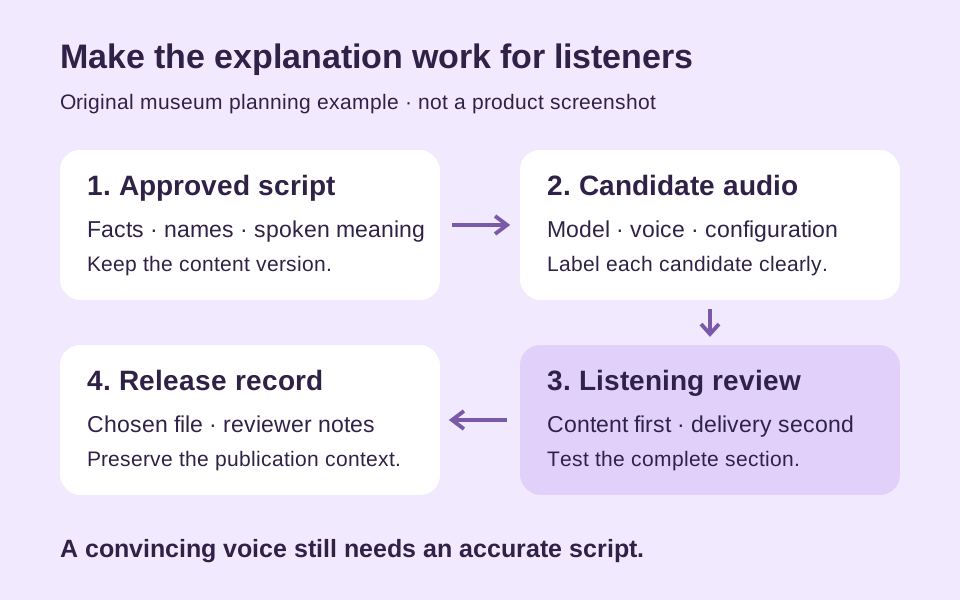
Before release, gather the approved script version, configuration references, chosen audio file and review notes. Record which language and playback environment were actually checked. The release record should explain the decision, including any limitations relevant to the intended audience. It should not claim a broad certification based on one attractive sample.
Lantern House's practical question is whether visitors can understand this audio trail and whether staff can maintain it. ElevenLabs can supply speech capabilities, while the project team supplies the script, review and publication judgement. A repeatable record connects those responsibilities. When an exhibit changes, the team can identify the affected passage, produce a new candidate and review the result without treating the entire earlier process as a mystery or assuming that yesterday's approval automatically covers tomorrow's content.
Further reading
Official resources and related guides for the concepts discussed above. Check the selected tool for current capabilities and terms.
Take the next idea into a conversation
Explore Didloo for personal chats, creative sharing and linked desktop messaging. Business messaging has its own approved API workflow.