AI and Learning
AI for Students: Practise, Check and Explain Your Work
An independent study guide with fictional examples. Follow your teacher’s rules and finish with work you can explain yourself.
Start with a learning task
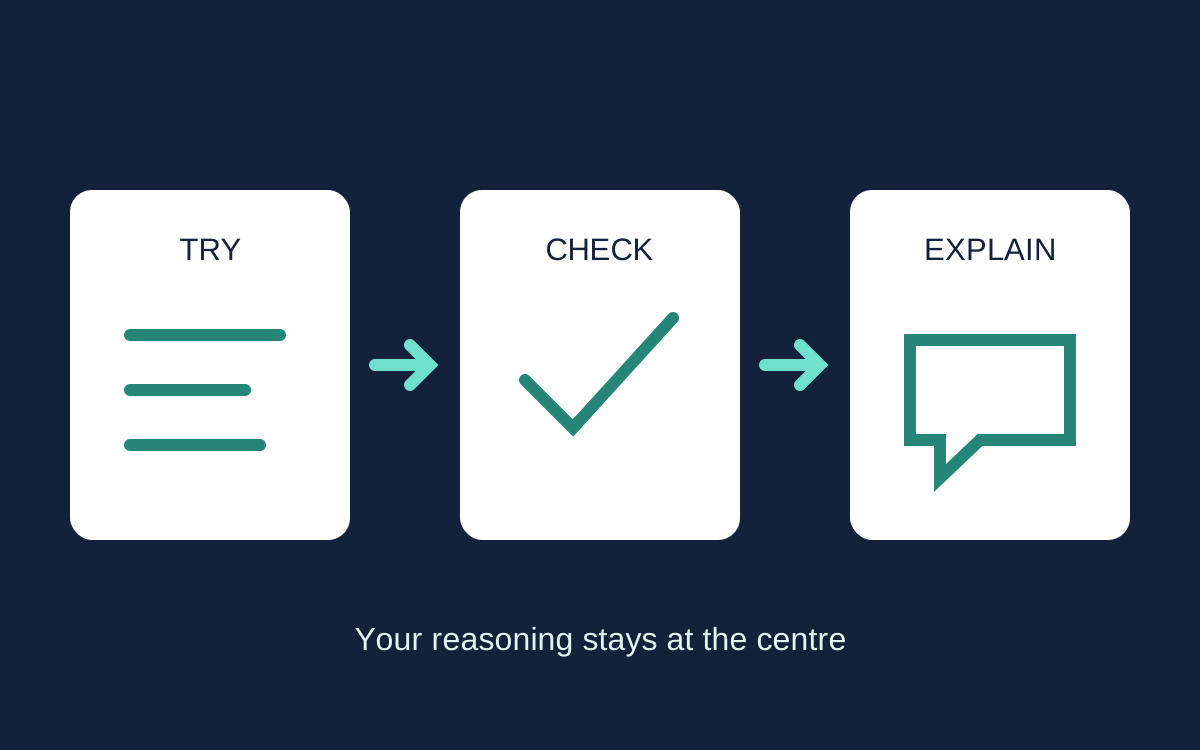
A useful AI study session begins with something you want to understand, not a file you want to finish. Choose a small outcome: explain why fractions need a common denominator, identify the argument in a history paragraph, or find the mistake in a short program. Write what you already know before opening a chatbot. That first attempt gives you something to compare with the response. If you cannot name the skill you are practising, a polished answer may hide the fact that you have learnt very little.
This guide uses fictional student examples and an editorial study routine. It does not promise better marks or establish a Didloo tutoring feature. Your teacher's assignment rules, institution's guidance and the selected tool's age and account requirements still apply.
Check permission before uploading work
Read the assignment instructions. Some teachers allow brainstorming but require independent writing; others permit feedback with an acknowledgement. A task may prohibit generative AI entirely. If the boundary is unclear, ask your teacher before using the tool for assessed work. A general article cannot grant permission for a particular course.
Do not paste another student's submission, private class messages, grades, identification documents or confidential research into a public chatbot. Replace personal details with invented examples when they are unnecessary. Use an institution-approved service when one is provided, and read its actual privacy settings. A paid subscription alone does not establish that uploading school records is permitted. Younger learners need the supervision and account arrangements required by their school and the service.
Make a first attempt without assistance
Suppose Meera is learning percentages. Before asking for help, she writes that a twenty percent discount on 250 means subtracting 20. Her attempt is wrong, but it reveals the exact misunderstanding: she is treating a percentage as a fixed amount. Asking for a finished answer would conceal that starting point.
She can instead write: “I subtracted 20 from 250 for a twenty percent discount. Explain what twenty percent means and ask me one question before giving the final price.” This request gives the tutor a narrow job. Meera still has to calculate and explain. The same method works with an essay outline, a grammar exercise or an algorithm: show your reasoning and request help with the uncertain step.
Ask for hints in stages
A good hint should leave meaningful thinking for you. Begin with a concept reminder, then request a similar worked example if needed, and only then compare a full solution. You might ask: “Give one hint about setting up this equation. Do not solve it yet.” After trying again, explain how the hint changed your approach.
A chatbot may ignore the instruction and reveal everything. If that happens, close the answer and work on a fresh problem with different numbers. Reading a solution can feel familiar without making you able to produce it. Treat hints as temporary support and reduce them as your understanding improves. Do not keep increasing the length of the conversation merely because the system always has another suggestion.
Verify the parts that can be checked
Confident wording does not prove a statement. Check definitions against your textbook or an appropriate primary reference. Open any suggested source and confirm that it exists, discusses the claim and supports the particular sentence. A plausible title or a link alone is insufficient. Do not cite an unread reference just because the chatbot supplied it.
For Meera's example, twenty percent of 250 is 50, so the discounted price is 200. She checks by finding ten percent first: 25, then doubling it. She also checks the direction: a discount must reduce the price. This independent calculation is stronger evidence than asking the same chatbot whether its previous answer was correct. For programming, run a small test and explain the expected result before comparing the output.
Use questions to test recall
After studying, put the explanation away. Ask for three short questions about the concept, answer them yourself, and request feedback on your reasoning. Include a new example rather than repeating the exact problem you just saw. A useful request is: “Ask one question at a time and wait for my answer. If I am wrong, identify the misunderstanding without writing the whole solution.”
The chatbot's assessment can also be mistaken. Keep your textbook or teacher's marking guidance available. A model-generated score is practice feedback, not an official grade. If the explanation remains confusing after a couple of attempts, write down the disagreement and take it to a teacher or class discussion. Changing tools repeatedly is not a substitute for resolving the concept.
Improve writing without replacing your voice
For a paragraph you wrote yourself, request focused feedback: is the main claim clear, which sentence lacks evidence, and where does the order become difficult to follow? Ask for comments before asking for a rewrite. Then revise the paragraph yourself and keep the earlier version so you can explain the changes.
Do not accept added quotations, achievements, experiments or references that you cannot verify. In language learning, compare one correction with the rule behind it and write a fresh sentence using that rule. If you only paste a polished paragraph into your assignment, the exercise may no longer show your ability. Follow any required acknowledgement format and describe the actual assistance rather than using a vague claim that everything was checked.
Keep a small study record
A simple record can contain the learning goal, your first attempt, the hint you used, the source checked and one independent follow-up answer. Avoid storing classmates' information in that record. You do not need to preserve every conversation indefinitely; retain only what your learning or assessment requirements justify.
At the end, write two sentences without assistance: what you now understand and what is still uncertain. That record is useful when asking a teacher for help because it shows the point where you became stuck. It also makes progress visible without relying on the volume of generated notes. Ten pages of summaries are not evidence that you can explain one difficult idea.
Finish with an independent explanation
Return to your original goal. Can you explain the idea aloud, solve a different example and say why an alternative answer is wrong? If not, choose a smaller step and practise again. These are practical self-checks, not a diagnostic test or a guarantee of performance.
UNESCO's guidance frames educational generative AI around human agency, privacy and appropriate educational use. The routine in this article applies that broad direction through original study examples; it is not a UNESCO-approved lesson plan. Use AI where it supports your thinking, keep responsibility for claims and calculations, and finish with work you can explain yourself. When a task requires independent work without AI, practise through the permitted books, exercises and human support instead.
Further reading
Official resources and related guides for the concepts discussed above. Check the selected tool for current capabilities and terms.
Take the next idea into a conversation
Explore Didloo for personal chats, creative sharing and linked desktop messaging. Business messaging has its own approved API workflow.