Physics
Black Holes: Understanding the Horizon, the Light and the Evidence
A black hole is a region of spacetime from which signals cannot escape to distant observers once they cross its event horizon. The dark region, the bright surrounding gas and an artist's dramatic illustration are different things. Separating them explains how astronomers can study an object that does not send light out from its interior.
Start with the boundary rather than a cosmic vacuum cleaner
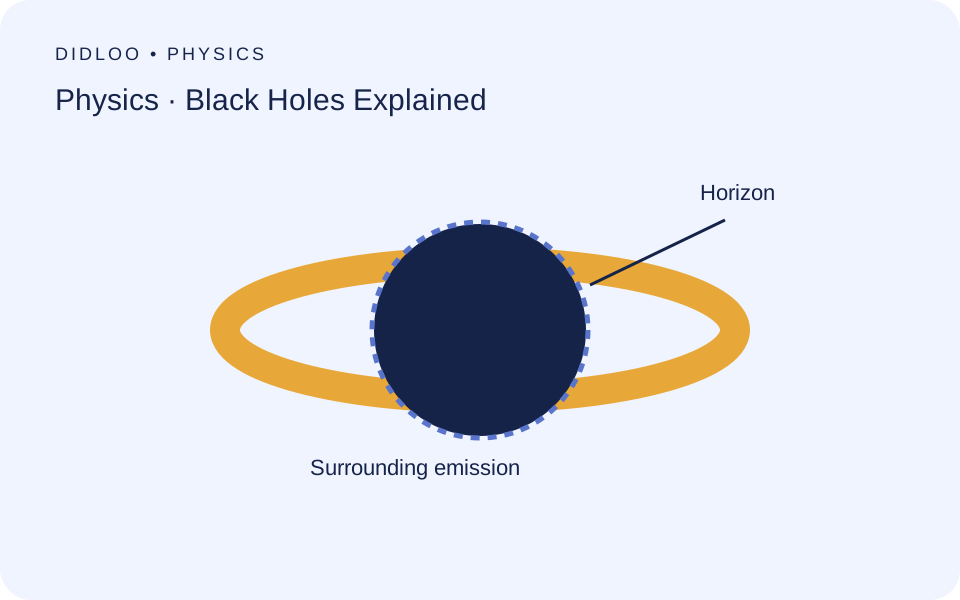
The event horizon is a causal boundary. Crossing it is not like passing through a solid shell with a painted warning sign. In the classical description, future-directed paths inside the horizon cannot carry an outgoing signal to the external universe.
The boundary is not normally the bright ring in a popular image. Light that reaches a telescope was emitted or redirected outside the horizon. A drawing may colour the boundary to make it visible, but that colour is an explanatory convention. The underlying distinction concerns which events can communicate with which observers.
A thought experiment that keeps the mass unchanged
Imagine replacing an isolated gravitating object with a much more compact object of the same mass. Far from both, a corresponding orbit need not suddenly turn into a plunge simply because a horizon now exists near the centre. Mass, distance and the particular spacetime determine the motion.
This is why describing black holes as objects that indiscriminately suck up everything nearby is misleading. Material needs an appropriate trajectory to fall in. Surrounding gas can orbit, interact, heat and lose angular momentum before some of it crosses the horizon. Compactness changes the close-up environment profoundly; it does not remove the need to analyse a trajectory.
Where the visible light comes from
Matter outside a black hole can release energy as it moves inward and interacts. An accretion flow can therefore be extremely luminous even though the black hole's interior is inaccessible to ordinary outgoing light. Not every black hole is surrounded by an equally bright flow.
A view of glowing gas should be read as evidence about the environment and gravity, not as a photograph of material after it has crossed the horizon. Likewise, an illustration of a luminous funnel may depict a jet associated with the surrounding system. It is not a demonstration of ordinary light escaping from inside the horizon.
Why a black-hole image has a dark central region
Light can follow strongly bent paths near a compact object. The observed dark region and surrounding emission depend on geometry, viewing direction and the behaviour of matter and light. A black-hole shadow is related to the horizon but should not be labelled as its simple directly photographed surface.
When looking at an image, first ask whether it is observational data, a reconstructed image, a simulation or an artist's impression. Those products can all be informative, but their evidential roles differ. A simulation explains a model; telescope measurements constrain which models fit what was observed.
Stellar-mass and supermassive systems
Astronomers study black holes across very different mass scales. Some are associated with the aftermath of massive-star evolution. Supermassive black holes occupy the centres of many galaxies and raise additional questions about growth and formation.
The category name does not by itself describe a visible size in a telescope image or the strength of every tidal effect nearby. Compare the mass, distance and local conditions. Do not turn an introductory classification into a claim that all objects in a category formed by one fully established route. Formation histories are inferred from multiple observations and remain an active area of research.
Several kinds of observations support the picture
The motion of nearby stars or gas can reveal a large mass concentrated in a small region. Radiation from orbiting and infalling material provides another line of investigation. Gravitational-wave observations probe compact-object mergers through a different physical messenger.
No single colourful illustration contains all that evidence. A stronger account explains what was measured and what assumptions connect the measurement to a black-hole interpretation. Researchers compare models against data and estimate uncertainties. Responsible explanations preserve that chain instead of presenting a compelling picture as a substitute for measurement.
What gravitational waves add
A changing gravitational system can produce waves in spacetime. Detectors such as LIGO measure exceptionally small changes in relative distances associated with passing waves. The signal from a suitable compact-binary merger contains information about the system's evolution.
These observations are not microphones recording sound through interstellar air. Public audio versions translate aspects of the signal into audible form. Treat that sonification as a communication tool. Its usefulness does not mean gravitational waves and pressure waves are the same physical phenomenon.
Tides, falling and the limits of a travel story
Tidal effects depend on how gravitational influence changes across an extended object. A falling body's different parts may follow different motions, producing stretching and compression. The local effect at a horizon depends on the black hole and the conditions, so a single universal movie scene is inadequate.
A story about surviving a particular boundary crossing is not a proposal for a safe expedition. Radiation, surrounding matter, trajectory control and the inability to send signals back from inside all matter. Numerical models address specified conditions; they do not provide a general tourist itinerary.
A singularity marks a theoretical problem
Classical general relativity predicts singular behaviour in standard idealised black-hole solutions. That prediction is widely taken as a reason to examine where the classical theory is incomplete, particularly when quantum effects should matter. It is not an observation of an infinitely dense physical speck.
Statements about an interior portal, another universe or a practical wormhole require additional assumptions and evidence. They do not follow merely from the existence of an event horizon. Separate well-tested external predictions from unresolved questions about the deepest interior.
Read the next black-hole headline carefully
Identify the observation, instrument, source distance and type of model being discussed. Check whether an image depicts light from surrounding material, a theoretical rendering or a reconstruction. Ask whether the result concerns a horizon, orbital motion, accretion or merger dynamics.
Black holes are compelling because a comparatively clear gravitational framework leads to demanding observational questions. The subject becomes more interesting when those questions remain visible. There is no need to turn every uncertainty into a claim that all known physics has failed.
Further reading
Official resources and related guides for the concepts discussed above. Check the selected tool for current capabilities and terms.
Take the next idea into a conversation
Explore Didloo for personal chats, creative sharing and linked desktop messaging. Business messaging has its own approved API workflow.