Physics
Spacetime Curvature: What Warping Space and Time Actually Means
Spacetime combines where an event happens with when it happens. General relativity uses its geometry to describe gravity. The expression spacetime warping can be useful shorthand, but it becomes confusing when a curved drawing is treated as a literal material sheet floating in another room.
An event needs both a place and a time
Telling a friend to meet at a railway station is incomplete without a time. Telling them only the time is equally incomplete. A physical event is specified using spatial and temporal information, with a reference system that explains how those coordinates are assigned.
Relativity does more than add a clock label to a map. Observers moving differently can assign different splits between space and time while agreeing on the physical relationships described by the theory. Coordinates are a way to describe events; they are not themselves painted grid lines in the universe.
Flat spacetime still permits moving observers
Flat spacetime is not a synonym for an empty two-dimensional plane. Special relativity describes a geometry with three spatial dimensions and one time dimension. Observers can move, exchange light signals and disagree about coordinate distances or simultaneity without requiring gravitational curvature.
This distinction matters when viewing a diagram. A tilted worldline or a stretched coordinate grid need not show physical curvature. To understand a claim about warping, ask what measurable relationship changes and whether the effect can be removed merely by changing coordinates in the region being considered.
Free fall provides the central clue
An unsupported object follows a natural path through spacetime in the general-relativistic description. Such paths are called geodesics. In a sufficiently small freely falling laboratory, many effects resemble those in an unaccelerated laboratory without gravity, although tidal differences cannot generally be removed over an extended region.
A person standing on the floor is being supported rather than freely falling. That observation can initially sound backwards because everyday language treats standing still as the simplest motion. The theory organises the comparison around local measurements, support forces and the geometry followed by unsupported bodies.
Why the rubber-sheet picture helps only partway
A stretched sheet with a heavy ball demonstrates how a diagram can represent a changed geometry. It offers a useful visual introduction, especially for a reader accustomed to flat maps. But the sheet bends into an extra visible direction and the demonstration already uses Earth's gravity to pull objects downward.
Real general relativity does not require the universe to sag into a physical basement. Nor does a ball circling on fabric reproduce every feature of an orbit in spacetime. Keep the drawing as an analogy and identify which feature it is meant to explain before extending it.
Curvature is about relationships between nearby paths
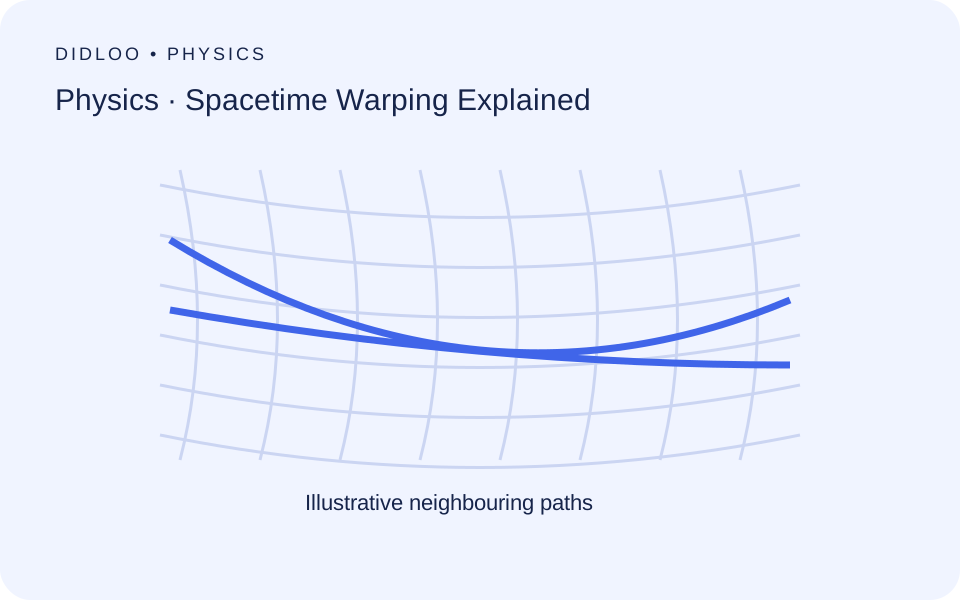
Consider a group of freely falling test objects with slightly different starting positions. Their separation can change in a way described by the spacetime curvature. This connects geometry to measurable tidal behaviour rather than to the artistic appearance of a grid.
A useful comparison is mapping a curved surface with local flat patches. A small patch can look approximately flat, yet relationships across a larger region reveal curvature. The analogy is limited because spacetime includes time, but it highlights why local simplicity and wider geometric structure can coexist.
Light can trace a bent route
Light follows null paths in spacetime. A sufficiently massive system can change the directions from which light reaches an observer, producing gravitational-lensing effects. The result may include distorted shapes or multiple images, depending on the source, lens and observer arrangement.
This does not mean photons need an ordinary material rest mass to be pulled as miniature stones. The trajectory is described using the geometry and the lightlike condition. Also distinguish gravitational deflection from bending at a glass interface: both can alter a visible path, but the mechanisms and calculations differ.
Clocks are part of the geometry too
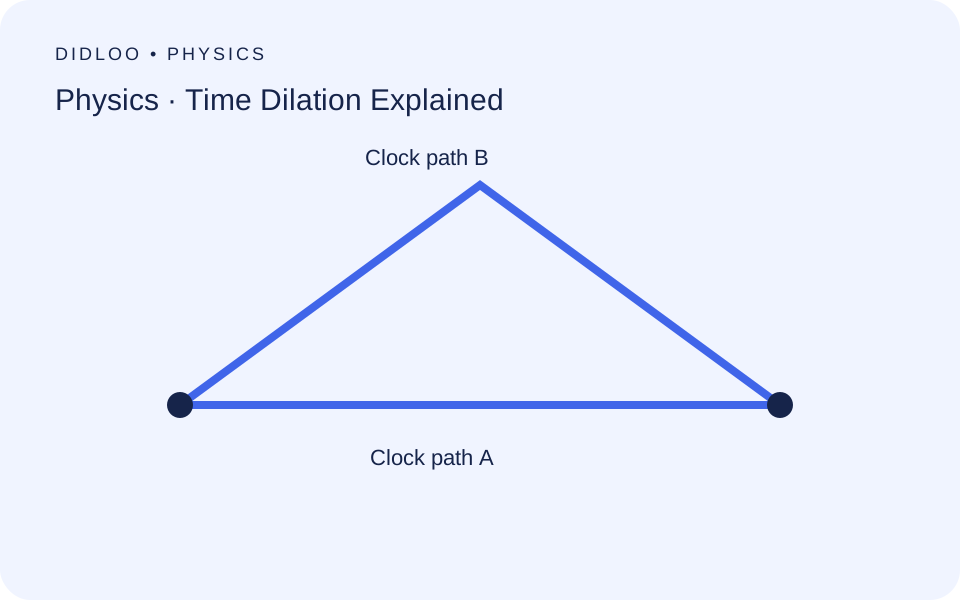
A discussion of curvature that only bends space leaves out a crucial part of general relativity. Clock comparisons in differing gravitational environments illustrate why temporal relationships belong in the description. The time measured along a particular path is a physical quantity, not merely a coordinate convention.
For a concrete reading exercise, compare two supported clocks at different elevations near Earth. Then compare that setup with two freely falling clocks. The labels stationary and moving are not enough; specify the paths, support conditions and signal-comparison method before expecting a numerical answer.
Dynamic spacetime and gravitational waves
Spacetime geometry can change. Gravitational waves carry propagating disturbances associated with changing gravitational systems. Their detection involves carefully measuring extremely small relative-distance changes and separating a candidate signal from instrumental and environmental disturbances.
The word ripple should not suggest a mechanical fluid with an everyday surface. A detector model links a passing gravitational wave to observable behaviour in the apparatus. An artistic animation helps communicate the pattern, while the actual measurement and analysis provide the evidence.
A warp drive is a separate speculative question
Science fiction often moves from the established idea of curved spacetime to a vehicle that travels between stars extraordinarily quickly. The first statement does not establish the second. A mathematical construction must still face questions about its physical ingredients, energy conditions, stability and how it would be created or controlled.
Finding an equation with an unusual solution is different from demonstrating an engineering process. Treat claims about a working drive, controllable wormhole or backward-time communication as separate claims requiring separate evidence. Existing tests of relativity do not automatically validate them.
Use diagrams as questions rather than answers
When a picture shows a funnel, ask what its axes represent. When a caption says time is stretched, ask which clocks are compared. When a path curves, ask whether the drawing depicts coordinate motion, physical curvature or the movement of an image across a screen.
Those questions turn an intimidating phrase into a practical reading method. Spacetime curvature describes relationships that can be tested through clocks, trajectories, light and waves. Its explanatory strength comes from connecting geometry to observations, not from making the most dramatic possible illustration.
Further reading
Official resources and related guides for the concepts discussed above. Check the selected tool for current capabilities and terms.
Take the next idea into a conversation
Explore Didloo for personal chats, creative sharing and linked desktop messaging. Business messaging has its own approved API workflow.