Astrology
Numerology Number 1: Birth Number, Destiny Number and the Meaning of Initiative
Numerology number 1 is commonly read as a symbol of beginning, independence and initiative. A useful reading explains how the number was calculated before discussing what the symbolism might mean. Someone born on the nineteenth can have birth number 1 while a person born on a different day can have destiny number 1. Those are different calculations, even when a website places them under the same headline. This original guide uses birth number for the reduced day of the month and destiny number, or Bhagyank, for the reduced complete date of birth. Other traditions use destiny for a name-based number. The definitions here are explicit so that you can check the arithmetic rather than depend on an unexplained label. Symbolic interpretations are cultural beliefs and reflection prompts, not a tested method for predicting personality, marriage, health, income or future events.
What number 1 means in this guide
The simplest symbolic picture of one is a first step: a proposal before a team exists, a blank page before a draft or a decision before a routine forms. Contemporary numerology practitioners often connect this image with self-direction. We use that convention as a starting point for questions about initiative, not as evidence that a calendar digit creates a fixed human nature.
A person may recognise parts of this description and reject others. That is allowed. Independence can appear in a quiet learner asking a careful question, not only in someone who commands attention. Beginning something also requires resources, timing and help. Calling a person number 1 does not remove those circumstances. Read the symbol as a lens that may highlight an issue, while keeping your actual experience available to challenge the interpretation.
Birth number 1: the dates and the calculation
Under the single-digit rule used here, the relevant days are 1, 10, 19 and 28 in any month. The first day is already a single digit. For the tenth, add 1 + 0 = 1. For the nineteenth, 1 + 9 = 10, then 1 + 0 = 1. For the twenty-eighth, 2 + 8 = 10, followed by the same final reduction.
The month and year are not included in this birth-number calculation. Someone born on 19 September and someone born on 19 February have the same reduced day number under this convention, although their complete dates and lives differ. It is a classification rule rather than evidence that those people should behave identically. Keep the original day alongside the result if you want to compare systems that also interpret compound numbers.
Destiny number 1: use every digit of the complete date
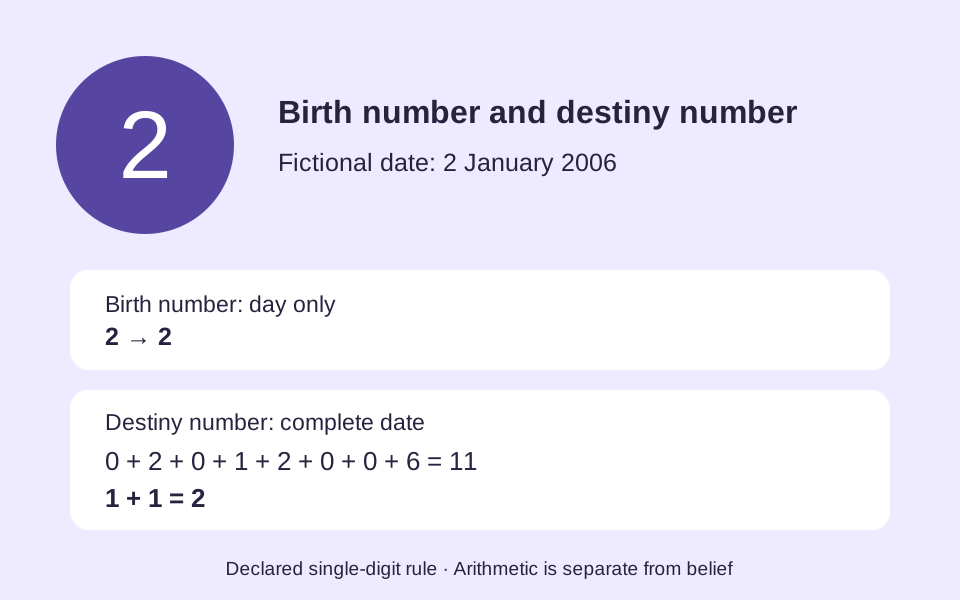
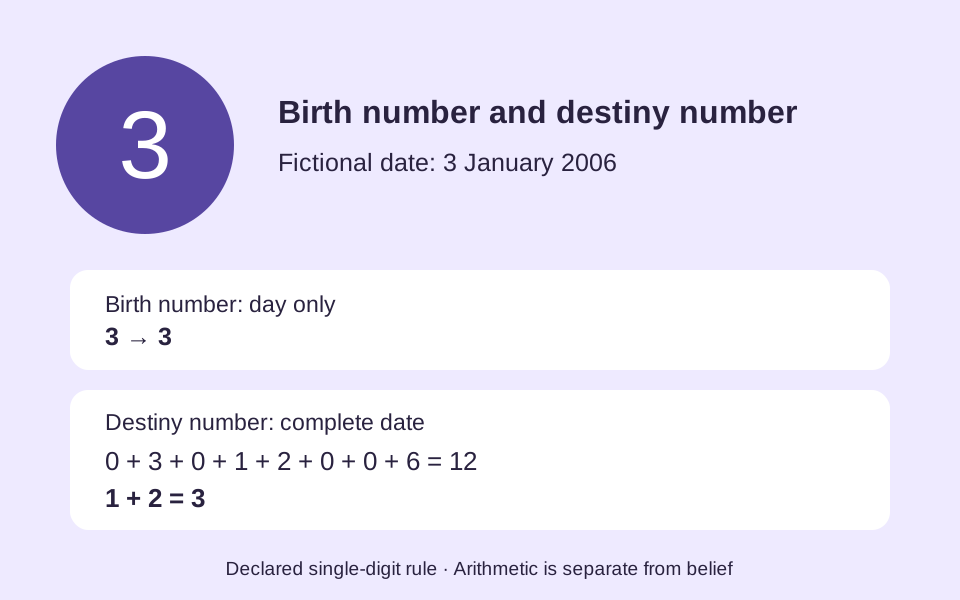
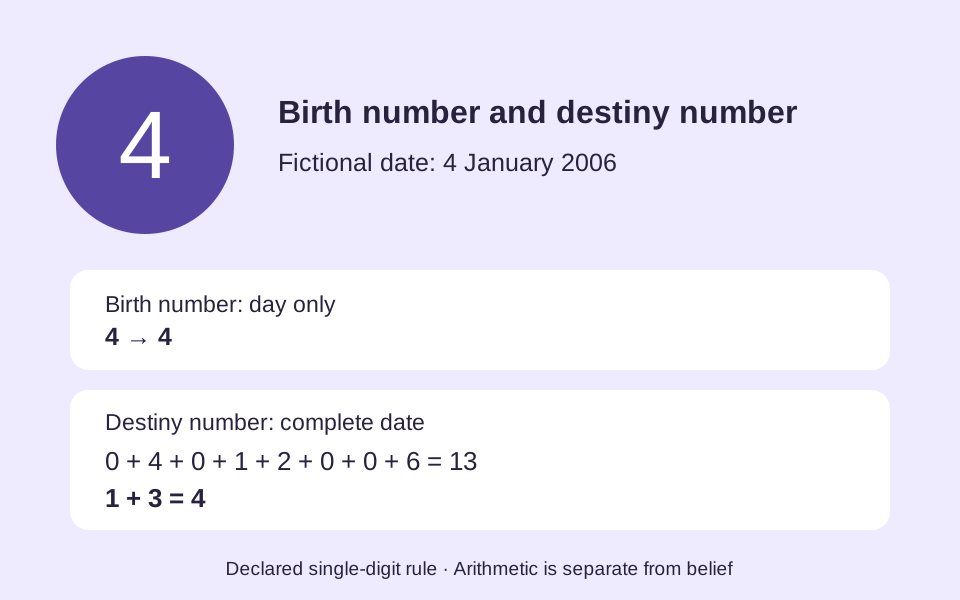
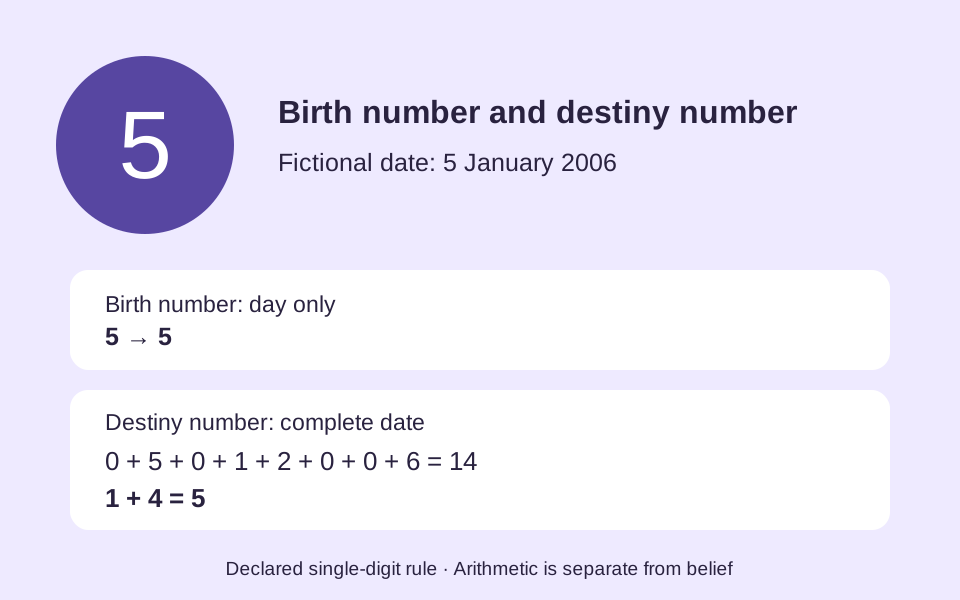
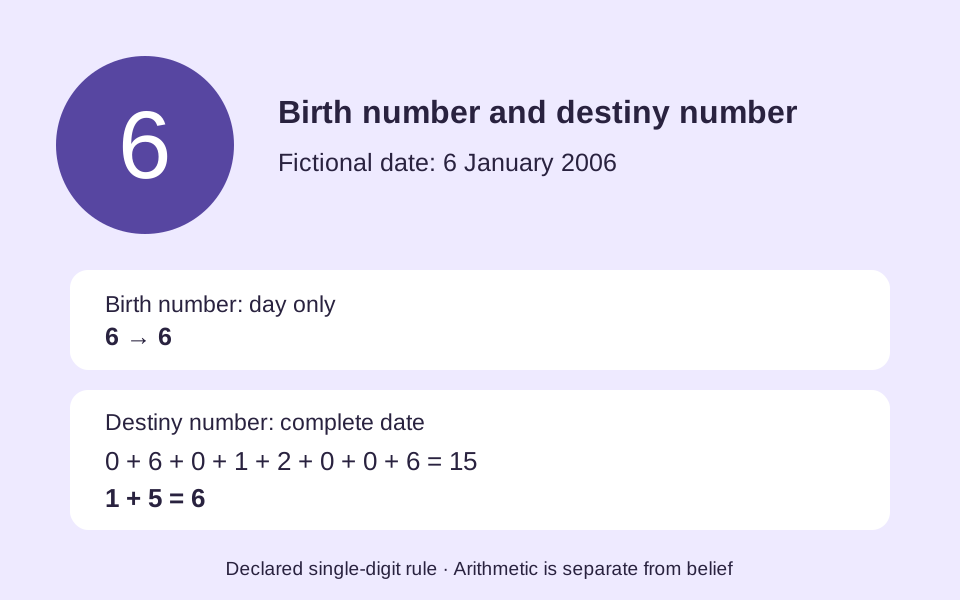
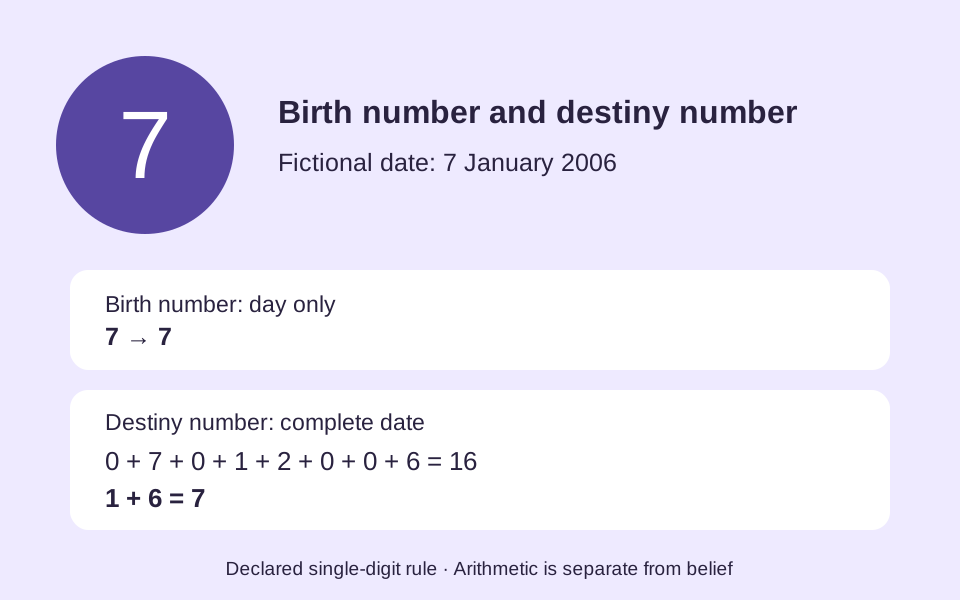
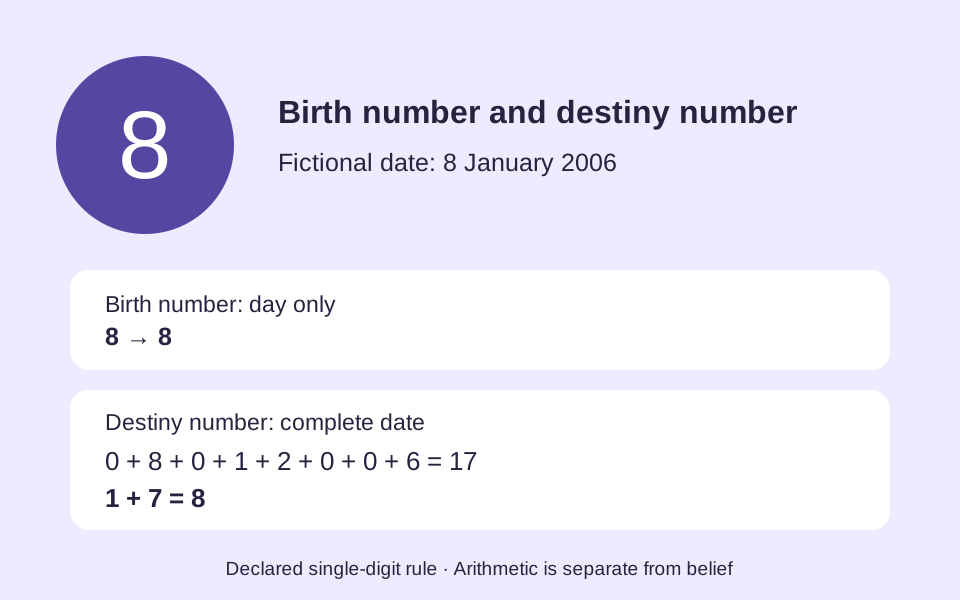
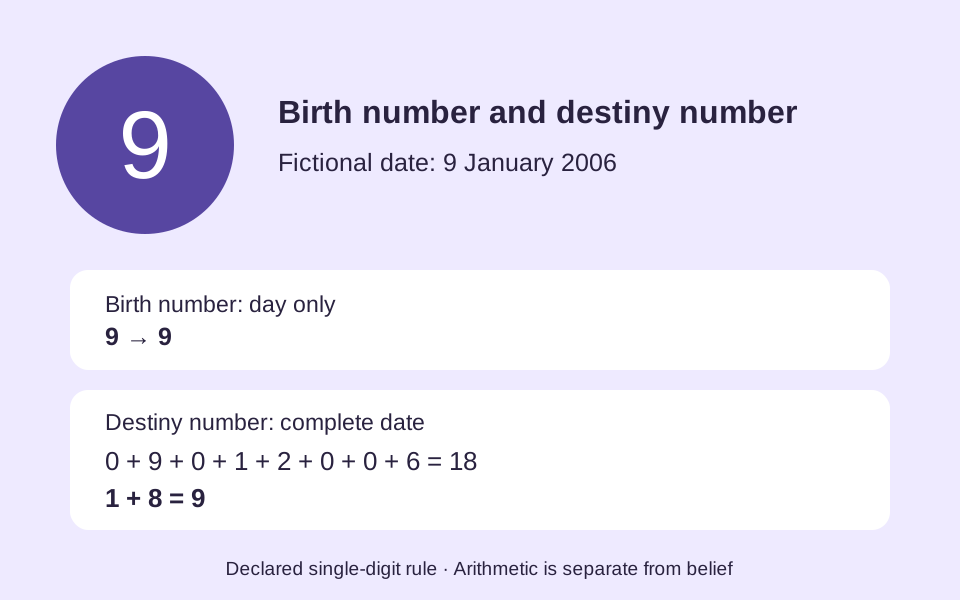
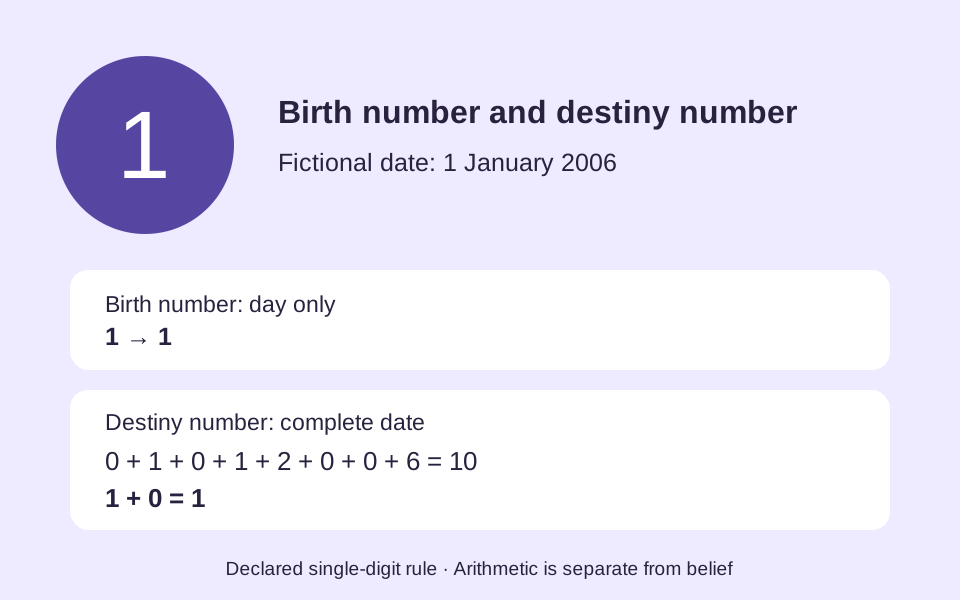
For destiny number 1, the total of the full birth date must reduce to 1. Consider the fictional example 1 January 2006. Written as 01-01-2006, its digits give 0 + 1 + 0 + 1 + 2 + 0 + 0 + 6 = 10. Reduce once more: 1 + 0 = 1. Both the birth number and destiny number are 1 in this particular example.
That coincidence is not necessary. A different day can belong to a full date whose sum reduces to 1. Always write down the entire date and the intermediate total. Do not omit a repeated digit, ignore the century or silently replace the recorded year. A clear derivation lets another reader reproduce the result. It also prevents a translation mistake from turning a correct formula into a contradictory answer.
Use an unambiguous date format in your notes. A notation such as 01-02 can mean different dates to readers using different conventions. Write the month in words when sharing an example and include the complete year. Adding all digits can sometimes hide that day-month confusion because the total stays the same, while the birth number changes. That is another reason to verify the original date before treating two calculator outputs as contradictory.
What happens when the birth number and destiny number differ
Imagine a fictional person born on 19 February 2006. The birth day reduces through 1 + 9 = 10 to 1. The complete date gives 1 + 9 + 0 + 2 + 2 + 0 + 0 + 6 = 20, then 2 + 0 = 2. The result is birth number 1 and destiny number 2 under the definitions in this article.
A symbolic discussion might compare initiative with cooperation. It should not announce that the person is internally broken or destined for relationship difficulty. These are interpretive themes selected by a tradition. A more useful question is whether the person wants greater independence in one setting and more support in another. The answer comes from conversation and observation, rather than the arithmetic proving a hidden conflict.
Why calculator results sometimes disagree
Two calculators may use different meanings for destiny number. One may add the complete date, while another converts letters in a name. Some systems retain selected double-digit totals instead of reducing every total to one digit. Compound-number interpretations can also differ. Before deciding that one calculator has discovered something profound, compare the stated inputs and reduction rules.
This series consistently reduces the complete date to a single digit for Bhagyank. It does not calculate a name number or preserve master numbers within that particular calculation. That is a declared convention, not a claim that every numerology school must follow it. If you study another system, keep its result with its own definition. Combining an answer from one method with an interpretation from another makes the explanation difficult to audit.
Initiative is a theme, not a leadership certificate
Number 1 is often described using the language of leadership. A practical reading asks what kind of initiative is involved. Starting a discussion, organising a task and making a final decision are different responsibilities. Someone can be good at proposing an idea while needing support with coordination. A title such as born leader hides those differences and can encourage people to overestimate their readiness.
For reflection, recall a recent task that nobody had clearly owned. Did you volunteer, wait for instructions or first ask what was needed? None of those responses automatically proves your number. Each may be suitable in context. The useful exercise is to identify a behaviour you want to develop and a situation where you can practise it. The symbol offers a topic for reflection; it does not award authority over other people.
Independence includes asking for help
An independent approach does not require doing every step alone. Suppose a learner decides to build a small portfolio. They can choose its purpose, make a schedule and ask someone experienced to review the first draft. Their willingness to seek feedback supports the project rather than cancelling their initiative. Treating help as weakness would make the number 1 story less useful.
Ask where you genuinely control a decision and where cooperation is essential. A shared household, workplace or volunteer group contains responsibilities that cannot be claimed by personal preference alone. The right to begin your own project is different from the right to change someone else's work. A thoughtful interpretation of independence makes room for consent, clear boundaries and responsibility for the effect of your decisions.
Confidence and the willingness to revise
Confidence can mean being willing to try an idea before every uncertainty disappears. It can also become a habit of defending the first answer because changing it feels embarrassing. The same outward certainty may therefore describe very different behaviours. Numerology cannot determine which one is present in a real person; you need to look at what happens when new information arrives.
Consider a fictional organiser who announces a meeting time without checking availability. When several people cannot attend, the organiser can consult them and adjust. Calling the initial decision number 1 energy does not settle whether it was considerate. A useful reflection asks whether you can keep initiative while improving the process. Revising a plan can be a stronger expression of responsibility than insisting that the first version must stand.
Work and career: turn the theme into questions
Searches for number 1 career often lead to lists of professions. A birth-date reduction does not establish aptitude, qualifications, access to training or suitable working conditions. Instead of announcing that every number 1 person must become an entrepreneur, use the theme to examine the kinds of responsibility you enjoy and the skills a real role requires.
Would you like more discretion over how a task is completed? Do you enjoy defining a problem, presenting a proposal or supporting implementation? What evidence do you have from completed work? A person who likes beginnings may still need practice with maintenance and handover. Discuss those observations alongside training, circumstances and opportunities. No job should be selected or rejected solely because its label appears on a numerology list.
A fictional workplace example
Mira, a fictional team member, proposes a simpler way to organise project notes. She initially assumes that everyone will welcome the change. A colleague points out that the old format contains information needed by another team. Mira then asks users what they need and prepares a small trial rather than replacing the shared system immediately.
Someone interested in number 1 symbolism might use this story to discuss initiative balanced with listening. The story is an editorial example, not a documented result of numerology. Its practical lesson can be assessed without knowing Mira's birth date. A useful improvement has a clear purpose, respects existing dependencies and accepts feedback. The digit is optional to that lesson; the behaviour and its consequences are the part readers can actually examine.
Relationships: independence and shared decisions
In a relationship, independence may involve personal interests, time alone or the ability to express a preference honestly. It does not mean that one person gets the deciding vote because their number is associated with leadership. Shared plans require discussion about responsibilities, comfort and consent. Neither birth number nor destiny number provides evidence that someone is entitled to control a partner.
If a number 1 description resonates, ask how you respond when another person wants a different arrangement. Can you explain your preference without turning it into a test of loyalty? Can you distinguish a personal boundary from a rule imposed on someone else? These questions are useful across number labels. They are offered as conversation prompts, not as a compatibility assessment or a prediction about the future of a relationship.
Compatibility with numbers 1 through 9
There is no evidence-backed compatibility score produced by reducing two birth dates. Number 1 with another 1 can be discussed symbolically as two strong preferences meeting. With 2, the discussion might concern cooperation; with 3, expression; with 4, structure; and with 5, freedom. These are chosen themes rather than measured outcomes or a ranking of suitable partners.
The same approach extends to 6 as care, 7 as inquiry, 8 as responsibility for resources and 9 as wider contribution. Different traditions assign meanings differently, so these prompts should not be mistaken for a universal compatibility table. Talk about actual expectations, reliability and the way disagreements are handled. A relationship cannot be approved or rejected responsibly by a pair of digits, especially when those digits were calculated using inconsistent methods.
Family life and labels given to children
A child born on the tenth should not have to perform a permanent leadership role to satisfy a numerology description. Children can be adventurous in one activity and cautious in another. They also need opportunities to learn, make mistakes and change their interests. A label that once felt encouraging can become restrictive if adults interpret every event through it.
Use the symbolism lightly, if the family enjoys it. Instead of saying that a child must always lead, invite them to choose one small responsibility and ask what support they want. Let other children take turns. Do not compare siblings as superior and subordinate numbers. The child's observed needs and wishes matter more than a symbolic story attached to the day of birth.
Beginning a creative project
One is a natural editorial image for the first page or initial sketch. An aspiring writer might identify the smallest useful beginning: a short outline, a character note or a single scene. This can make the symbolism tangible without claiming that the date supplies artistic talent. The next question is what turns that beginning into something another person can understand.
Separate exploration from commitment. You may try several ideas before choosing one to develop. Keep a note of why you selected it and what a finished version would contain. If you abandon it, record what you learned instead of treating the change as evidence that your number failed. Creative work develops through decisions and revision, not through an obligation to prove a favourable description correct.
Number 1, the Sun and differences between traditions
Some Indian numerology practitioners associate number 1 with the Sun. This is a symbolic correspondence within their system. It is not an astronomical mechanism by which the reduced date determines a person's authority, mood or achievements. A description of that belief should not be presented as a finding from physics or as a medical explanation.
Other numerology traditions may describe number 1 without the same planetary framework. When reading a source, identify which system it is using. You can understand an association historically or culturally without accepting every prediction attached to it. This article does not prescribe gemstones, rituals, purchases or changes to official documents. Understanding the convention is enough to follow the explanation; spending money is not part of the calculation.
Lucky colours, dates and everyday preferences
Readers often ask for number 1 lucky colours or lucky dates. A preferred colour can be meaningful as a personal or family tradition. Choosing a nonessential celebration date can also express a preference. Neither choice demonstrates that a colour or calendar day controls outcomes. Avoid treating a preference as a requirement that overrides practical arrangements or another person's needs.
If you enjoy keeping a symbolic reminder, decide what it means in your own words. It might remind you to begin a postponed drawing or ask a question you have been avoiding. The action can be evaluated directly. An appointment, examination, deadline or necessary journey should not be delayed simply to obtain a preferred number. The symbol should support thoughtful choices rather than create a new source of fear.
Repeating 1, 11 and 111 are separate questions
Seeing the same digit on clocks or receipts is different from calculating a birth or destiny number. These observations may be discussed under angel-number or repeating-number traditions, but they do not change the arithmetic of your recorded date of birth. This guide does not treat a repeated sequence as an instruction from an external authority or proof that an event will happen.
If a sequence catches your attention, you can use it as a voluntary reminder to pause and reflect. Record the thought without claiming that every occurrence has a hidden message. There is no need to keep searching for confirmation. The clear distinction is between a meaning you choose to attach to an observation and a claim that the observation reliably predicts another person's intentions or your future.
A reflection exercise with observable answers
Choose a small task that you can begin and review without involving major commitments. Write its purpose, the next action and the support you may need. Then complete the action and record what actually happened. Did the task become clearer? Did you discover a missing dependency? Did someone else offer a perspective that improved the plan?
Compare those observations with the story you initially told yourself about initiative. Perhaps the difficult part was beginning; perhaps it was asking for feedback or finishing. All are possible. Do not count only successful outcomes as proof of the number while ignoring contradictory experiences. The exercise is useful when it produces an honest description of behaviour, including results that do not fit the symbolic theme.
Common mistakes when reading a number 1 profile
The first mistake is confusing a reduced birth day with the full-date result. The second is assuming that a shared digit makes two people identical. A third is treating descriptions such as independent or ambitious as precise measurements, although readers may understand those words differently. Ask what concrete behaviour a description refers to before deciding whether it is useful.
Another mistake is using a flattering reading to dismiss criticism. A person may be capable of initiative and still need to apologise, learn a skill or respect a boundary. Likewise, a difficult experience does not prove that a particular date or name is defective. Keep the arithmetic transparent, the cultural interpretation labelled and the person's real circumstances visible throughout the discussion.
Recording a date without exposing someone else's details
You do not need to publish your complete birth date to understand this calculation. A fictional date demonstrates the rule just as clearly. If you discuss a friend's number, ask whether they want that conversation and avoid sharing their identifying information in a public comment. Interest in numerology does not create permission to disclose someone else's personal history.
Keep a private worksheet if you want to compare methods. Write the method name, the input and the reduction sequence rather than collecting unnecessary details about many people. This also makes it easier to notice a mathematical error. A list of unexplained final digits is less useful than one carefully worked example. Our fictional examples teach the procedure without claiming to describe a real customer's personality or experience.
Compare two decisions instead of collecting favourable descriptions
For a more detailed reflection, choose two recent decisions: one that worked well and one that caused difficulty. Identify what information was available, who was affected and how you responded to feedback. Compare the processes before applying the language of independence. The successful decision may have involved considerable cooperation, while the difficult one may have involved acting alone too quickly.
This comparison prevents initiative from becoming a compliment that automatically explains every good outcome. It can also reveal a useful distinction between deciding promptly and deciding without enough information. If you want to improve something, describe the behaviour precisely, such as checking a dependency before committing to a deadline. That is a practical observation you can revisit. Calling the adjustment a number 1 lesson is an optional cultural framing, not the mechanism that makes the adjustment work.
Questions to take away from the reading
Can you show the calculation for both numbers without skipping a digit? Have you checked whether a source uses destiny for a name or a date? Which parts of the initiative theme match specific examples from your experience, and which do not? These questions give a reader something concrete to examine rather than a verdict they must accept.
You may keep the symbolism as a cultural interest, adapt it as a reflection prompt or decide it is not helpful. None of those choices changes your recorded date or limits what you can learn. Number 1 can be discussed as the image of a beginning, but an actual beginning belongs to the person making a choice in a real situation. Their opportunities, responsibilities and freedom to revise remain part of the story.
Further reading
Official resources and related guides for the concepts discussed above. Check the selected tool for current capabilities and terms.
Take the next idea into a conversation
Explore Didloo for personal chats, creative sharing and linked desktop messaging. Business messaging has its own approved API workflow.