Astrology
Numerology Number 4: Birth Number, Destiny Number and Building Useful Structure
Numerology number 4 is often discussed through the themes of order, effort and reliability. Those words can describe useful habits, but a reduced date does not measure them. A person assigned number 4 may enjoy routine in one area and experimentation in another. The purpose of a careful reading is to explain the convention and offer questions, rather than turn a symbol into a rule for someone's entire life. Here birth number, or Mulank, means the reduced day of the month. Destiny number, or Bhagyank in this date-based system, means the reduced sum of every digit in the complete birth date. Both finish as single digits. The interpretations are variable cultural beliefs, not established predictions about work, relationships, health or money. Our examples are fictional and our reflection exercises are original editorial suggestions that can be considered independently of numerology.
What the structure theme can mean
Contemporary numerology descriptions often use four as a symbol of dependable arrangements. A simple editorial image is a table that needs its supports to work together. The image can prompt questions about what holds a project up, which responsibilities are clear and which assumptions have never been checked. It is a metaphor, not a physical mechanism linking a birthday to reliability.
Structure is useful when it serves a purpose. A schedule that helps someone remember a shared task may be helpful; a rule nobody understands may create confusion. Do not assume that more structure is always better or that disliking a particular routine contradicts your number. Ask what the arrangement is trying to achieve and whether the people using it can explain how it helps.
Birth number 4 and its calendar days
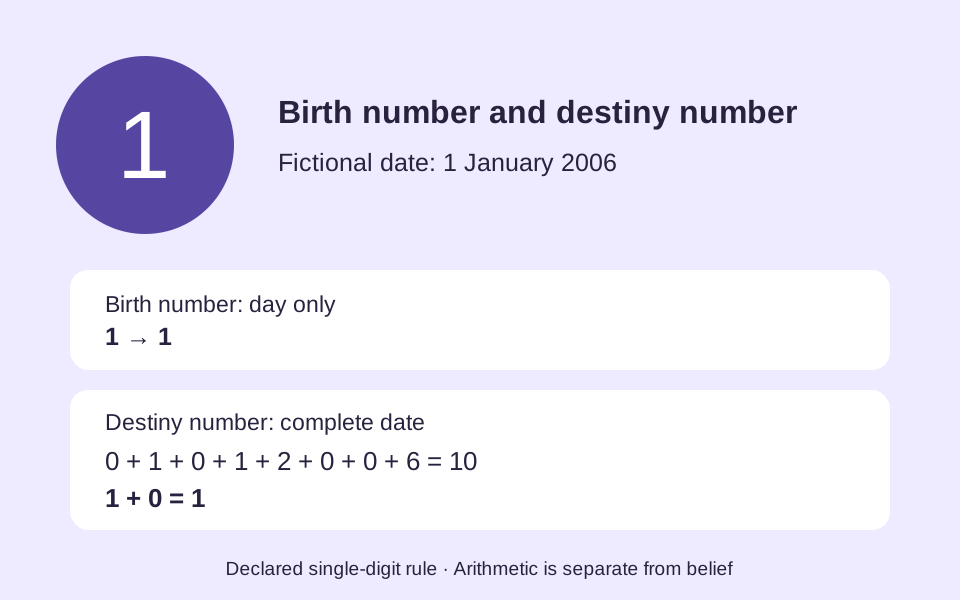
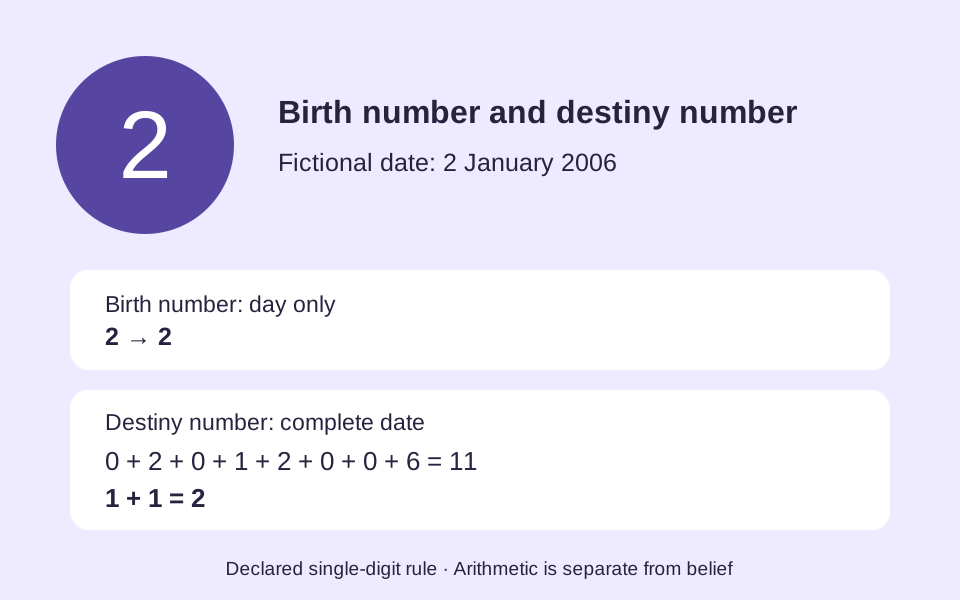
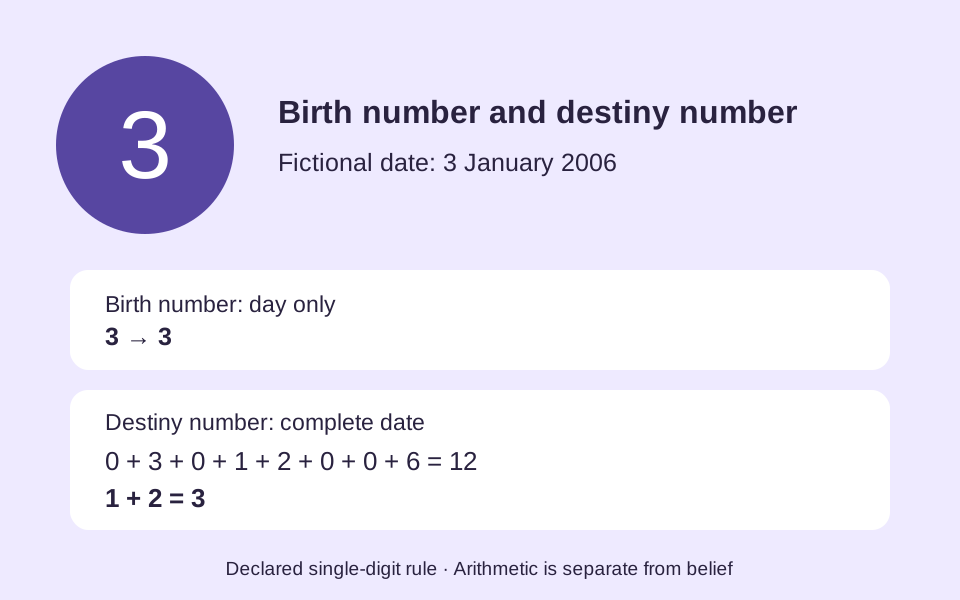
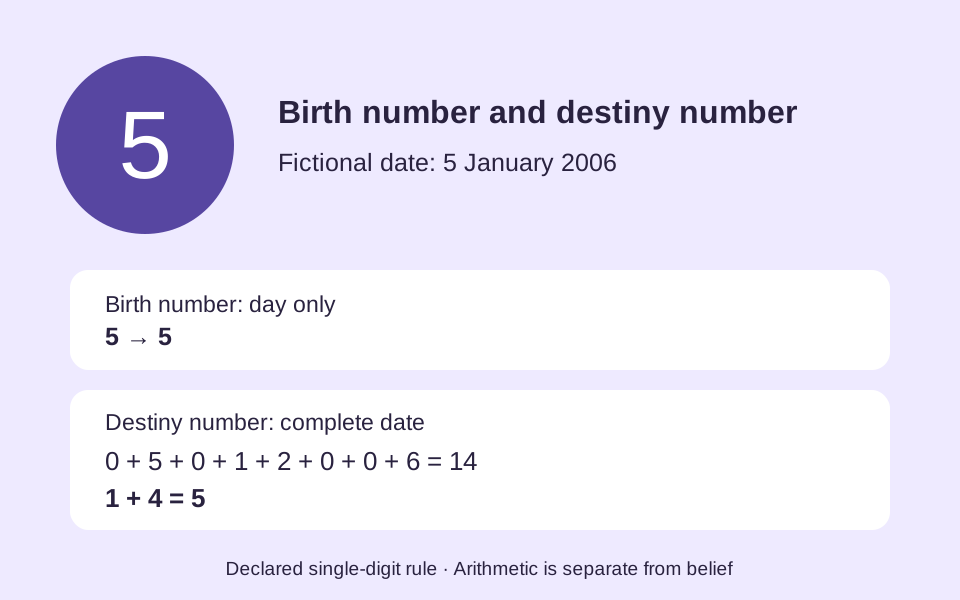
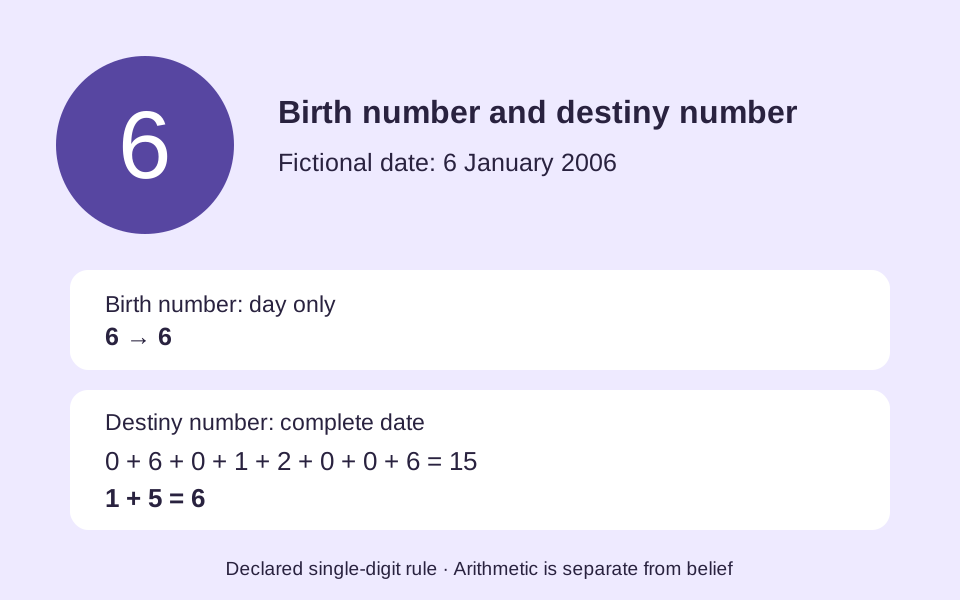
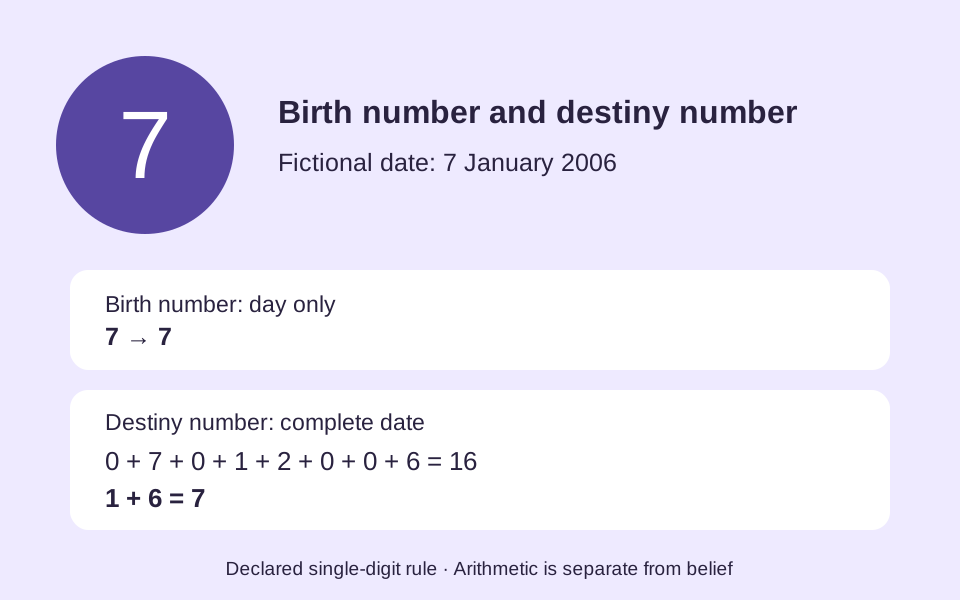
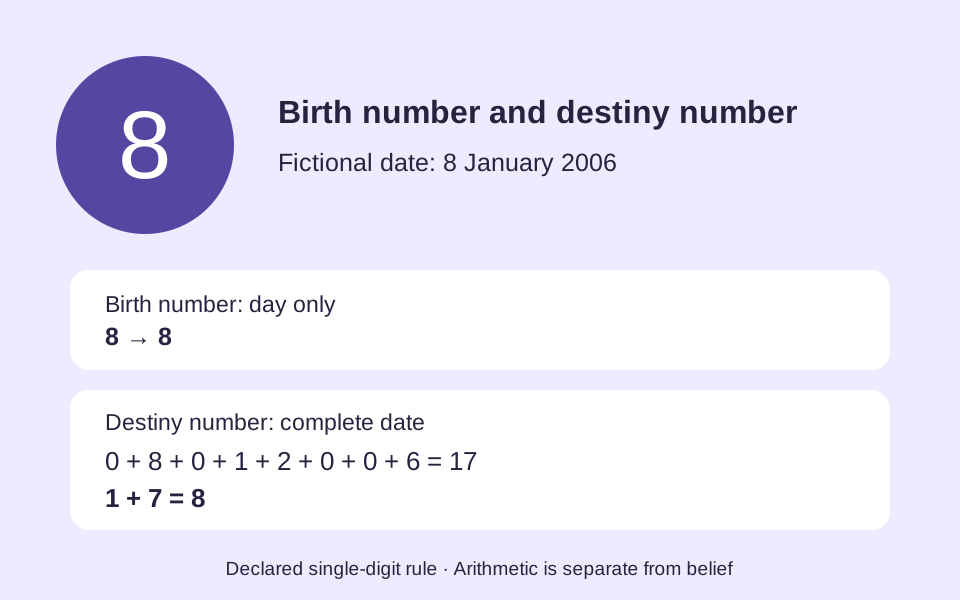
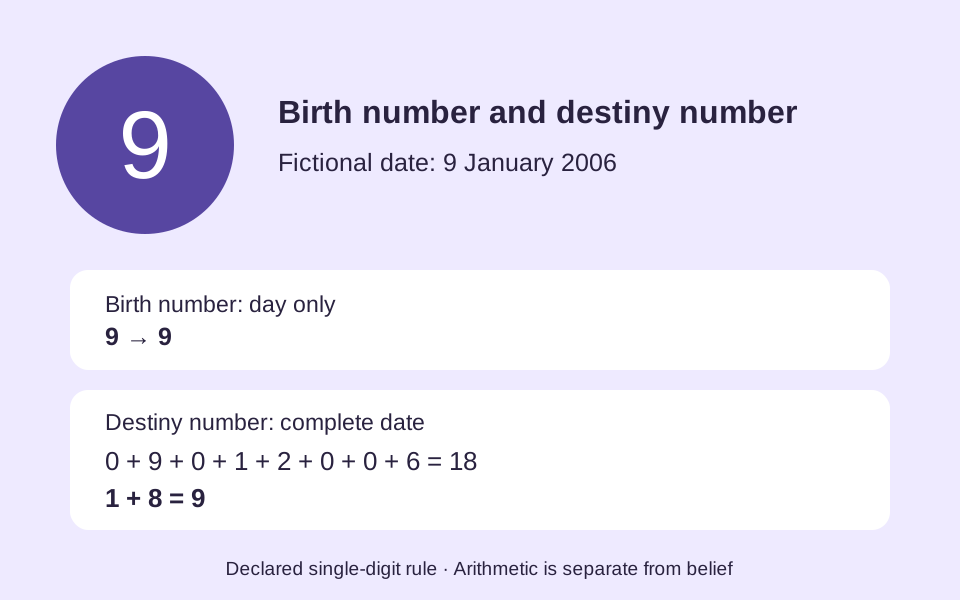
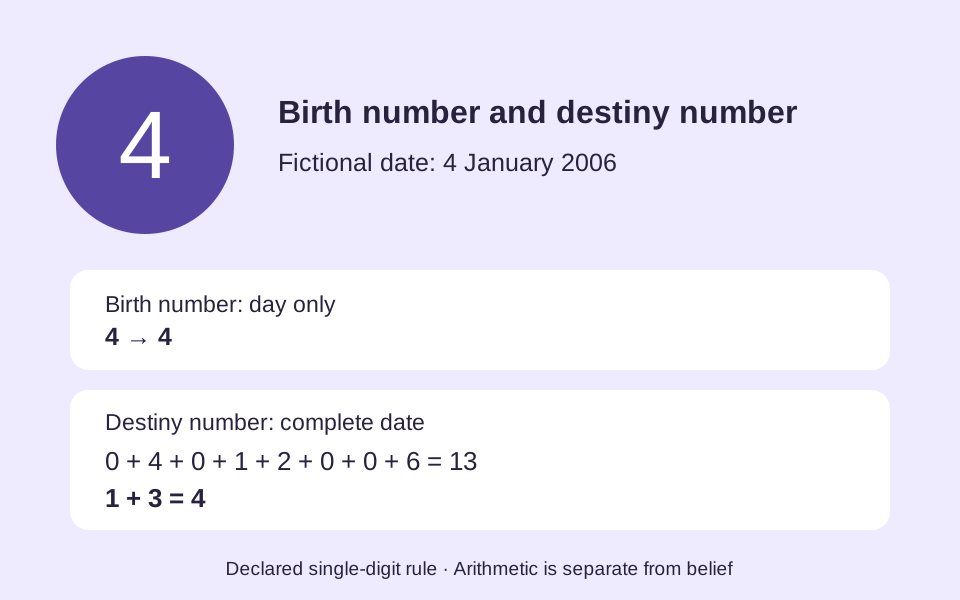
The days 4, 13, 22 and 31 reduce to birth number 4. For the thirteenth, 1 + 3 = 4. The twenty-second gives 2 + 2 = 4. The thirty-first gives 3 + 1 = 4. The fourth is already a single digit. These calculations use only the day, regardless of the month or year.
Some systems retain 22 as a master number at particular stages. This article uses the declared single-digit birth-number rule instead. Other sources may also discuss 13, 22 and 31 separately as compound numbers. Keep those methods distinct when comparing results. The fact that several days reduce to 4 establishes a shared arithmetic category, not identical personalities or a requirement that everyone born on those days must enjoy the same kind of work.
Destiny number 4: a full-date example
Use the fictional date 4 January 2006. In the format 04-01-2006, the sum is 0 + 4 + 0 + 1 + 2 + 0 + 0 + 6 = 13. Reducing the total gives 1 + 3 = 4. The date-based destiny number is 4. Its birth number is also 4 because the day is the fourth.
Show both the full sum and its reduction. Omitting the century digits or discarding repeated digits changes the method. Zeros do not change the total, but retaining them in the example makes transcription easier to check. The final result is reproducible arithmetic. A further interpretation about a person's life belongs to numerology as a belief system; the sum alone does not demonstrate that the interpretation describes an actual person accurately.
The same birth day with a different destiny number
For the fictional date 4 February 2006, the day remains birth number 4. The full date becomes 0 + 4 + 0 + 2 + 2 + 0 + 0 + 6 = 14, then 1 + 4 = 5. This produces birth number 4 and destiny number 5. A date written ambiguously can therefore cause confusion even when someone remembers the reduced day correctly.
A symbolic discussion might compare structure and variety. Those interests need not be enemies. Someone may want a dependable working routine and plenty of freedom within it. The actual balance depends on their responsibilities, resources and preferences. Do not interpret a mixed pair as proof of a troubled life. Ask which parts of an arrangement need consistency and which would benefit from room to experiment.
Why the method must travel with the result
The word destiny can refer to a name-based result in some traditions. Other sources use it for the full-date Bhagyank calculation. A reader cannot compare the answers responsibly without knowing which inputs were used. A letter-value table, a reduced birth day and a complete-date sum answer different procedural questions.
This guide does not calculate name numbers, retain master numbers in its final date result or infer a chart from a phone number. It keeps the method narrow and visible. If another source follows a different convention, record its rule before deciding that one result disproves the other. Understanding that distinction is more useful than collecting several favourable answers and treating their agreement as independent confirmation of a prediction.
Reliability is demonstrated through actions
Being called dependable does not establish that someone follows through. Look at what was agreed, what was completed and how changes were communicated. A person may be reliable partly because they make realistic commitments and tell others promptly when circumstances change. Those behaviours can be observed; they are not revealed by a date reduction.
If number 4 symbolism appeals to you, choose one responsibility you want to handle more clearly. Define the expected outcome and who needs to know its status. Review it afterwards without excuses based on the number. A completed task can show that a particular arrangement worked. An incomplete task can reveal an unrealistic expectation or missing support. Both results provide more information than a general label of hardworking.
Routine should serve the people using it
A routine can reduce repeated decisions, but a routine that no longer fits its purpose can become a burden. Suppose a household checklist contains tasks that nobody actually needs while omitting a newly shared responsibility. Following the old list precisely would not make the arrangement useful. The list needs review, not greater loyalty simply because it already exists.
Ask when a routine was created, what problem it addressed and whether that problem has changed. Invite the people affected to describe difficulties. This is a practical way to examine the tension between consistency and flexibility. A number 4 reading should not encourage defending every existing rule as evidence of discipline. Changing an unhelpful process can be an act of responsibility rather than a failure to maintain order.
Planning and the problem of hidden assumptions
A plan can look detailed while depending on information nobody has checked. A task may assume access to a room, agreement from a collaborator or materials arriving at a certain time. Writing more steps does not resolve those uncertainties. A useful plan identifies which assumptions matter and how they will be checked.
For reflection, take a small project and mark what you know, what you expect and what you still need to ask. Keep these categories separate. You may discover that the most important next action is a question rather than another item on the schedule. The structure theme becomes useful when it makes a plan more honest about uncertainty. It is less useful when it turns a neat document into a reason to ignore missing information.
A fictional example: repairing a shared checklist
Dev, a fictional club organiser, maintains an event checklist inherited from an earlier group. Volunteers repeatedly miss a required step because the instruction uses a name for a room that has changed. Dev initially assumes that people are careless. After watching someone use the list, he updates the label and adds a clear handover point.
The improvement comes from reviewing how the checklist works, not from knowing Dev's number. Number 4 symbolism could provide a discussion theme about dependable systems. It cannot prove that the date caused the improvement. The example also distinguishes a process problem from a judgment about people. A careful reader asks whether an instruction is usable before explaining every mistake as a lack of discipline.
Effort is not the same as endless availability
Working hard can become an expectation that a person must always accept another task. A number 4 profile should not reinforce that pressure. Responsibilities need realistic limits, and a reliable commitment may involve saying what cannot be completed. Accepting everything without enough time can make the overall arrangement less dependable.
Describe capacity in concrete terms. Which part of the work can you do, what information is needed and who should handle the rest? A clear boundary is different from indifference. It helps other people plan accurately. The symbolic language of effort is useful only when it leaves room for rest, changing circumstances and the fact that no individual can carry every responsibility alone.
Career questions beyond a list of occupations
Number 4 career lists often emphasise organised or practical work. A birthday does not establish professional competence or determine which training is suitable. Organisation can matter in creative, technical, service and administrative roles. The details of a real role matter more than whether its title appears in a symbolic profile.
Ask which tasks you have completed well and what helped. Do you enjoy maintaining a process, investigating a fault, documenting a handover or building something tangible? What skills would make the work easier? Use actual examples when discussing opportunities with someone who understands the role. Numerology can supply a topic for reflection, but qualifications, interests and circumstances should remain visible instead of being replaced by a prediction about an ideal career.
Learning a new skill without demanding immediate certainty
Someone attracted to a structure theme may prefer clear instructions and a known sequence. Learning sometimes requires trying a small step before the whole process is understood. That does not mean the learner lacks discipline. It means the task contains unfamiliar parts that need exploration as well as repetition.
Choose a practice exercise with a clear, modest purpose. Record what you expected, what happened and what question arose. Repetition becomes useful when it incorporates feedback rather than reproducing the same misunderstanding. A number 4 interpretation can encourage patient practice, but it should not make mistakes feel like a threat to an identity of competence. Learning includes changing the plan after discovering something new.
Flexibility and the willingness to explain a rule
If a rule matters, try explaining what it protects or enables. A shared file-naming convention may prevent confusion; a deadline may coordinate several tasks. Once the purpose is clear, people can discuss exceptions without treating every question as an attack. A rule with no identifiable purpose deserves examination.
For reflection, notice how you respond when someone proposes a different method. Do you ask whether it meets the same need, or reject it because it is unfamiliar? The answer may vary by situation. Numerology cannot determine your response in advance. The useful observation is whether a process remains open to evidence about how well it works and whether the affected people understand their part in it.
Relationships and agreements that remain revisable
Clear agreements can support a relationship, but an agreement may need review when circumstances change. Dividing tasks fairly at one point does not guarantee that the same division will remain workable. A number 4 description should not turn an old arrangement into a permanent rule that one person cannot question.
Discuss what each person understands the agreement to include. Ask whether the workload, available time or practical needs have changed. A dependable relationship involves responding to that information rather than insisting that consistency means never adjusting. These are conversation prompts, not a compatibility assessment. A reduced date cannot establish whether someone is caring, whether a partnership is healthy or whether a concern should be ignored.
Compatibility with the other numbers
There is no reliable relationship score generated by pairing number 4 with another digit. Symbolically, 1 can prompt discussion about initiative and planning; 2 about consultation; 3 about expression; another 4 about shared routines; and 5 about flexibility. These themes are editorial ways to frame a conversation, not evidence that one pairing is superior.
With 6, 7, 8 and 9, possible topics include care, reflection, responsibility and contribution. Those qualities are not exclusive to those digits, and traditions vary in how they describe them. Look at actual expectations and behaviour. The ability to discuss differences, respect a refusal and revise an arrangement provides more direct information than a chart. No person should be approved, rejected or pressured into a decision because of a pair of number labels.
Family roles and the child called responsible
A child who remembers tasks can quickly become the person expected to manage everyone else's needs. Numerology should not be used to justify that burden. A number 4 label does not mean a child must always be mature, tidy or willing to help. They need opportunities to explore, make mistakes and express preferences that do not fit the label.
If your family enjoys symbolic readings, use them as optional conversation starters. Ask which task the child wants to practise and what support is appropriate. Share responsibilities rather than assuming that one child is naturally designed to carry them. Praise a specific action without turning it into a permanent role. Actual needs and developing interests matter more than a description attached to the birth day.
Rahu, Western descriptions and differences in symbolism
Some Indian numerology practitioners connect number 4 with Rahu, while other contemporary accounts emphasise order and stability without using that planetary framework. These are different symbolic systems. They should not be blended into a claim that every source has always taught exactly the same meaning or that a celestial correspondence is a demonstrated cause of personality.
Identify the source of a particular interpretation and keep its claims labelled. This article does not establish that number 4 is unlucky or that a remedy is needed to correct a birth date. It also does not prescribe a gemstone, ritual purchase or official name change. A reader can study the traditions while retaining the right to question predictions and decline actions proposed in their name.
Unlucky-number claims and practical choices
Different cultures attach different meanings to numbers. A negative claim about 4 in one setting does not prove that a person, home or document containing the digit will experience misfortune. Treat the claim as cultural information rather than a forecast. A symbolic preference should not be used to frighten someone about an otherwise ordinary choice.
When comparing a room, address or appointment, examine the actual circumstances and requirements. A preferred number may be a personal choice when everything else is genuinely equivalent. It cannot establish building quality, another person's intentions or the result of a future event. Avoid repeatedly changing arrangements or buying remedies because a digit appears. The arithmetic of a number is clear; the alleged consequence remains an unverified interpretation.
Colours and dates as optional reminders
A preferred colour can remind someone of a quality they want to practise, such as clarity or patience. A chosen date may have personal significance for a nonessential celebration. Neither demonstrates that a colour or calendar entry controls outcomes. If you enjoy those choices, explain them as preferences rather than requirements other people must obey.
For a number 4 reflection, a reminder could prompt a short review of a plan: what is finished, what changed and who needs an update? Those questions are useful because they make information visible. They do not become more valid when attached to a particular colour. Necessary appointments, deadlines and essential tasks should not be delayed to fit a symbolic arrangement.
A practical review exercise
Select one small process you use regularly. Write its purpose, its steps and the point where another person depends on your result. Ask a willing participant to explain the instructions in their own words. Notice where the written process differs from what people actually do. Then revise one unclear part and review whether the change helped.
This exercise tests the usefulness of the arrangement rather than your fit with a number 4 profile. A simpler process may work better than a more elaborate one. An exception may reveal an overlooked need. Record those results honestly, including anything that challenges your original plan. The reflection has value when it improves understanding, not when every outcome must be counted as proof of a symbolic trait.
Compare consistency with rigidity
Choose two recent situations where you kept an existing method. In one, it may have protected an important requirement; in the other, it may have created unnecessary difficulty. Describe what the method achieved and what information was available. Avoid judging the decision only by whether you changed your mind.
Consistency means applying a reasoned approach across relevant circumstances. Rigidity can mean ignoring a meaningful difference because the previous rule feels familiar. The boundary between them needs context. Numerology cannot locate it automatically. A useful number 4 discussion asks what evidence would justify an adjustment and whether the people affected have a way to raise a concern without being dismissed.
Privacy and the limits of a profile
You can demonstrate every calculation with a fictional date. There is no need to publish a colleague's full birth date or collect personal details about a group to decide who should handle a task. Ask people about their experience and preferences instead of assigning responsibilities from a numerology chart.
Broad words such as organised or stubborn can fit many people at different times. Recognition is not the same as proof that the date predicted a trait. Keep examples that do not fit the description alongside those that do. A reader should be free to disagree with a profile without the disagreement being treated as another symptom of the same label. Respectful interpretation leaves room for the person's own account.
Make the handover visible
A process often fails where responsibility passes from one person to another. Finishing your own part does not necessarily tell the next person that they can begin. Identify the information they need, where it will be recorded and how completion will be communicated. Check that both people understand the same boundary.
This is a concrete way to discuss dependability without treating it as an invisible quality. If a handover is missed, review the arrangement before judging someone's character. The useful improvement might be a clearer message, a shared definition of completion or a smaller task, rather than a stronger demand that everyone simply try harder.
Questions for a balanced reading
Can you reproduce the birth-day and full-date calculations separately? Does a source explain its treatment of 22 and its meaning of destiny? Which routine in your life serves a clear purpose, and which might need revision? These questions make the reading specific enough to examine instead of turning it into an identity you must defend.
Number 4 can be used as an image of useful structure, but real structure is built through decisions, communication and review. It should support the people involved rather than demand that they fit a predetermined story. You can enjoy the symbolism while keeping plans revisable, acknowledging uncertainty and judging a process by what it actually helps people do.
Further reading
Official resources and related guides for the concepts discussed above. Check the selected tool for current capabilities and terms.
Take the next idea into a conversation
Explore Didloo for personal chats, creative sharing and linked desktop messaging. Business messaging has its own approved API workflow.