
Religion
What Happens After Death? Beliefs Across Religions and Ancient Worlds
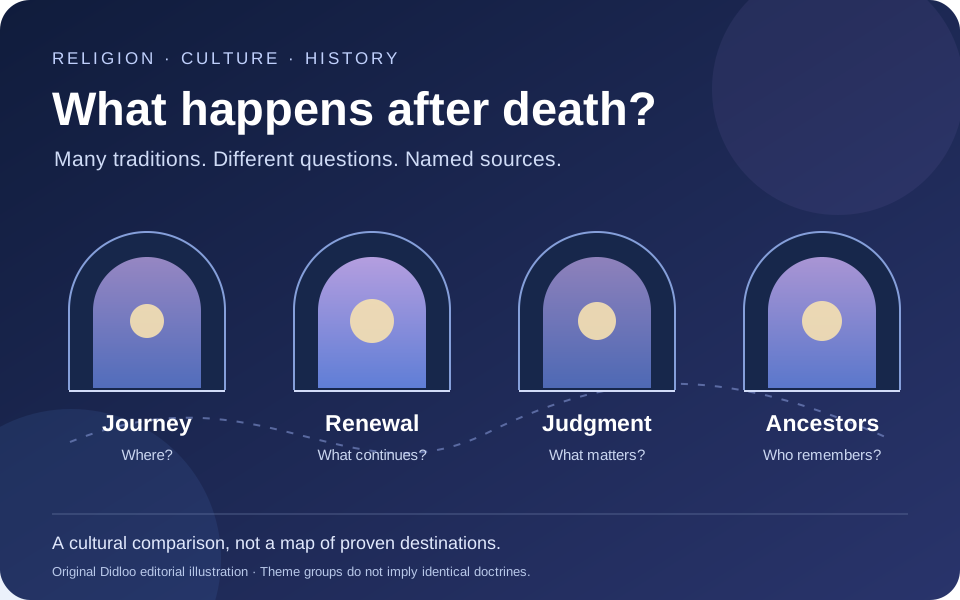
One question, many kinds of answer: rebirth, resurrection, liberation, an underworld journey, or a continuing relationship with ancestors. This original cultural guide follows selected sources without treating belief as scientific proof or communities as a single voice. Numbers in brackets refer to the linked reading list below.
A question that changes when somebody matters to us
Imagine finding a handwritten recipe in an old family notebook. The writer is gone, but the handwriting still feels unmistakably theirs. Does a person continue through memory alone, through an enduring soul, through another birth, or through a future resurrection? The same short question opens several very different conversations. It asks about identity, justice, love and the limits of what a living observer can know.
This article follows selected religious teachings, named Indigenous traditions and ancient evidence. It does not announce a scientifically established answer about an afterlife, rank religions, or speak for every member of a community. Our comparisons are editorial tools. A tradition’s own account deserves to be understood before we compare it with somebody else’s.
Before the journey, separate four meanings of “after”
The word “afterlife” can conceal a surprisingly crowded room. One account concerns what happens immediately after death. Another concerns a final event beyond ordinary history. A third describes repeated births. A fourth concentrates on continuing relationships between descendants, ancestors and land. These are useful questions to ask a source, rather than boxes into which every religion must fit.
Also separate a belief from a burial practice and both from an archaeological interpretation. A community can perform the same ceremony while its members understand it differently. An ancient object can reveal careful preparation without explaining every private conviction of its owner. Keep asking: who is speaking, in which period, and what kind of evidence have we actually found?
Hindu traditions: another birth, and freedom from the cycle
The Hindu American Foundation’s overview describes an enduring atman, karma and repeated embodiment, with moksha as liberation from samsara. It also distinguishes temporary heavenly or painful states from that ultimate liberation. This is a useful introduction, not a substitute for the differences among Hindu philosophical and devotional traditions. [1]
Here is a question to carry into a family conversation: when someone says “a better next life,” are they discussing a desirable experience within the cycle or release from the cycle itself? Those are different goals. Ask which text, teacher or family practice informs the explanation. Familiar vocabulary can make a conversation feel settled even when the participants mean different things by it.
Buddhist traditions: rebirth does not automatically mean a permanent soul
SN 22:59 treats the changing aggregates, including consciousness, as not-self. A Theravada explanation by Thanissaro Bhikkhu discusses rebirth within the setting of karma and craving. Read together, these sources caution against replacing Buddhist language with an unchanging soul travelling between bodies. They represent particular teachings and interpretations, not every Buddhist school. [2, 3]
Try keeping two questions apart: what continues causally, and what could count as a permanent identity? A quick comparison often collapses them. Saying that two traditions both discuss rebirth does not show that they explain the person, liberation or continuity in the same way. The interesting part is often the difference hidden inside a shared English word.
Jain traditions: the soul and the removal of karmic bondage
Jainworld explains moksha as freedom of the soul from all karmic bondage and the ending of repeated birth and death. Its account places liberated souls at siddha-shila. This is a Jain description of reality and liberation, not an astronomical location established by scientific observation. [4]
Notice how the question changes when liberation, rather than a reward within an ordinary future life, becomes the destination. A reader can compare this with other uses of “moksha” while keeping the underlying theories distinct. Shared South Asian terminology is an invitation to learn more carefully; it is not permission to blend several traditions into one general story about reincarnation.
Sikh teachings: the present life, grace and union with the Divine
The Sikh Coalition describes karma and scriptural support for reincarnation alongside the importance of the Guru’s grace. Its explanation directs attention toward actions in this life and connection with Waheguru, rather than an obsession with imagined heavenly rewards. This is a community introduction, not a complete account of Sikh interpretation. [5]
That shift offers a useful reading question: does the passage invite the reader to predict a later destination, or to change how they live now? Those tasks can overlap, but they are not identical. Let the source set its own priorities. Otherwise a comparison can become a questionnaire that every tradition is forced to answer in another tradition’s language.
Islam: an interval, resurrection and accountability
Quran 23:99–100 describes an appeal to return to earthly life and a barrier, barzakh, until resurrection. The nearby verses discuss judgment and the weight of deeds. These are scriptural religious claims. This brief reading does not cover all Sunni, Shia or other interpretations of the intervening state and final judgment. [6]
The distinction between an interval and a final event matters. A description of what happens directly after death should not be treated as though it has already described the whole future sequence. When reading a translation, retain the verse reference and consult its context. A familiar word such as “barrier” does not carry every nuance of a tradition’s interpretation by itself.
Christian traditions: resurrection is more than a floating soul
Paul’s argument in 1 Corinthians 15 makes resurrection central to Christian hope. The Catholic Catechism also describes particular judgment, heaven and purification, and a future reunion of soul and body. Those latter formulations are specifically Catholic; Christian communities differ over how to understand the intermediate state and related teachings. [7, 8]
Popular pictures of clouds and wings can distract from the vocabulary of the actual text. Ask whether a source is discussing a person’s state after death, the resurrection of the dead, or the renewal of creation. Do not treat Catholic explanations of purification as a position accepted by every Christian. A comparison becomes more interesting when its differences remain visible.
Judaism: a conversation with room for more than one answer
Rabbi Howard Jaffe’s Reform Jewish explanation discusses Sheol, the world to come and resurrection, while stressing that Jewish afterlife ideas are not a single fully systematized account. It also emphasizes the ethical work of living. This is one rabbinic perspective within a much larger, internally diverse tradition. [9]
If one Jewish person describes resurrection and another speaks primarily about memory, descendants or the life being lived now, do not immediately declare one of them inauthentic. Ask about community and interpretation. “What do all members believe?” may be a less helpful question than “Which strand of the tradition are we hearing, and what concern is it addressing?”
Indigenous communities: begin with names, places and permission
The label “tribal beliefs” is too broad to supply an answer on its own. In this article, the examples are named: Māori traditions in Aotearoa New Zealand and a K’iche’ Maya narrative from Guatemala. They are distinct cultural settings. Neither stands for every Indigenous people, nor should either be presented as a surviving fragment of some supposedly unchanged prehistoric humanity.
Public museum and community-facing sources allow us to discuss particular material without claiming access to restricted knowledge. A responsible question is not “What secret do these people know?” It is “What have the people and custodians chosen to share, and what context is necessary to understand it?” Leave room for a community member to explain a different family or local understanding.
Māori traditions: a journey that also belongs to a landscape
Te Ara describes the wairua, or spirit, departing toward Te Rerenga Wairua in the far north, alongside the tangihanga’s support for bereaved whānau. It presents a relationship between the departing person, place and the living community. This public account should not be mistaken for one uniform statement by every iwi or Māori family. [10]
The landscape here deserves more than the role of an exotic backdrop. A name on a map can belong to a living web of relationships. When you read about a sacred place, first learn how its custodians describe it. A visitor’s imagined journey and a community’s responsibilities to that place are not interchangeable experiences.
K’iche’ Maya: the Hero Twins and Xibalbá
The Smithsonian’s Living Maya Time presents the Popol Wuj narrative and the Hero Twins’ encounter with the lords of Xibalbá. Its account notes that royal K’iche’ lineages recorded the narrative in the sixteenth century under colonial rule. The accompanying transcript connects the underworld story with the Twins and the Maize God. [11, 12]
A sacred narrative is not automatically a rulebook telling us where every deceased person goes. Nor does a sixteenth-century written record establish that every detail was unchanged across earlier Maya centuries. Read the story as a particular cultural account with a transmission history. Maya peoples are living communities; the word “Maya” should never be used as if it described only vanished ruins.
Ancient Egypt: when a heart appears in a courtroom
A heart scarab at The Met, dated approximately 1080–664 BCE, introduces the judgment before Osiris: the heart is assessed in relation to Maat, the principle of right order. British Museum material places deities such as Anubis and Osiris within funerary beliefs. These are historically documented Egyptian religious ideas, not evidence that such a tribunal has been observed. [13, 14]
The object invites a remarkably personal question: what would your own life say about you if it could testify? That is an editorial reflection, not a translation of an ancient spell. Keep the two apart. An object label can explain a motif without telling us that every Egyptian, in every century and social position, imagined death in precisely that form.
Mesopotamia: the dead still had relationships with the living
The Met’s ancient Near East teaching resource describes Mesopotamian spirits in a netherworld and offerings by descendants. British Museum curator Irving Finkel explains traditions in which improper burial could leave a ghost troubling the living. Such accounts link care for the dead with duties among survivors; they are historical beliefs, not verified ghost encounters. [15, 16]
Imagine reading a household instruction rather than an adventure story. Who remembers a name? Who maintains a grave or makes an offering? This change of viewpoint helps us notice ordinary relationships behind a dramatic image of an underworld. It does not prove that every ritual had the same meaning, or that every family accepted the explanation preserved in a particular text.
Ancient Greece: shadows, burial and being remembered
The Met’s Greek and Roman Art department discusses Homer’s shadowy underworld and the importance of proper burial, mourning and grave remembrance. Its examples include objects from the first millennium BCE. This is a historically situated account of ancient Greek traditions, not a universal description of every Greek philosophical or religious view. [17]
Two questions now stand beside one another: where does the dead person go, and how do the living continue to recognize them? A grave marker can address the second even while a poem explores the first. Avoid turning a powerful literary scene into a survey result about every person who lived in the same broad civilization.
What an ancient grave can tell us—and what it cannot
A burial may preserve an object, its position and traces of the ceremony around it. Researchers can compare those observations with other sites and surviving texts. The leap from “this was carefully placed” to “we know the owner’s exact belief” still requires argument. More than one explanation may fit incomplete evidence. Our method here is to keep the observation visible before presenting an interpretation.
Try a simple thought experiment. A future visitor finds a photograph in a modern grave. Was it an offering, a family memory, a sign of companionship, or several things at once? The object alone may not settle that. Ancient people deserve the same allowance for complex motives that we readily grant ourselves.
Why similar images do not make all traditions the same
Journeys, thresholds, moral accounting and returning ancestors can be useful comparison themes. In this article, those are editorial groupings, not a claim that all traditions share one original doctrine. Similar imagery by itself cannot establish a historical line of borrowing. To argue for a connection, one would need more specific evidence about contact, chronology and the meaning of the material involved.
Imagine placing several books beside one another because each contains a journey. That comparison might reveal something worth discussing, but it does not make their plots identical. Apply the same patience here. “Judgment,” “liberation” and “continuity” become more informative when we retain their local meanings rather than treating them as interchangeable labels.
A small guide to reading the sources below
The numbered references lead to different kinds of material. Scriptural translations show what particular passages say. Religious organizations explain teachings from within a community. Museums connect objects and texts with historical interpretation. Te Ara supplies a named cultural context. None of these source types, simply by appearing in a reference list, demonstrates the metaphysical truth of an afterlife claim.
Follow a reference and ask three questions: is this the primary passage or somebody’s explanation, whose voice is represented, and what claim is the page actually equipped to support? Sources can disagree. A clear article should show the scope of its evidence instead of adding a long reading list to make uncertainty look like certainty.
Does this comparison answer which belief is true?
It answers a narrower and worthwhile question: what have selected people and traditions said, and how can we compare those accounts without distorting them? It does not settle a person’s final spiritual commitments. A devotional explanation, a philosophical argument and an archaeological finding do not become the same kind of evidence because they address the same human concern.
You may finish the article with conviction, doubt or a more precise question. None requires treating another community as a curiosity. A thoughtful next step is to read one source slowly and learn the language in which it frames the issue. Understanding a belief accurately is valuable even when you do not adopt it.
The question returns to the life in front of us
Return to that handwritten recipe. One reader may understand it as a memory of someone whose soul continues. Another may connect it with rebirth, resurrection, an ancestor’s presence or a life that continues only through its effects. The notebook cannot adjudicate those positions. It can still invite a real conversation about what the person taught, whom they cared for and what we remember.
If you share this article, choose a section and ask, “Is this how your family or community would explain it?” Listen to the answer without forcing agreement. The most interesting discovery may not be a secret map beyond death. It may be a better understanding of the people with whom we share this life.
Further reading
Official resources and related guides for the concepts discussed above. Check the selected tool for current capabilities and terms.
- [1] Hindu American Foundation: reincarnation, moksha and diversity
- [2] SN 22:59: the not-self characteristic, translated by Thanissaro Bhikkhu
- [3] Thanissaro Bhikkhu: a Theravada explanation of rebirth and not-self
- [4] Jainworld: liberation from karmic bondage
- [5] Sikh Coalition: karma, reincarnation and union with the Divine
- [6] Quran 23:99–100: the barrier until resurrection, English translation
- [7] 1 Corinthians 15: Christian resurrection teaching, USCCB
- [8] Vatican Catechism, paragraphs 1051–1060: Catholic eschatology
- [9] Rabbi Howard Jaffe, Reform Judaism: interpretations of life after death
- [10] Te Ara: Māori tangi, wairua and Te Rerenga Wairua
- [11] Smithsonian NMAI, Living Maya Time: K’iche’ creation account
- [12] Smithsonian NMAI: creation-story transcript (PDF)
- [13] The Met: a heart scarab and the Egyptian judgment tradition
- [14] British Museum: Egyptian deities and funerary beliefs
- [15] The Met, Art of the Ancient Near East: The Afterlife, p. 43 (PDF)
- [16] British Museum, Irving Finkel: Mesopotamian ghosts and burial rites
- [17] The Met: death, burial and the afterlife in ancient Greece
Take the next idea into a conversation
Explore Didloo for personal chats, creative sharing and linked desktop messaging. Business messaging has its own approved API workflow.