Astrology
Disha Vichaar and Disha Shool: Weekday Directions and Travel Traditions
Disha Vichaar means considering direction. In travel-related astrology, Disha Shool describes a direction treated as unfavourable on a particular weekday within a traditional system. Readers often want a weekday chart, an explanation of east or west, and clarity about conflicting rules. This guide gives those answers while separating a published belief from a measurement of a journey's safety. It uses original fictional examples rather than predicting anyone's future. Practical travel arrangements, current conditions and essential commitments should be assessed on their own evidence.
Understand what the traditional question asks
A person asking about Disha Shool may be asking which weekday association a family follows, rather than asking for a route map. Begin by identifying the question. Disha Vichaar is a broader expression about considering directions; Disha Shool is a particular travel-related convention discussed by panchang publishers.
The distinction helps a fictional family planning a visit to a relative. One member wants the customary weekday association, another wants the station entrance and a third needs the departure time. Those are different information needs. A helpful conversation can answer each without claiming that one answer supplies all the others. This guide presents the customary chart as a cultural reference, with its source and disagreements visible. It does not calculate a personalised horoscope, select a guaranteed auspicious departure or label a traveller as fortunate or unfortunate.
Read the seven-day chart as an attributed reference
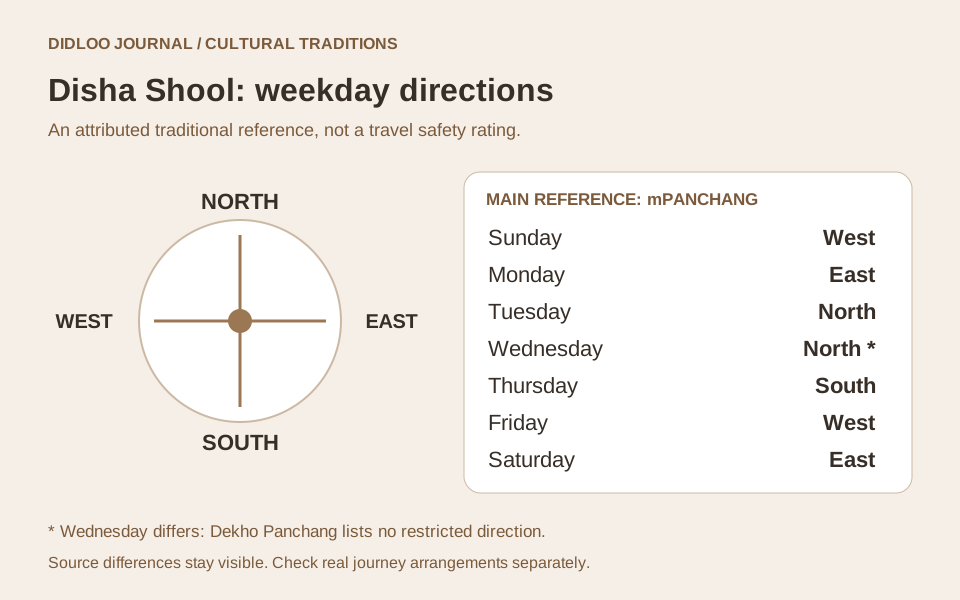
The mPanchang article cited below publishes this four-direction pattern: Sunday—West; Monday—East; Tuesday—North; Wednesday—North; Thursday—South; Friday—West; Saturday—East. These are the directions that its traditional reading treats as unfavourable for beginning a journey, not directions this guide has measured as dangerous.
Read a row by matching a weekday with its stated direction. Do not turn the other three cardinal directions into a promise of success: a limited chart does not contain that conclusion. The examples below explain how to read and discuss the entries. They are original illustrations, not additional traditional rules. Where another publisher differs, retain the attribution instead of quietly combining incompatible systems. The purpose is to make a cultural reference understandable, not to convert a brief list into a prediction about every trip.
Sunday: understanding the west entry
Sunday corresponds to west in the cited chart. The entry describes an association within that published reading. It does not tell a family which platform a train uses, whether a road is open or how long a connection will take.
Imagine the fictional family visiting a relative whose town lies west of their starting town. A family member can identify the Sunday entry without treating the observation as an instruction to abandon an important visit. If they discuss a customary departure practice, make clear whose practice it is and what the actual travel arrangements allow. This is a reading example, not a report of a completed journey or a recommended detour. Keep the distinction between describing a tradition and making decisions for the people who will travel.
Monday: understanding the east entry
Monday corresponds to east in the same chart. A reader who remembers the weekday but not the direction can use the labelled reference rather than guessing from a forwarded image with cropped headings.
In an original example, a fictional student has a scheduled appointment in an eastern neighbourhood. The useful factual questions are the appointment time, correct destination and available transport. A household may also discuss its Monday custom, but that conversation should remain separate from evidence about the appointment. If a family shares a note, include the weekday and direction in words so that an arrow is not misread after a screenshot is rotated. The example does not claim that a missed or successful appointment would validate the traditional association. A personal story and a demonstrated cause are different things.
Tuesday: understanding the north entry
Tuesday corresponds to north in the cited four-direction pattern. Keep the cardinal direction attached to the named source. Do not replace it with a corner direction merely because another list uses a different set of labels.
Suppose fictional cousins meet at a station that lies north of one cousin and south of the other. Their starting points are different. This simple example explains why a direction statement needs a reference point; it does not establish how every tradition defines the start of a journey. The cousins can agree on the real station and meeting time without forcing the same map description onto both travellers. If someone wants to follow a particular household convention, first clarify that convention rather than treating an ambiguous north-facing arrow as a complete instruction.
Wednesday: keep the disagreement visible
Wednesday is north in mPanchang's chart. A different publisher, Dekho Panchang, presents Wednesday without a restricted direction in its travel lesson. That disagreement is a reason to name the source, not a reason to declare one universal rule on behalf of every tradition.
For a fictional group planning a Wednesday outing, two relatives may therefore arrive with different references. Compare the actual wording before arguing about who remembered the day correctly. Ask whether the difference is in the weekday entry, the method or an unstated exception. Do not select whichever version produces the most reassuring answer and then call the result a verified calculation. This guide preserves the mPanchang pattern for its main reference and explicitly records the Wednesday variation, without claiming to settle the history of the belief.
Thursday: understanding the south entry
Thursday corresponds to south in the main chart. Knowing the label is a small reference task; interpreting the whole journey is a different task. A southward destination does not supply information about the actual condition of a road or the suitability of a departure time.
Consider a fictional household visiting a community event south of town. The host needs an arrival estimate and the visitors need the correct entrance. Those practical details can be settled directly. If the household also values a Thursday custom, explain it as its own cultural choice. Do not present a change of wording, a symbolic turn or a favourable label as proof that all practical questions have been resolved. The example helps readers keep a direction association within its stated scope while making the real event understandable to everyone involved.
Friday: understanding the west entry
Friday and Sunday share west in the cited chart. That repeated label is useful for checking a transcription: seven weekdays do not each need a unique cardinal direction. Repetition here is part of the published pattern, not evidence that a row was accidentally duplicated.
A fictional family might compare a Friday plan with an earlier Sunday note. They can notice the matching entry while still checking the actual dates and arrangements separately. A message that says only same as last time is poor travel information when the train, meeting place or people have changed. Write the current plan explicitly. This is an original communication suggestion, not a ritual instruction. It also prevents a cultural reference from becoming a substitute for the ordinary details a relative needs to join a journey.
Saturday: understanding the east entry
Saturday shares east with Monday in the main reference. Keep that relationship distinct from Tuesday and Wednesday's north entries, especially when copying a compact list between English and Hindi.
Imagine fictional siblings preparing a weekend visit. One has copied a weekday abbreviation and the other has copied a direction abbreviation. Reading both in full can expose a swapped row before the note is shared. Confirm what the note actually describes: the departure day, the destination's general direction or a family custom. The reference chart does not determine a booking's validity or guarantee that a trip goes well. A careful explanation helps the siblings understand the cultural entry without adding unsupported claims about personal luck, unavoidable obstacles or the effectiveness of an unexamined remedy.
Separate four cardinal directions from eight-direction lists
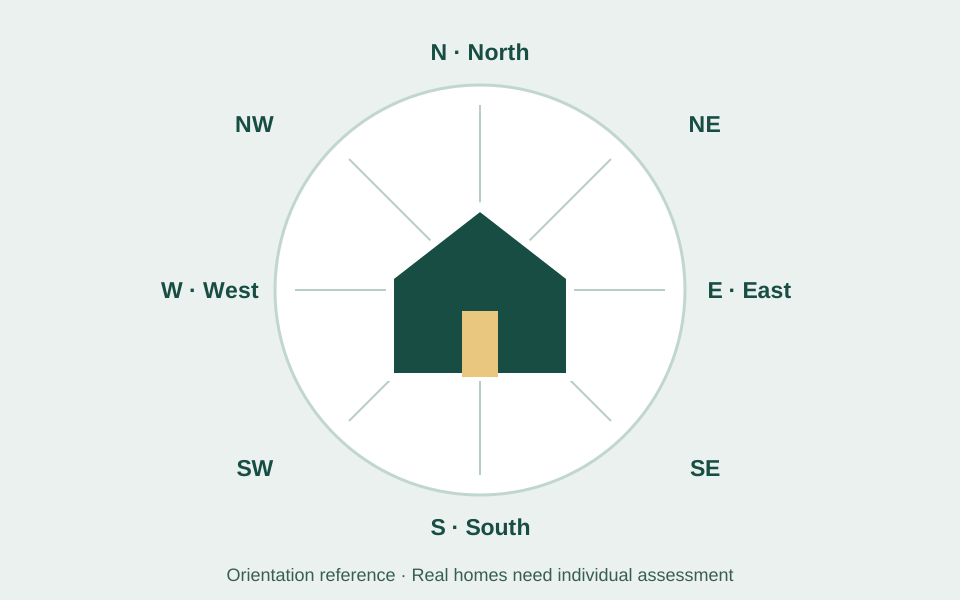
North, east, south and west are the four cardinal directions. Northeast, southeast, southwest and northwest lie between them. A list built around four labels cannot silently answer every question in a system that uses eight.
For an original reading exercise, draw a simple cross with north at the top, then add the four diagonal labels. Write the weekday reference in a separate box. This makes it obvious which information comes from the cited chart and which is basic orientation vocabulary. It does not add a traditional weekday rule for northeast or southwest. When another source includes corner directions, examine that source's own method rather than filling its missing entries with guesses. The useful habit is to preserve the boundaries of each reference so that a reader can see what is known and what has not been established.
Direction is not the same as left or right
Left and right depend on which way a person is facing. A cardinal direction provides a different kind of reference. Turning around changes what is on the left without changing where north is located.
A fictional visitor standing outside a station may receive an instruction to turn left while a relative inside describes the same exit as east. Both descriptions need context to be useful. Use named entrances and a readable map for the actual meeting arrangement. This orientation example explains language; it does not instruct someone to navigate by a symbolic weekday chart. Where a map is rotated, check its displayed orientation before interpreting a screenshot. Clear communication about the physical location should remain independent of any cultural association attached to the day.
Clarify departure, destination and route
A destination's general direction, a vehicle's first turn and the full route are different descriptions. A road can bend away from the straight line between two places. A route to a station can also point differently from the later train journey.
When a household discusses its travel custom, ask which description it means rather than treating those distinctions as an automatic loophole. This guide does not resolve every regional interpretation of departure. For the practical plan, state the actual starting point, destination and required connections. Avoid adding an unnecessary detour merely to make a diagram look more favourable. A fictional example can clarify the question, but it cannot certify a route or prove that a symbolic first movement changes the outcome of a journey. Keep the real route suitable for the people using it.
Check the day boundary used by the calendar
The mypanchang.com interpretation guide describes a sunrise-to-sunrise panchang day, distinct from a midnight-based civil date. That matters when comparing an early-morning departure with a weekday shown on an ordinary device calendar. Read the chosen publisher's convention instead of assuming that every today label uses the same boundary.
For a fictional departure before dawn, write the civil date, clock time and calendar convention in separate fields. This is a documentation exercise, not a sunrise calculation for a real location. If the relevant panchang requires local sunrise, consult its actual dated entry. An undated screenshot cannot establish which day the publisher intended. Keeping the inputs visible makes a disagreement easier to understand without inventing a universal answer for every calendar, region or departure time.
Keep local time attached to the place
CSIR-NPL's official time display identifies Indian Standard Time as UTC plus five hours and thirty minutes. A traveller communicating across countries should still label the relevant local date and time rather than assuming that everyone sees the same weekday at the same moment.
In an original example, a relative abroad helps coordinate a departure in India. The booking's stated local time is the useful reference for the journey, while a cultural calendar may have its own day convention. Keep those two descriptions explicit. This guide does not publish a live global clock, convert a booking or calculate a panchang for another country. The practical lesson is simple: a weekday without a place and time context can be ambiguous in an international conversation, even before any traditional rule is considered.
Disha Shool and Rahu Kaal answer different questions
Disha Shool's weekday reference concerns a direction. The mypanchang.com guide describes Rahu Kalam as a traditional time period and explains its dependence on the local day's sunrise and sunset. A direction entry and a time interval should therefore retain their separate labels.
A fictional reader comparing two pages might see north on one and a pair of clock times on the other. Those are not contradictory answers to one identical question. They are different kinds of reference. Do not combine them into an invented all-purpose travel score. This article does not calculate Rahu Kaal, Choghadiya, Tara Bala or a personalised muhurta. Readers studying those systems should use each source's actual method. Understanding a term's scope is more useful than placing several familiar astrological words together and implying that a complete calculation has occurred.
Treat exceptions as source-specific readings
mPanchang also discusses same-day returns and day-or-night exceptions. Those statements belong to that publisher's presentation. They should not be promoted into a universally accepted permission that overrides every other household or textual interpretation.
For an original comparison note, keep three columns in a private notebook: the main weekday entry, any stated exception and the named source. A blank exception means not recorded in that note, not that every possible case has been prohibited. Similarly, a claimed exemption does not certify actual travel conditions. The purpose of recording a variation is to make the reading honest. Do not build a complicated personal rule by selecting fragments from unrelated pages while leaving the reader unable to identify where any individual claim came from.
Discuss remedies without promising protection
Readers often search for Disha Shool remedies when a planned journey does not fit a customary preference. Published descriptions and household practices can differ. A claim that a particular act guarantees protection goes beyond describing a tradition.
This guide does not prescribe a food, donation, purchase or detour to make travel safe. A family wishing to preserve a harmless custom can discuss its meaning as a voluntary cultural practice, without treating it as an emergency decision or a financial obligation. Keep essential care, real transport arrangements and individual needs authoritative. The original editorial point is to separate symbolic reassurance from evidence about the trip. A small ceremony may matter personally to someone; that personal meaning should not be misrepresented as a tested mechanism that prevents accidents or ensures a successful outcome.
Make room for different family views
A family can share a cultural vocabulary while disagreeing about how closely to follow it. Start with the actual concern: respect for an elder, anxiety about an unfamiliar journey or a wish to maintain a custom. Those concerns can be heard without assigning blame to the traveller.
In a fictional planning conversation, one relative can explain which chart the household remembers while another confirms the real booking. Agree on what information needs to be shared and what remains an individual choice. Avoid using a weekday label to accuse someone of causing a later problem. This is an original communication approach, not a report of counselling or a prediction about relationships. It helps keep a cultural discussion proportionate to the people involved rather than allowing an ambiguous reference to take over every decision.
Keep the practical journey plan usable
A practical itinerary needs the correct destination, departure details, connections and a way to communicate an important change. Those facts should be readable even by a person who does not use the family's astrological reference. Put the confirmed arrangements in one clear note.
For the fictional visit, the note could identify the station entrance, planned meeting time and contact for an unexpected delay. Check actual transport information and current local conditions through the relevant services when planning a real journey. This article supplies no live warning, timetable or route certification. Its recommendation is to keep the operational plan separate from cultural commentary. A useful message tells the traveller what is actually arranged, while leaving optional beliefs labelled as beliefs and avoiding any suggestion that a favourable direction replaces preparation.
Daily commutes and essential commitments need context
A recurring journey does not become a new prediction experiment every time a weekday changes. People may have work, education, caregiving or other essential commitments. A cultural reference alone does not establish that those commitments should be missed.
In an original example, a fictional commuter can understand the chart while keeping the practical route and required arrival time clear. If a family wants to discuss its custom, do so without creating pressure for unnecessary delay or expense. This guide does not classify all short trips as exempt or every long trip as restricted; those are claims to attribute to a particular tradition. It instead preserves the difference between studying a customary rule and directing another person's real obligations. An important or urgent need should not be postponed solely because of a generic weekday label.
Keep travel-direction beliefs distinct from home Vastu
A question about the direction of a journey differs from a question about the orientation of a room or entrance. Sharing words such as east and south does not make the two systems interchangeable. This guide's weekday reference should not become an instruction to alter a home.
A fictional household might read about Thursday travel and then worry about a south-facing doorway. That is an unsupported jump between different questions. For home planning, use the separate Vastu guide to understand attributed cultural associations, while assessing construction, ventilation, access and other practical needs with appropriate expertise. Do not infer a structural defect or a personal misfortune from this travel chart. The original comparison helps readers organise their questions without implying that one brief table supplies a universal rule for every use of direction.
Evaluate an outcome without rewriting the story
If a journey goes well, that observation alone does not establish why. If it has a delay, a weekday association alone does not identify the cause. A useful explanation should distinguish the actual event from an interpretation added afterward.
For a fictional travel diary, record the plan, the observed change and the information available at the time. A missed connection may have a documented operational explanation that deserves attention. Do not replace that explanation with blame directed at a traveller who did not follow a custom. This is an original reasoning exercise, not a statistical study of astrology. It keeps the cultural reading visible while avoiding a claim that selected personal memories demonstrate a general predictive rule. Belief, emotional meaning and measured evidence should each be described in the terms they actually support.
Preserve weekday and direction meaning in Hindi
In a bilingual reference, check Monday with Somvar, Tuesday with Mangalvar, Wednesday with Budhvar, Thursday with Guruvar, Friday with Shukravar, Saturday with Shanivar and Sunday with Ravivar. Check east with Purva, west with Paschim, north with Uttar and south with Dakshin.
Review the completed mapping in both directions, especially the repeated east, west and north entries. A reader should not need to infer whether an abbreviation names a weekday or a direction. Keep the Wednesday variation explicitly labelled in both versions, along with the distinction between a traditional association and actual journey conditions. This is an original editorial checking method, not a native-speaker certification. Equal layout or similar sentence length does not prove that the translation preserved a negative, an exception or the source attribution.
Use the reference with its limits visible
A clear reading record identifies the source, weekday convention, direction label and any specifically attributed variation. It also states what the reference does not contain: a live route assessment, an individual prediction or a guarantee about a journey's outcome. That makes the article useful without overstating it.
The fictional family's successful discussion is one in which everyone understands the actual plan and the optional cultural reference. The family does not need to agree that a chart controls events in order to speak respectfully about it. Keep the weekday list readable, source differences visible and practical arrangements current. That approach supports learning about Disha Vichaar and Disha Shool in original, understandable language while avoiding copied verses, invented scriptural authority, fear-based claims or promises that a symbolic remedy can make every trip safe.
Further reading
Official resources and related guides for the concepts discussed above. Check the selected tool for current capabilities and terms.
Take the next idea into a conversation
Explore Didloo for personal chats, creative sharing and linked desktop messaging. Business messaging has its own approved API workflow.