Astrology
Numerology Number 2: Birth Number, Destiny Number and the Meaning of Cooperation
Numerology number 2 is often associated with partnership, sensitivity and the ability to notice another perspective. Those themes can be interesting without becoming a verdict about someone's character. A number cannot tell you whether a person is trustworthy, whether a relationship will last or whether agreement is the right response to a difficult situation. A thoughtful reading leaves room for disagreement and individuality. This guide explains number 2 as both birth number and destiny number. Here birth number, also called Mulank, comes from the day of the month; destiny number, called Bhagyank in this date-based convention, comes from the complete date. We reduce each result to one digit. Interpretations are variable cultural beliefs. The practical examples below are independently written reflection exercises, not observed outcomes or proof that numerology predicts behaviour.
The symbolic idea behind two
Two suggests a relationship between things: a question and an answer, two people sharing a task or two viewpoints about the same event. Contemporary practitioners often build a story of cooperation around that image. The symbol can encourage someone to consider how they listen and negotiate. It does not establish that every person assigned this number is gentle, hesitant or naturally suited to supporting someone else.
Cooperation is also different from automatic agreement. Two people can work together while retaining separate preferences. They may need to discuss what each person can offer, what each needs and which decision belongs to whom. If a numerology reading turns number 2 into a duty to keep everyone comfortable, it becomes a restrictive label. A more useful interpretation recognises that clear boundaries can support cooperation rather than undermine it.
Birth number 2 covers these calendar days
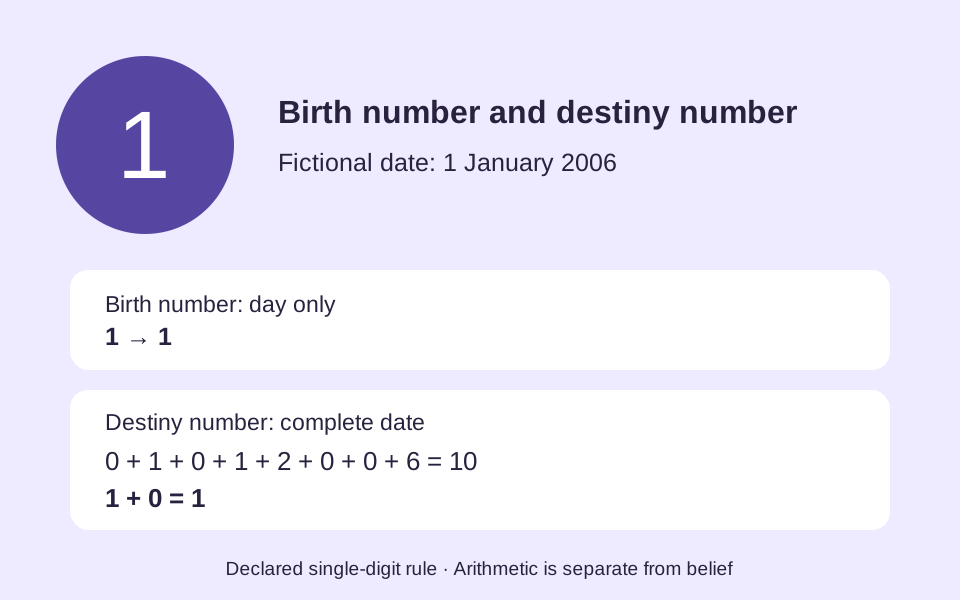
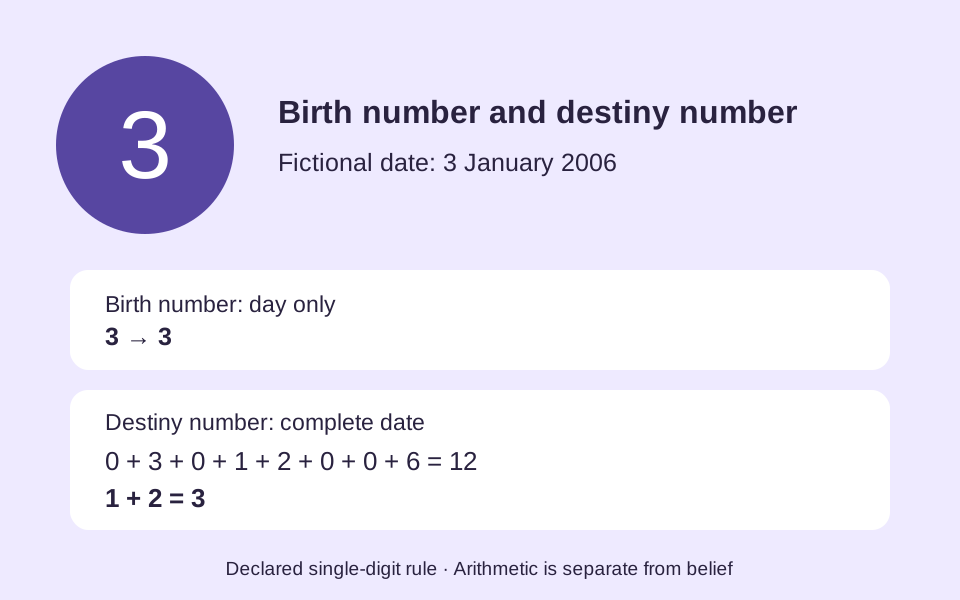
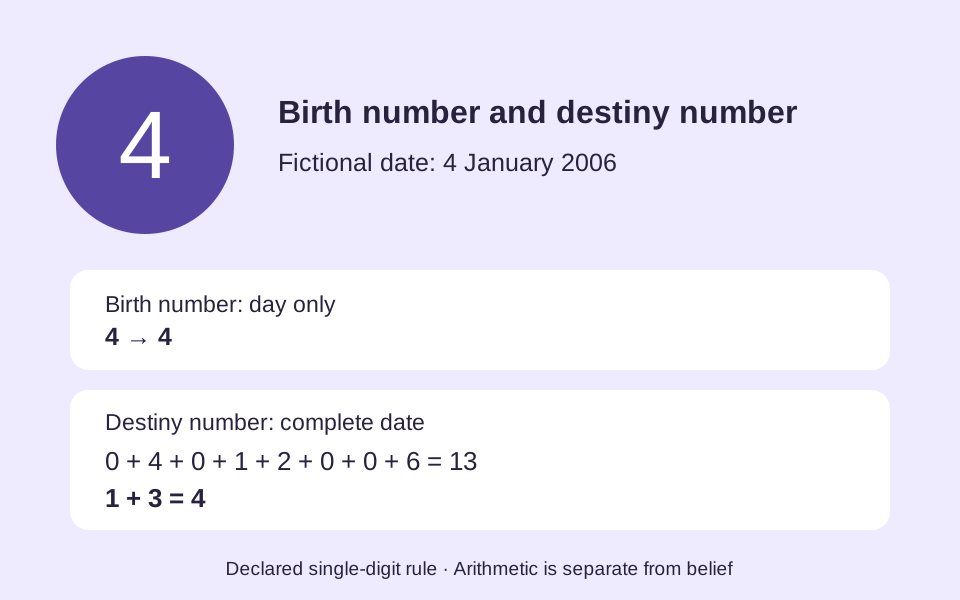
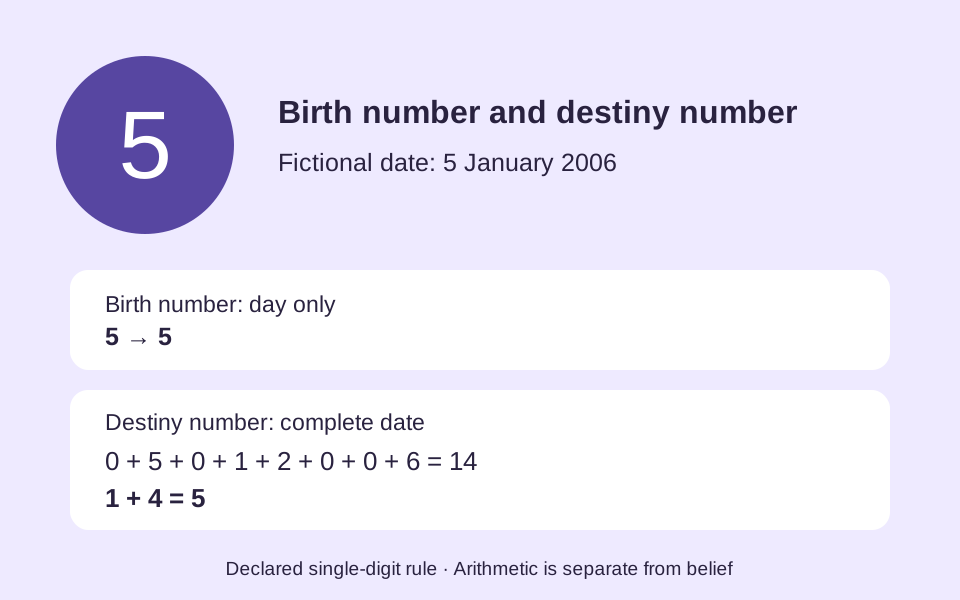
Under the single-digit calculation, days 2, 11, 20 and 29 reduce to birth number 2. For the eleventh, 1 + 1 = 2. The twentieth gives 2 + 0 = 2. The twenty-ninth needs two steps: 2 + 9 = 11, then 1 + 1 = 2. We retain the intermediate total in the explanation while reducing the final result.
Some traditions give 11 additional significance and preserve it at selected stages. This article does not use that exception in its birth-number result. That difference is a rule choice, not a mathematical disagreement about the sum. Always check the method before comparing interpretations. A person born on the twenty-ninth may see both 29 and 2 discussed elsewhere; the writer should explain whether they are describing the compound day or the reduced birth number.
Calculate destiny number 2 from a complete example
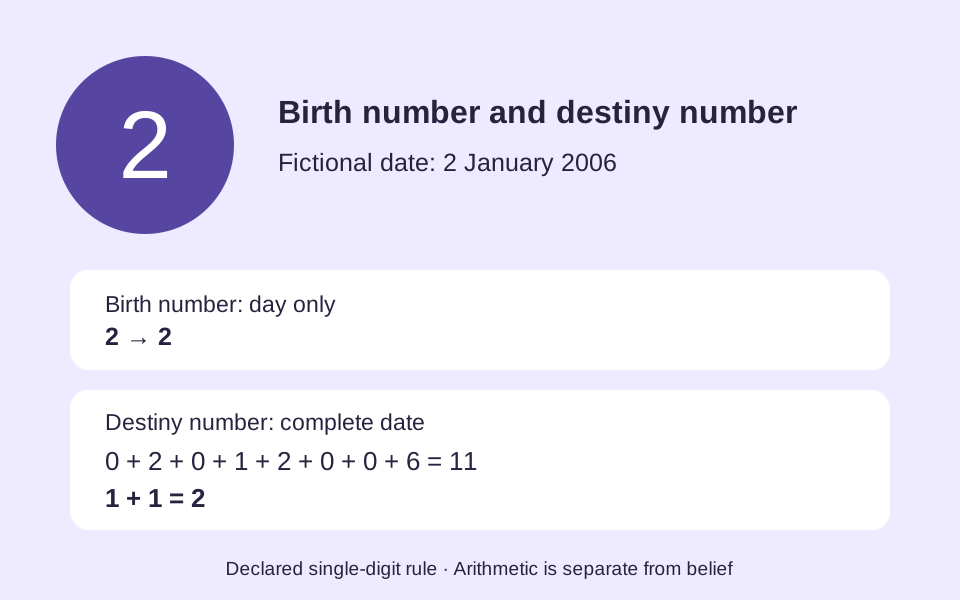
Take the fictional birth date 2 January 2006. Written as 02-01-2006, it contains the digits 0, 2, 0, 1, 2, 0, 0 and 6. Add them: 0 + 2 + 0 + 1 + 2 + 0 + 0 + 6 = 11. Under the rule declared here, reduce 11 through 1 + 1 = 2. The destiny number is therefore 2.
Keep both occurrences of the digit 2 and all other digits in the written formula. Repeated digits are separate addends, not duplicates to discard. Zeros add nothing but can help show that the full date was transcribed correctly. The calculation produces an arithmetic classification. The further claim that it describes a life direction belongs to numerological belief and does not follow from addition alone.
A different birth number can share destiny number 2
The fictional date 1 February 2006 also gives a complete-date sum of 11, reduced to 2. Its birth number is 1 because only the first day is used in that calculation. Thus the person has birth number 1 and destiny number 2 in this system. Reversing the day and month in a written date can preserve the total while changing the birth number.
This is why a clear date format matters. Write the month in words when explaining a case to someone unfamiliar with your notation. It also shows why a shared destiny number does not mean two people have the same chart or the same experience. If you use the symbolism, discuss initiative and cooperation as separate themes. Do not turn that comparison into an unsupported diagnosis of inner conflict.
Destiny, life path and name numbers are not interchangeable labels
In some numerology traditions, destiny or expression number is derived from letters in a name. Other writers use destiny for the reduced full date, as this article does for Bhagyank. Life path is another term often associated with a full-date calculation. The names alone do not guarantee identical inputs or reduction rules.
Before reading a profile, identify exactly which operation produced the number. A name-based 2 may depend on a letter-value table and the spelling used. A date-based 2 follows the date rule. Comparing them without that distinction is like comparing answers to different questions. This guide covers only the reduced day and full date. It does not require you to change a name, choose a new spelling or purchase a personalised report.
Sensitivity as a question about attention
Number 2 descriptions often use the word sensitive. That word can mean noticing tone, caring about a response, responding strongly to an event or feeling uncertain about a disagreement. Those are different experiences. A short profile cannot determine which one applies, and a birth date cannot establish a psychological condition or the reason someone finds a situation difficult.
For reflection, choose one recent conversation. What did you notice, and what did you assume? Perhaps you observed that a colleague paused before answering, then assumed they disliked your suggestion. Distinguishing the observation from the assumption creates room to ask a question. The exercise can be useful whether or not number 2 appears in your calculation. It focuses on an actual communication process rather than proving a trait.
Listening without taking responsibility for every emotion
Listening means allowing someone to explain their experience. It does not require accepting every interpretation or fixing every difficulty they describe. A number 2 profile should not make a reader feel responsible for the emotional state of everyone around them. That expectation would confuse consideration with an unlimited obligation.
Imagine a friend who wants to discuss a frustrating day while you are finishing a task. You can acknowledge them and suggest a time when you can pay attention. You might also ask whether they want ideas or simply someone to listen. These are practical choices about availability and expectations. Numerology does not determine the right answer, but a cooperation theme can provide a starting point for discussing how support is offered and received.
Agreement, compromise and consent
Agreement occurs when people genuinely accept an arrangement. Compromise may involve each person adjusting a preference. Consent requires room to choose rather than being pressured by a symbolic label. These distinctions matter if number 2 is described as a peacemaker. Keeping a room quiet is not always the same thing as resolving the issue that caused disagreement.
In a fictional shared household, one resident repeatedly accepts an inconvenient cleaning schedule to avoid discussion. A useful conversation would ask whether the responsibilities can be divided more fairly. Calling that resident cooperative does not make the arrangement fair. A numerology reading should leave the person free to object, request a change or decline a responsibility. Cooperation works best as an active choice rather than an identity that forbids disagreement.
A worked example of negotiating a shared project
Two fictional volunteers, Kavya and Imran, plan a small community display. Kavya wants a quiet written presentation; Imran prefers a spoken introduction. Rather than decide which preference belongs to a stronger number, they identify the goal and the audience. They agree on a short introduction with a written summary that visitors can read afterwards.
The example illustrates how different contributions can coexist. It does not demonstrate that their birth dates caused a successful compromise. They clarified a purpose, described their preferences and designed an arrangement that addressed both. Someone using number 2 as a reflection theme might ask whether they stated their own preference as clearly as they heard the other person's. That question is more informative than assigning automatic roles of leader and supporter.
Work settings where collaboration matters
Searches for number 2 career often promise a list of ideal occupations. A reduced date does not measure communication skills, training or a person's preferred responsibilities. Rather than assigning a profession, consider what collaboration means in a particular role. Coordinating information, responding to feedback and negotiating priorities can be important in many kinds of work.
Look at tasks you have actually completed. Did you enjoy explaining options to someone, keeping a group informed or identifying a misunderstanding? Which tasks were tiring or required support? Answers should be tested through experience and learning rather than assumed from a profile. A person interested in number 2 symbolism can use it to identify a skill to practise, without treating it as a limit on technical, creative or independent work.
Decision-making when you see several sides
Being able to understand different views can make a decision more informed. It can also make it difficult to stop gathering opinions. Neither possibility is established by being number 2. The practical issue is whether you have enough relevant information and a clear understanding of who has the responsibility to decide.
Try separating a decision into questions. What is the actual choice? Which facts would change the answer? Whose input is necessary, and whose opinion is optional? When does the decision need to be made? This structure allows consideration without requiring unanimous approval. If you later review the result, examine the information and process rather than saying that hesitation or confidence was inevitable because of a birth-date label.
Friendship and the expectation of availability
A friendship can contain different communication habits. One person may prefer frequent short messages while another prefers occasional longer conversations. A symbolic description of number 2 as attentive should not create a promise of constant availability. Clear expectations are more useful than guessing how a person must behave because of a number.
You can ask what kind of contact feels comfortable and how urgent matters should be signalled. You can also explain when you are unavailable without describing the limit as rejection. The point is not to optimise a friendship through arithmetic. It is to notice whether a theme of cooperation has become a conversation about real preferences. An honest disagreement about communication can be healthier than repeatedly pretending that both people want the same arrangement.
Relationship compatibility with the other digits
No pair of digits supplies a reliable test of relationship success. Symbolically, number 2 with 1 may prompt discussion about initiative and consultation, while 2 with 2 may prompt discussion about expressing preferences clearly. With 3, the topic might be expression; with 4, agreements; and with 5, flexibility. These are editorial prompts rather than favourable or unfavourable scores.
For combinations with 6, 7, 8 and 9, one could discuss care, privacy, responsibility and wider commitments respectively. Those themes are not exclusive to those numbers. Actual compatibility involves how people treat each other, what they expect and whether they can discuss differences safely and honestly. A reading must not be used to pressure someone into a relationship or to dismiss their concerns because a chart is said to be favourable.
Family expectations and the quiet child
Adults sometimes describe a quiet child as easygoing and assume that the child needs little attention. A number 2 label can reinforce that assumption if it is treated as proof that the child should always accommodate others. Quietness does not reveal every preference, and cooperation should not make someone's needs less visible.
If a family enjoys numerology, keep the interpretation open. Ask the child what they want to try, allow them time to answer and avoid praising only the moments when they give way. A child may enjoy helping while also wanting a turn to choose. These observations belong to the child's actual experience. Neither the day of birth nor a favourable description should determine which interests, responsibilities or opportunities the child is allowed to explore.
The Moon association is a traditional correspondence
Some Indian practitioners connect number 2 with the Moon. That is a correspondence within their symbolic system, not evidence that a reduced birth date gives the Moon control over an individual's decisions or emotions. Other numerological approaches may use different explanatory frameworks, so identify the tradition before comparing statements.
You do not need to accept a planetary prediction to understand the cultural language. A reader can study the association as an example of symbolism while questioning claims made in its name. This article offers no remedy for a medical problem and no instruction to buy an object, wear a gemstone or rearrange essential plans. Its purpose is to make the method and interpretation understandable without turning interest into an obligation.
Colours, preferred days and symbolic reminders
A favourite colour or date may have personal meaning. It can be used to mark a celebration, decorate a notebook or remind someone of a quality they want to practise. The meaning is chosen or inherited through tradition; it does not prove that the colour changes a relationship or that the date guarantees an outcome.
If a number 2 reminder helps you pause before answering, describe that action directly. Perhaps you want to ask one clarifying question instead of assuming what a person meant. That is a behaviour you can review. Do not postpone necessary appointments, ignore deadlines or buy repeated remedies because an arrangement lacks a preferred digit. A cultural interest should not make ordinary choices feel dangerous or place a burden on other people's schedules.
Repeating twos do not alter the birth-date calculation
The sequences 22 or 222 may be discussed in repeating-number traditions. Seeing them on a screen or receipt is a different activity from reducing a birth date. It does not change your recorded day or the full-date sum. Nor does it establish what another person thinks about you or predict that a message will arrive.
If a repeated sequence feels meaningful, you may use it as a voluntary cue to reflect on cooperation. Keep the distinction clear: you are choosing a reminder, rather than receiving a demonstrated external instruction. There is no need to search for a sequence before taking a routine action. The arithmetic in this article can be checked openly, while the meaning attached to a coincidental observation remains an interpretation.
An exercise for identifying an unspoken preference
Think of a small shared decision that left you dissatisfied. Write what was decided, what you actually wanted and whether you expressed that preference. Then write what the other person could reasonably have known from the conversation. This is an exercise in description, not an attempt to determine who has the correct number or whose feelings count more.
If you did not state a preference, consider how you might express it next time. If you did state it and it was ignored, the issue may concern the response rather than your clarity. Keep both possibilities available. A cooperation theme becomes useful when it helps distinguish those situations. It becomes unhelpful when every difficulty is explained as evidence that a number 2 person is simply too sensitive.
Review both successful and difficult interactions
Choose one interaction that felt balanced and another that did not. Compare the setting, available time, expectations and the words used. Did both people understand the purpose of the discussion? Was there room to decline? Did someone assume that silence meant agreement? These details are more specific than a general statement that you are diplomatic.
Record observations that do not fit the numerology description as carefully as those that do. You might discover that you negotiate clearly at work but avoid stating preferences at home, or the reverse. That variation is valuable information about context. A fixed profile cannot replace it. Reflection is most useful when it allows you to change your explanation after looking at what actually happened.
Privacy and respectful discussion of another person's number
Use fictional dates when teaching the calculation. You can show every step without posting someone's complete birth date or personal story. If a friend wants to compare numbers, check that they are comfortable with the conversation and keep private information out of public comments. Numerology does not create permission to analyse someone publicly against their wishes.
Avoid using a number as a shortcut for a colleague, partner or family member. Ask about their preferences directly instead of announcing that you already know what they need. Even a favourable label can feel intrusive when it replaces listening. A respectful reading allows the person to disagree with the interpretation and does not treat disagreement as further proof that the label must be correct.
A small meeting exercise: make room without losing your view
Before a shared discussion, write your preferred outcome in one sentence. During the discussion, note a second person's actual proposal before responding to it. Compare what they said with what you expected them to say. This can reveal whether you were listening to the proposal or preparing an answer to an imagined disagreement. The exercise does not require assigning either person a number.
Afterwards, ask whether your own preference remained visible. Making room for someone else should not mean disappearing from the discussion. You can acknowledge their reasoning and still explain why you prefer a different option. That combination is a concrete example of cooperation with individuality. It avoids both extremes of insisting on control and accepting everything merely to keep the conversation comfortable.
When a profile sounds right for almost everyone
Descriptions such as caring, uncertain at times or wanting to be understood can fit many people. Recognising yourself in a broad description is therefore different from demonstrating that the description was uniquely derived from your date. Ask whether the wording identifies a specific behaviour and what evidence could show that it does not apply.
This question need not spoil an interest in symbolism. It simply keeps a distinction between a story that feels meaningful and a method that has established predictive accuracy. You can enjoy the cultural vocabulary while declining to use it for consequential judgments. A good reading should become clearer when questions are asked, rather than demanding that every possible response be interpreted as confirmation.
Questions that keep the reading useful
Can you distinguish the reduced day from the complete-date result? Have you checked whether another source preserves 11 or uses a name-based destiny number? Can you identify a specific situation where listening, expressing a preference or negotiating a boundary would help? These questions connect a symbolic interest to something you can actually examine.
Number 2 can represent a meeting between perspectives, but a real conversation needs more than a number. People bring circumstances, choices and changing needs. You may retain the symbolism, adapt it or set it aside. Its value is not measured by how completely you fit the description. A thoughtful interpretation leaves you free to cooperate, disagree and revise your view without treating any of those choices as a failure of destiny.
Further reading
Official resources and related guides for the concepts discussed above. Check the selected tool for current capabilities and terms.
Take the next idea into a conversation
Explore Didloo for personal chats, creative sharing and linked desktop messaging. Business messaging has its own approved API workflow.