Astrology
Numerology Number 3: Birth Number, Destiny Number and Creative Expression
Numerology number 3 is commonly associated with expression, imagination and the enjoyment of sharing ideas. A reader may recognise those themes without accepting a prediction about talent or success. Someone who likes making things can still find speaking difficult; someone who speaks confidently may prefer structured work. A reduced date cannot settle these differences or determine what a person is capable of learning. This guide explains the calculation before the interpretation. Birth number, or Mulank, uses the day of the month. Destiny number, or Bhagyank in the date-based convention used here, uses every digit of the full date. Both are reduced to a single digit. The meanings are variable numerological beliefs. The exercises and fictional examples are original editorial suggestions for reflection, not evidence that numbers produce personality or guarantee creative achievement.
Three as a symbol of expression
Contemporary number 3 profiles often emphasise communication and creative interests. A useful way to approach that symbolism is to ask what expression means in your situation. It might involve telling a story, explaining a complicated task, choosing an image or asking a question that helps a group understand a problem. Expression is broader than performing confidently in front of a crowd.
The symbol does not give everyone assigned number 3 the same preferences. A person may enjoy drawing privately and dislike public presentation. Another may like discussion but need a clear brief before writing. Keep those distinctions visible. The value of a reflection theme lies in the questions it helps you ask, not in forcing every interest and difficulty into a single description that cannot be challenged.
Birth number 3: days 3, 12, 21 and 30
The days that reduce to birth number 3 are 3, 12, 21 and 30. The third is already one digit. The twelfth gives 1 + 2 = 3. The twenty-first gives 2 + 1 = 3, and the thirtieth gives 3 + 0 = 3. Only the day of the month is used for this calculation.
Do not add the month or year and still call the result the reduced birth day. That would be a different operation. Keep the original day in your notes if another source discusses compound numbers, because its interpretation of 12 may differ from its interpretation of 21. A common final digit does not erase the different inputs. It also does not establish that people sharing those dates have equivalent opportunities, abilities or circumstances.
A complete destiny-number 3 example
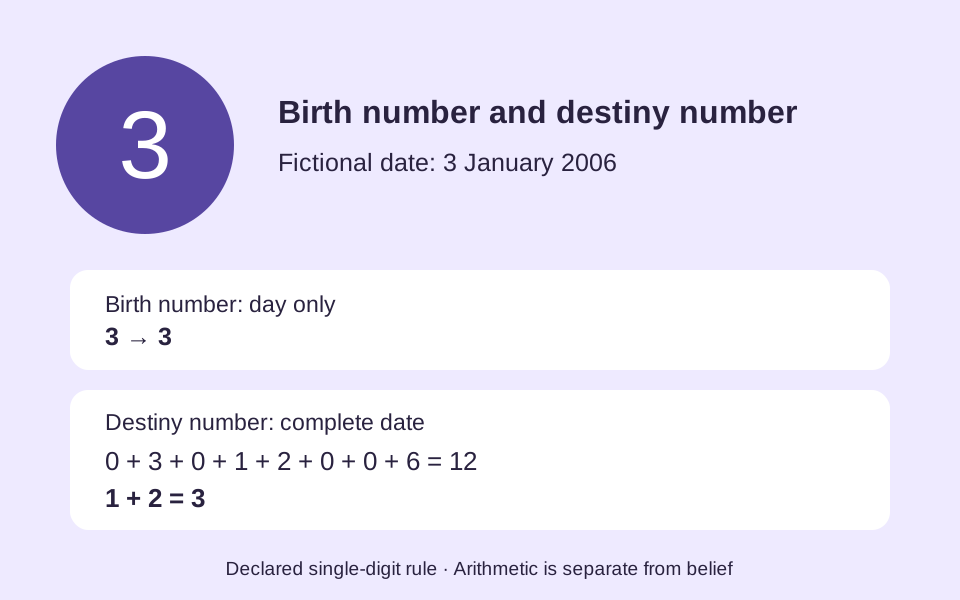
Consider the fictional date 3 January 2006. Written as 03-01-2006, it gives 0 + 3 + 0 + 1 + 2 + 0 + 0 + 6 = 12. Reduce the total through 1 + 2 = 3. Its date-based destiny number is 3. In this example, the reduced birth day is also 3, but that match is not a requirement.
Write the entire sequence when explaining the calculation. A missing digit can leave a plausible-looking final answer with an incorrect derivation. It is useful to check the sum separately before discussing symbolism. The arithmetic can be verified by anyone following the same rule. The suggestion that the resulting digit describes a life theme is a traditional interpretation, not an additional mathematical result proven by the sum.
When birth number and destiny number tell different symbolic stories
For a fictional person born on 3 February 2006, the day gives birth number 3. The full date gives 0 + 3 + 0 + 2 + 2 + 0 + 0 + 6 = 13, then 1 + 3 = 4. The result is therefore birth number 3 and destiny number 4 under the declared convention.
A symbolic reading might compare expression with structure. It should not say that the person is doomed to struggle between creativity and discipline. In real work, structure can support expression: a clear schedule may help someone finish a story they enjoy writing. Whether that happens depends on choices and circumstances. The two numbers can be used as prompts for discussion, but they do not prove a psychological conflict or establish a prediction.
Be clear about the word destiny
Different numerology systems use the term destiny differently. Some derive it from a name using letter values, while date-based Indian Bhagyank calculations use the complete birth date. A page that does not identify its inputs can make two correct calculations appear to contradict each other. Ask what was added before interpreting the result.
This series uses the full-date single-digit method consistently. It does not use name spelling, birth time or place for this particular number. It also does not preserve master-number totals within the final Bhagyank result. Those are explicit limits of the convention, not claims that other traditions do not exist. Keep each method with its own definition instead of combining a result from one with a prediction borrowed from another.
Creativity is an activity, not a guaranteed identity
Calling someone creative can be encouraging, but it can also make ordinary difficulty feel like failure. A person who identifies with number 3 may expect every idea to arrive easily or every draft to impress an audience. Creative work often involves incomplete attempts, revision and learning a medium. A birth-date label does not remove those steps.
Think about an activity you enjoy making rather than a talent you must prove. You might prepare a small sketch, record a melody idea or explain a familiar process in writing. Decide what you want to explore and what a usable result would contain. The exercise has value if it helps you understand your decisions, even when the result is modest. It does not need to confirm a grand description of natural brilliance.
Communication starts with an audience and a purpose
A message can be expressive and still fail to explain what the reader needs. Before polishing the wording, ask who the message is for and what they should understand or do after reading it. A friend asking for directions, a classmate reviewing notes and a colleague considering a proposal need different information.
The number 3 theme can be used to examine how you adapt an explanation. Do you assume that someone shares your background knowledge? Do you provide the context before the conclusion? Do you ask what remained unclear? These are observable habits that can change with practice. Numerology cannot measure them or determine whether an audience understood. A direct response from the actual reader is more informative than a favourable communication label.
Enjoyment does not eliminate the need to finish
Starting a new idea may be more enjoyable than resolving its awkward middle. Number 3 profiles sometimes describe this as a tension between enthusiasm and focus. Treat that as a possible reflection theme, not a defect automatically assigned to everyone with the number. Plenty of people encounter unfinished projects for different reasons, including limited time or unclear requirements.
Choose one project and define a small finished version. A complete paragraph can be more useful than an imagined book with no draft. Record what belongs in the current version and what can wait. If you later change the scope, explain why. The practical distinction is between a deliberate revision and continually adding possibilities so that completion becomes impossible. That distinction can be examined without claiming a numerical cause.
A fictional writing example
Arjun, a fictional beginner, wants to write a short account of a local event. His first draft includes several unrelated stories because each feels interesting. A reader cannot tell what the piece is about. Arjun then chooses one central question, removes material that does not answer it and asks the reader whether the revised sequence is clear.
This example could accompany number 3 symbolism about expression. It is not a measured numerology result or a real customer testimonial. The improvement comes from editing for purpose and audience. A reader who prefers another number can use the same process. The symbolic story may make the exercise memorable, but the actual decisions remain visible and can be discussed on their own terms.
Optimism and realistic commitments
An optimistic approach can make it easier to attempt something unfamiliar. It can also encourage a person to promise more than the available time allows. Neither tendency can be established from a number. Look instead at how a commitment was made: what was understood, which resources were available and whether the other person knew the limits.
If you recognise a habit of agreeing enthusiastically and struggling later, practise describing a smaller commitment accurately. You might offer to prepare an outline rather than an entire presentation. That is not a rejection of creativity or generosity. It makes the offer more reliable. A useful number 3 reading leaves room for realistic limits instead of praising every expansive promise as proof of a positive personality.
Work and career questions for number 3 readers
Search results about number 3 career often point toward visible creative professions. A date reduction cannot tell whether you have the training, interests or working conditions suited to those roles. Communication and invention also occur in technical, administrative and practical work. Avoid narrowing your options to a list built from a symbolic description.
Review tasks you have actually enjoyed. Did you like generating possibilities, explaining a process, improving an existing design or presenting a result? Which parts required skills you still want to learn? These questions can guide a discussion about training and experience. They should be considered alongside real opportunities and responsibilities. Numerology may provide a theme for reflection, but it should not decide whether you apply for a role or abandon an interest.
Collaboration and credit
Creative work often involves ideas contributed by several people. If you identify strongly with an expressive role, consider how you acknowledge someone who supplied research, corrected an error or made the final result usable. Being the person who presents an idea does not mean being its only contributor. A symbolic label gives no special ownership over shared work.
In a fictional group assignment, one person enjoys presenting while another prefers checking details. They can discuss how the work will be divided and credited before the presentation. Both contributions matter. The number 3 theme becomes useful if it prompts clearer communication about that arrangement. It becomes unhelpful if it is used to excuse ignoring preparation or to assume that less visible collaborators have nothing creative to offer.
Relationships and the difference between talking and connecting
A lively conversation can be enjoyable without addressing an important concern. Someone may speak easily about ideas but find it difficult to explain a disappointment or ask for support. A number 3 profile should not assume that verbal confidence equals comfort with every kind of conversation. Look at the particular subject and relationship.
If a discussion keeps returning to jokes or interesting distractions, ask whether something important remains unsaid. Make room for the other person's pace and preferred form of expression. They might want time to think or a quieter setting. The aim is mutual understanding rather than proving who is the better communicator. A numerology reading cannot judge a relationship or replace asking someone what they actually mean.
Compatibility with numbers 1 through 9
Pairing number 3 with 1 can provide a prompt about ideas and initiative, while 2 can prompt discussion about expression and listening. With another 3, the question might be how shared enthusiasm becomes a completed plan. With 4, it might concern structure; with 5, variety. These are optional conversation topics, not measured compatibility rankings.
The remaining combinations can be framed around care with 6, depth with 7, responsibility with 8 and wider purpose with 9. Different traditions may describe the numbers differently. None of these themes establishes that a couple should marry, separate or ignore a concern. Actual treatment, shared expectations and the way people handle disagreement are more direct information than two reduced dates. Keep personal choices separate from a symbolic table.
Supporting a child's expression without assigning a role
A child described as number 3 should not be expected to entertain others whenever asked. Enjoying drawing or storytelling does not mean wanting public attention. Children can also change interests. A label that adults intend as praise may become a demand if the child feels they must always be cheerful, inventive or outgoing.
Offer different forms of expression and allow a choice. A child might want to show a drawing privately, explain a model or simply continue practising without an audience. Notice effort, learning and the child's own goals rather than comparing them with an ideal numerology profile. The day of birth does not establish what a child should enjoy or how they must behave for the family.
Jupiter and other symbolic correspondences
Some Indian practitioners associate number 3 with Jupiter. This is part of a traditional system of correspondences, not an astronomical explanation for creativity, academic performance or authority. Other sources may emphasise different symbolic connections. Identify which tradition a writer follows before treating its vocabulary as universal.
Studying a correspondence does not require accepting its predictive claims. You can understand the cultural association while declining a prescribed purchase, remedy or change to important plans. This guide does not describe a gemstone as a way to create talent or a ritual as a guarantee of success. Its interest is in transparent calculation and clearly labelled interpretation. A reader's freedom to question the symbolism remains part of a responsible explanation.
Preferred colours and dates do not complete a project
A colour or date can be a personal reminder connected with a tradition. It cannot write a draft, provide feedback or ensure that an audience responds well. If you enjoy symbolic choices, keep them optional and describe what they mean to you. Do not confuse an aesthetic preference with evidence that an external event has been controlled.
For example, a preferred notebook might remind you to collect ideas. The useful next step is to select one idea and develop it. That action can be reviewed directly. There is no need to delay a deadline, miss an appointment or repeatedly buy objects because an arrangement lacks a supposedly favourable number. Cultural meaning can coexist with ordinary planning without becoming a condition for beginning or finishing work.
Repeated threes are different from a calculated number
The sequences 33 and 333 are sometimes discussed in repeating-number traditions. Noticing them does not change a birth-number or full-date calculation. A number appearing on a clock also does not establish that an idea will succeed, that someone approves of you or that a particular event is about to occur.
You may choose to use a repeated sequence as a reminder to pause and record a thought. Keep the agency clear: it is a meaning you attach voluntarily, rather than a demonstrated instruction that must be obeyed. The arithmetic in this guide can be checked using an explicit method. A personal interpretation of a coincidence is a different kind of statement and should not be presented as equivalent evidence.
A practical expression exercise
Choose an idea you can explain in a short paragraph. Write it once for someone familiar with the subject and once for someone new to it. Ask a willing reader what they understood from each version. Compare their response with your intended point, then revise one sentence that created confusion. You do not need their birth date or a numerology chart.
The exercise focuses on communication as an exchange rather than a performance. You may discover that an example helps more than an elaborate phrase, or that your opening assumes too much background knowledge. Record what changed and why. Those observations can guide future writing. They are more useful than deciding that a good response proves number 3 talent while an unclear response must be the audience's fault.
Compare the idea you imagined with the result you made
Before a small creative task, describe what a finished version will contain. After completing it, compare that brief with the actual result. Which changes were intentional? Which arose because the original plan was unclear? Which parts would you keep? This creates a concrete record of development instead of judging the work only by whether it felt inspired.
Keep failed attempts in the review when they teach something relevant. An unfinished sketch may reveal that the chosen format was too complex for the available time. A simple explanation may work better than the ambitious first version. These are ordinary creative decisions. Number 3 symbolism can accompany the discussion, but it should not prevent you from admitting that an idea needed revision or that another person's suggestion improved it.
Broad descriptions and selective examples
Words such as imaginative, social or easily distracted can apply to many people in some situations. Recognising yourself in them does not demonstrate that your date uniquely predicted the description. Ask whether the statement identifies a specific behaviour and whether a contrary example would be allowed to count against it.
If every possible response is treated as confirmation, the reading cannot be tested fairly. You can still enjoy the symbolic vocabulary while keeping that limit visible. Write down examples that fit and examples that do not. Perhaps you finish complex work reliably but dislike casual conversation. That variation matters. A useful account of your experience should become more precise when new information appears, rather than forcing the information to fit a flattering story.
Privacy, originality and respect for other people's work
Use fictional dates to teach the calculation and avoid posting another person's identifying details without their agreement. Likewise, an interest in creativity does not make someone else's writing or art available for copying. Learn from sources, acknowledge a specific idea where appropriate and make your own explanation rather than replacing a few words in a borrowed passage.
When working with a group, agree on what can be shared publicly and how contributors will be credited. These practical responsibilities do not depend on number 3 symbolism. They help make expression considerate and accountable. A creative identity should leave room for other people's privacy, effort and choices instead of treating a desire to publish as sufficient permission.
Keep the scope of feedback clear as well. Asking someone whether a paragraph is understandable does not invite a judgment about your entire personality. A reader can find a sentence confusing while respecting your effort. That distinction makes revision less personal and keeps the conversation about the work you actually shared.
Read the result as a starting question
Check the day calculation and the complete-date total separately. Identify the convention behind any other calculator you compare. Then ask which form of expression matters to you now, what you want to make and whose feedback would help. These questions keep the reading connected with a real activity rather than a fixed prediction.
You may enjoy the number 3 image of expression without accepting every trait or correspondence attached to it. Your interests can be quiet or public, structured or exploratory, and they can change. A digit does not supply a finished identity. The useful part of the reading is the opportunity to describe your choices clearly, try something manageable and revise your understanding after looking at the result.
Further reading
Official resources and related guides for the concepts discussed above. Check the selected tool for current capabilities and terms.
Take the next idea into a conversation
Explore Didloo for personal chats, creative sharing and linked desktop messaging. Business messaging has its own approved API workflow.