Astrology
Numerology Number 5: Birth Number, Destiny Number and the Theme of Freedom
Numerology number 5 is often linked with curiosity, movement and a preference for varied experience. Those associations can make an interesting cultural reading, but they do not establish that someone must dislike routine or continually change direction. Real preferences vary across situations. A person may enjoy unfamiliar places while wanting a stable home routine, or like experimenting with ideas while keeping long-term commitments. This guide covers number 5 as both birth number and destiny number. Birth number, or Mulank, is the reduced day of the month. Destiny number, called Bhagyank in the date-based convention used here, is the reduced sum of the complete birth date. Interpretations are variable beliefs rather than demonstrated predictions. The original examples and exercises below are prompts for examining choices, not evidence that a number creates personality, luck or future events.
The symbolic meaning of variety
Contemporary numerology practitioners often describe number 5 through an interest in change and exploration. A practical question arising from that symbolism is what kind of variety you actually enjoy. Learning a new tool, meeting a new group and changing a routine are different experiences. A broad word such as adventurous can hide those distinctions if it is treated as a complete description.
Consider a particular example before accepting the label. You might welcome a new creative task but dislike an unexplained change to a shared plan. There is no contradiction that needs to be solved by another numerology rule. Context matters. The symbol is useful if it helps you identify a preference precisely, while remaining open to experiences that do not match a simple story of constant movement.
Birth number 5: days 5, 14 and 23
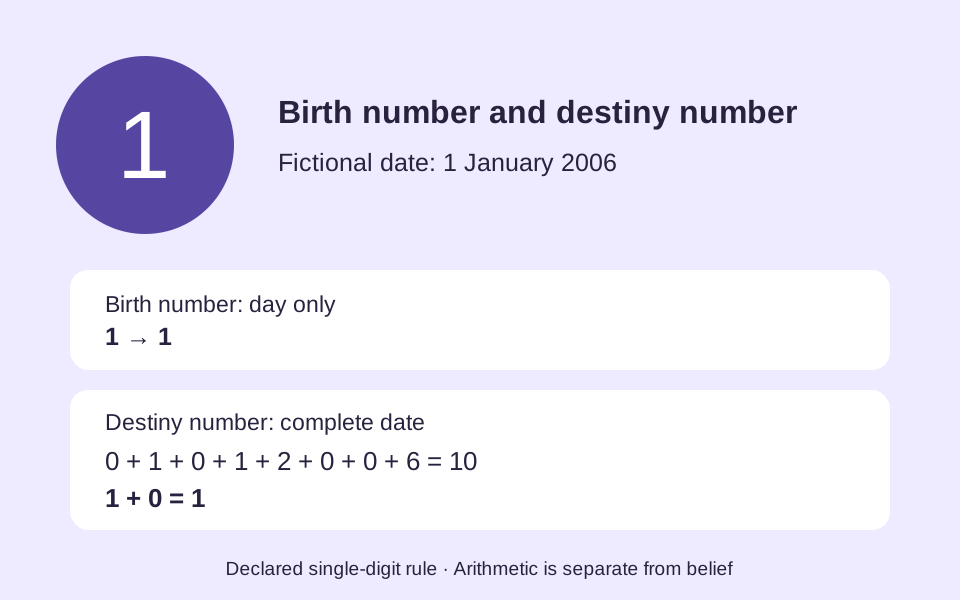
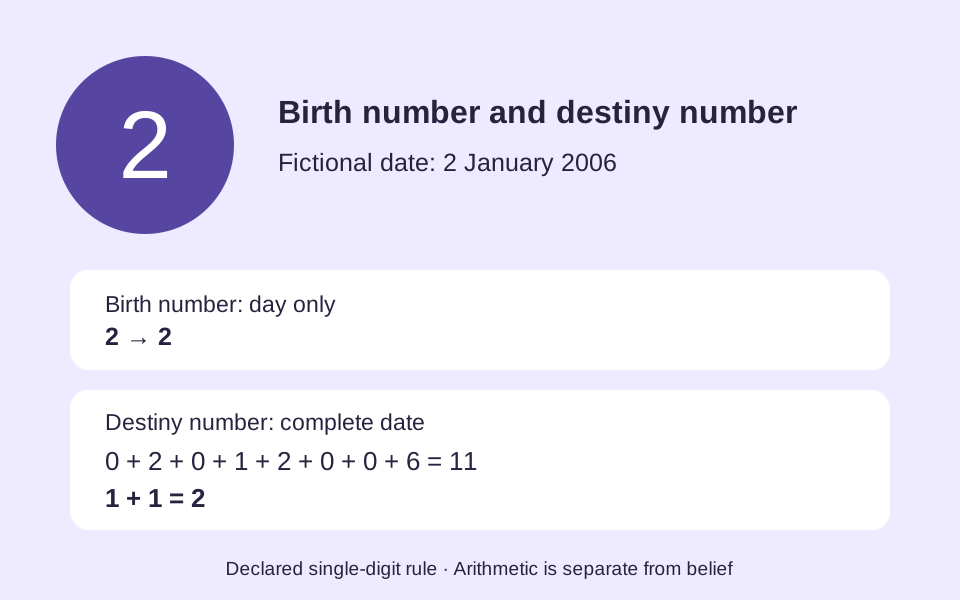
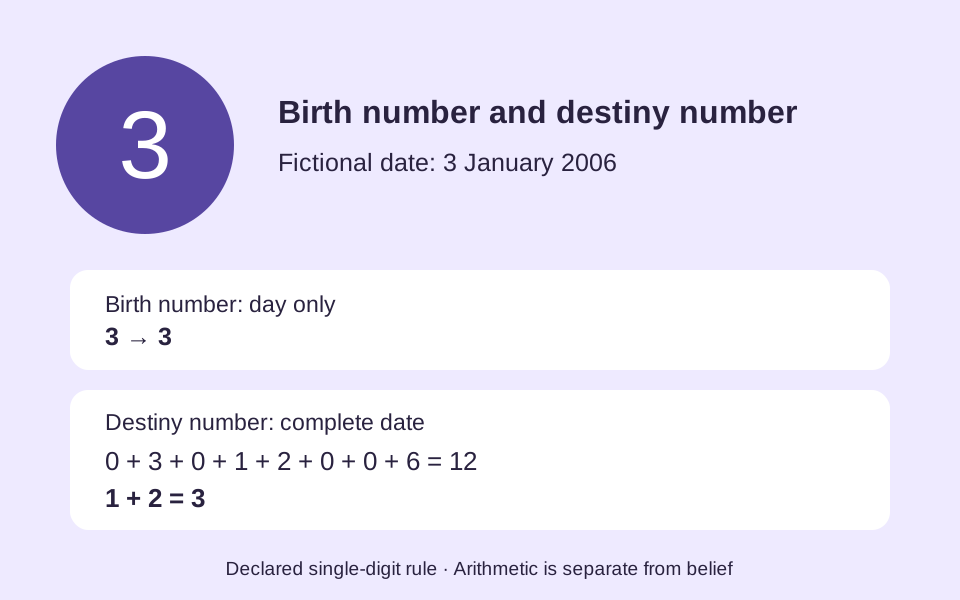
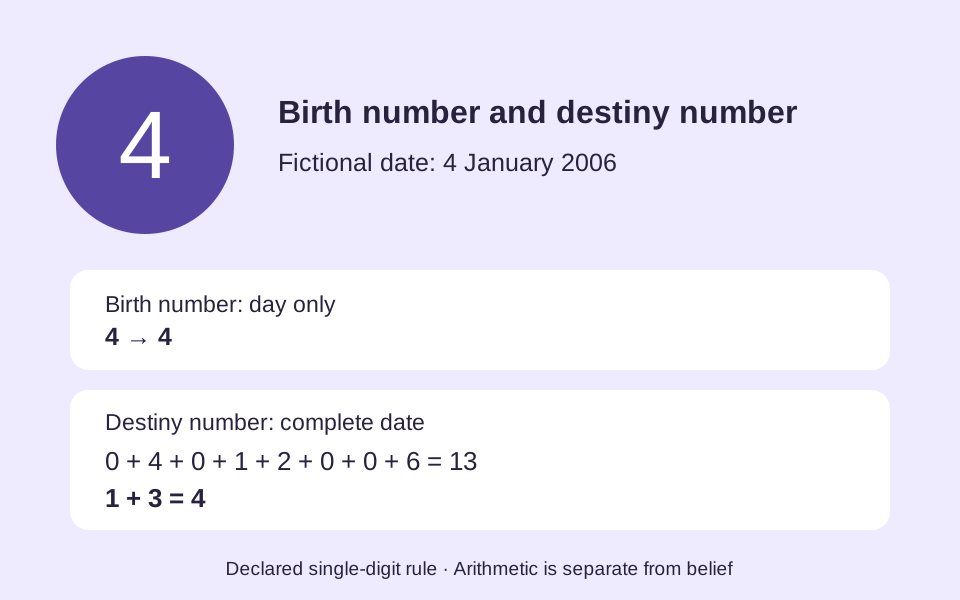
The calendar days that reduce to birth number 5 are 5, 14 and 23. The fifth is already one digit. The fourteenth gives 1 + 4 = 5, while the twenty-third gives 2 + 3 = 5. There is no thirty-second day of a month to add to this list. Use a real valid day when demonstrating the procedure.
Only the day is included in this calculation. Someone born on 14 March and someone born on 14 November have the same reduced day number, although the complete-date results can differ. Keep the original day visible if comparing compound-number interpretations. Sharing a reduced result is an arithmetic relationship. It does not prove shared temperament, equivalent opportunities or an inevitable preference for the same lifestyle.
Destiny number 5 from a complete date
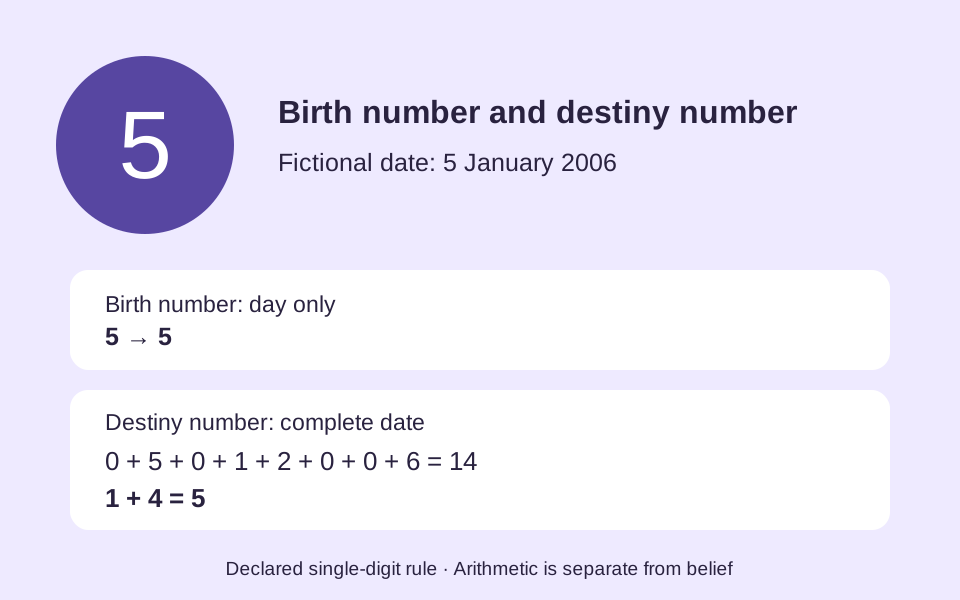
Take the fictional date 5 January 2006. Written as 05-01-2006, it gives 0 + 5 + 0 + 1 + 2 + 0 + 0 + 6 = 14. Reduce the total through 1 + 4 = 5. The date-based destiny number is therefore 5. The birth number is also 5 in this example, because the day itself is the fifth.
The equality of the two results is not required. A different day can belong to a full date whose sum reduces to 5. Record every digit and the intermediate total so that another person can reproduce the answer. This transparent arithmetic should remain separate from the cultural interpretation. Adding the date correctly does not demonstrate that it can forecast a person's experiences or explain why a particular event occurred.
A different destiny number with birth number 5
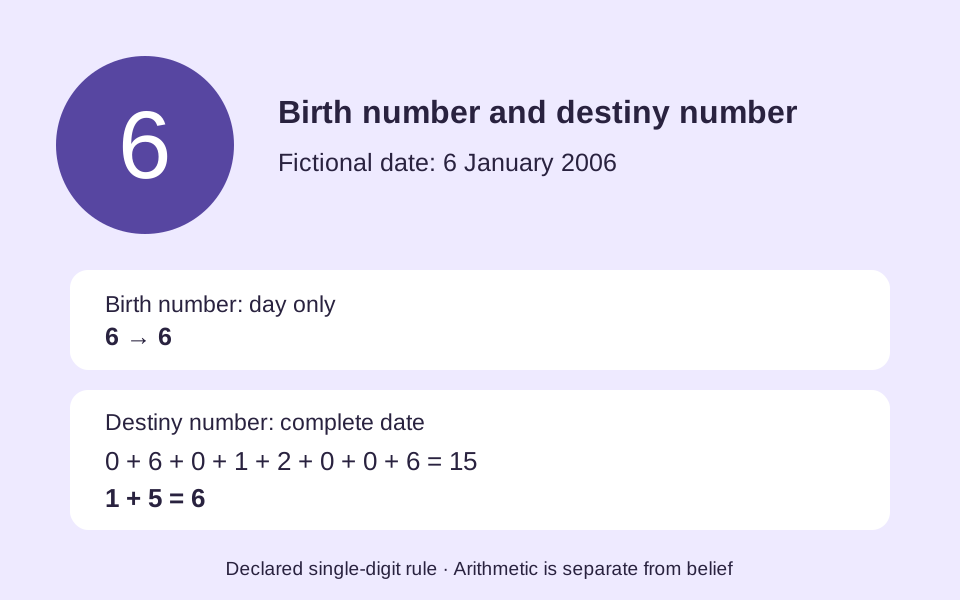
The fictional date 5 February 2006 retains birth number 5. Its full-date sum is 0 + 5 + 0 + 2 + 2 + 0 + 0 + 6 = 15, followed by 1 + 5 = 6. The result is birth number 5 and destiny number 6 under the rule used here. Notice that the repeated digit 2 is included twice.
Symbolically, someone might discuss variety alongside care and responsibility. That does not establish a conflict between freedom and family. A person can value both, and the workable arrangement depends on their actual circumstances. Ask what kind of change is desired and which commitments are shared. The answer requires conversation and practical information; it cannot be read automatically from the pair of reduced digits.
Check the definition before comparing calculators
Some sources use destiny or expression number for a result calculated from letters in a name. Others use destiny for the full-date Bhagyank. A calculator may also retain selected double-digit totals instead of reducing every total to a single digit. These differences should be declared rather than hidden behind a final label.
This guide consistently uses the reduced day and the reduced complete date. It does not need a name spelling, time of birth or place for those two calculations. If another method gives a different result, compare the inputs and rules first. Do not combine a name-based answer with a date-based interpretation without saying so. Clear definitions make the reading understandable even to a reader who does not accept its symbolic claims.
Freedom includes the effects of a choice
Freedom can mean having room to choose, explore and decline. It does not mean that a personal preference automatically overrides another person's agreement or responsibilities. A number 5 description should not become an excuse for changing a shared arrangement without notice. The practical question is how much of the choice belongs to you and who else is affected.
Suppose you want to try a new schedule for a personal hobby. That may be straightforward. If the change affects shared work or care responsibilities, discussion is needed. State the desired change, identify its impact and ask what arrangement would work. The symbolism of freedom can support that reflection, but it does not grant permission on behalf of other people or erase a commitment already made.
Curiosity and the difference between trying and committing
Trying something briefly is different from promising to continue it. Problems arise when those expectations are unclear. Someone may believe they are joining an experiment while another person believes they have accepted an ongoing responsibility. Number 5 language about exploration is useful only if it helps make that distinction explicit.
Before starting a small activity, say whether it is a trial, what it will involve and when it will be reviewed. If you decide not to continue, explain that within the arrangement you agreed. This makes experimentation more considerate and easier to evaluate. A desire for novelty need not be denied, but neither should it be used to disguise uncertainty about a commitment that affects others.
Adaptability is more specific than liking every change
An adaptable response involves understanding what changed and adjusting an action accordingly. It is not a duty to welcome every disruption or pretend that an inconvenient situation is exciting. A person may adapt effectively while still explaining the cost of the change. Numerology cannot determine the correct response without knowing the circumstances.
For reflection, recall an unexpected alteration to a plan. What information did you need, what could stay the same and what had to be revised? Perhaps the most useful response was asking one clear question. Perhaps it involved keeping a familiar routine while changing one part. These details reveal an actual process of adaptation. They are more informative than declaring that a number 5 person naturally thrives on uncertainty.
A fictional example of testing a new method
Farah, a fictional student, wants a different way to organise revision notes. She is tempted to replace everything with a new format after seeing an appealing example. Instead, she tries the format on one topic and checks whether she can find the important information later. Some features help; others create extra work.
She keeps the useful parts and leaves the rest. This is an editorial example of experimentation with a review point, not a testimonial about numerology. Number 5 symbolism could make the idea of trying something new memorable. The actual improvement comes from comparing the method with the task. A new arrangement is not automatically better merely because it feels unfamiliar, and an old one is not automatically a restriction.
Novelty and the unfinished middle
The beginning of a project can feel more exciting than the stage where details must be resolved. That experience is not unique to a particular birth number. If a number 5 reading raises the issue, ask what specifically makes the middle difficult. The answer might be an unclear goal, a missing skill, limited time or a genuine change in priorities.
Choose whether to finish a smaller version, pause deliberately or end the project with a clear explanation. Each can be a reasonable decision. Continually starting replacements without reviewing the earlier work makes it harder to learn what happened. Reflection becomes useful when it distinguishes an intentional change from avoidance, while allowing honest reasons for stopping rather than treating every unfinished task as proof of a symbolic weakness.
Variety within a dependable routine
A routine and variety do not have to cancel each other. Someone can keep a regular time for creative practice while trying different subjects within it. A team can maintain a clear handover while experimenting with how a result is presented. Stability can create room for exploration by making some expectations predictable.
Identify which part of an activity needs consistency and which part can vary. You may discover that freedom feels more useful when a boundary is clear. The number 5 theme can encourage this distinction, but it does not establish a universal balance. Review what works for the actual people involved. A flexible arrangement should remain understandable rather than requiring everyone to guess which commitments will change next.
Career questions about learning and movement
Searches for number 5 career often produce occupations associated with travel, sales or communication. A date cannot measure suitability for those roles. Real work contains training requirements, repeated tasks and responsibilities that may differ from its public image. Enjoying novelty does not tell you whether the daily work of a particular role will suit you.
Look at completed experiences. Did you enjoy learning unfamiliar information, explaining options, working with changing requirements or connecting ideas across subjects? Which conditions helped you do the work reliably? Discuss those observations with people who know the role and consider actual opportunities. Numerology may provide a theme for questions, but it should not replace evidence about skills or become the only reason to change a career plan.
Travel symbolism and practical planning
Movement is sometimes used as a symbolic theme for number 5. That does not mean a person must travel frequently to fulfil a destiny or that a journey made on a preferred date will have a particular outcome. Travel involves real arrangements, permissions, time and the needs of the people involved.
If the theme encourages you to explore, consider a manageable way to learn about an unfamiliar place or idea. Exploration can include reading, a local activity or a new conversation; it need not require major expense or disruption. Necessary journeys should not be delayed because a date lacks a preferred digit. Keep the cultural interest separate from decisions that depend on actual schedules and practical requirements.
Communication when plans change
A change feels different when it is communicated clearly. Tell affected people what is changing, what remains agreed and what response you need from them. A vague announcement that you want more freedom may leave others unsure whether their responsibilities have also changed. Specific language allows them to respond to the actual proposal.
If you have already made a commitment, acknowledge it rather than pretending the earlier conversation never happened. You may still ask for a revision. The other person may also need time or a different arrangement. A number 5 reading should leave room for that negotiation. It should not turn spontaneity into a reason that everyone else must absorb the consequences without discussion.
Relationships and room for individuality
People can want closeness and personal space at the same time. The useful question is what those words mean in a particular relationship. Time alone, separate interests and shared plans need clear expectations. A number associated with freedom cannot determine which arrangement another person should accept.
Ask about preferences directly rather than guessing from a chart. Explain what helps you feel comfortable and listen to the other person's account. A request for space is not automatically rejection, and a request for clarity is not automatically control. Those judgments require context. Numerology cannot establish whether a relationship is suitable or excuse dismissing a concern. The quality of the actual conversation matters more than a favourable pairing description.
Compatibility with numbers 1 through 9
There is no evidence-backed compatibility score for number 5 and another reduced digit. Symbolically, 1 may prompt discussion about initiative, 2 about consultation, 3 about expression and 4 about structure. With another 5, the topic might be how shared enthusiasm becomes an arrangement both people can rely on. These are prompts, not predictions.
With 6, 7, 8 and 9, possible topics include care, solitude, responsibility and wider commitments. Those qualities are not restricted to those numbers, and different traditions describe them differently. Look at how people actually handle a changed plan, a refusal or a competing need. A chart should not pressure someone to remain in an unwanted arrangement or dismiss a person because an online table calls the numbers incompatible.
Children, exploration and the right to settle
A child given a number 5 label should not be expected to be adventurous all the time. They may want to repeat a familiar activity or prefer a quiet setting. Repetition can be part of learning, and caution can reflect a sensible need for information. A symbolic profile should not make those preferences seem wrong.
Offer manageable choices and ask what the child wants to try. Make it clear whether an activity is a short experiment or an ongoing responsibility. Let interests develop rather than continually pushing novelty. Actual comfort, learning needs and the child's own account matter more than a description that predicts restlessness. Numerology can remain an optional family interest without defining which experiences a child must enjoy.
Mercury as a traditional association
Some Indian numerology practitioners connect number 5 with Mercury. This is a symbolic correspondence within their framework. It is not evidence that the planet causes a person's communication style, appetite for change or success in a particular field. Other numerology sources may explain the number without the same planetary language.
Identify the tradition when reading a claim and separate its cultural vocabulary from demonstrated facts. This guide does not prescribe a gemstone, purchase or ritual as a requirement for making the number favourable. It also does not advise changing official details. A reader can understand a correspondence without accepting predictions attached to it. The calculation remains a declared arithmetic procedure, while the further meaning remains interpretive.
Preferred dates, colours and repeated fives
A colour or date may be meaningful as a personal reminder. Repeated sequences such as 55 or 555 may also be discussed in other symbolic traditions. None of these observations changes the calculation of a birth or destiny number. Seeing a sequence does not prove that a change is required or that a particular opportunity will succeed.
If you choose a reminder, decide what action it represents in your own words. It might prompt you to ask whether an old routine still serves its purpose. The answer should come from reviewing the routine, not from the appearance of the digit. Do not ignore deadlines, delay necessary appointments or make repeated purchases to obtain a symbolic arrangement. Meaning can be voluntary without becoming an instruction that overrides practical information.
A small experiment with a clear end
Choose one low-impact activity and write a question you want the experiment to answer. For example, will a different note format make information easier to find? Define what you will try and how you will compare the result. Keep the test small enough that a disappointing result does not create a major burden for you or others.
Afterwards, record what helped, what did not and what you would change. You may return to the old method, combine useful parts or continue experimenting. None of those outcomes proves or disproves your identity as an adventurous person. The exercise is useful because it turns curiosity into a question with observable answers, rather than treating every new choice as automatically better.
When flexibility becomes an unclear promise
Review a recent situation where someone did not know what to expect from you. Was the commitment itself vague? Did you change your mind without explaining the effect? Or did the other person assume more than you had agreed? These possibilities need different responses. A broad label such as unreliable can hide the information needed to improve the arrangement.
Write what was actually said and which expectation remained unstated. If you discuss it again, focus on a clearer agreement rather than defending a numerology description. The goal is not to remove all freedom from the relationship or task. It is to make the boundary between choice and commitment understandable to everyone involved. That clarity can support both experimentation and trust.
Keep a record of the experiences that do not fit
If a profile says number 5 dislikes routine, note the routines you genuinely enjoy as well as those you find restrictive. Ask what distinguishes them. Perhaps one gives you useful support while another serves someone else's unspoken expectation. The difference may be purpose, control or context rather than the presence of repetition itself.
Broad personality descriptions can feel accurate because people select examples that match them. Recording contrary examples helps keep the reflection honest. You can enjoy symbolic language without requiring it to explain everything. A useful account of your experience should be able to become more precise. It should not treat every disagreement with a profile as further evidence that the profile must secretly be correct.
Privacy and respectful curiosity
Curiosity about someone does not create permission to publish their full date of birth or analyse their personal choices publicly. Use fictional dates when demonstrating the calculation. If another person wants a reading, let them decide what they wish to share and whether they want to discuss the interpretation.
Ask about their actual interests instead of assuming that a number reveals them. Someone assigned number 5 may enjoy stability, dislike travel or prefer a familiar group. Their own account is more direct information than your expectation. Respect includes allowing them to reject a label without argument. A cultural interest should make conversation more considerate rather than turn another person's life into an example collected to support a theory.
Questions for an open and grounded reading
Can you show the reduced day and the complete-date sum separately? Have you checked what another source means by destiny? What kind of variety do you want, and what commitments would a proposed change affect? Those questions move beyond a broad promise of freedom toward decisions that can be discussed clearly.
Number 5 can be used as an image of exploration, but exploration does not require rejecting every routine or promise. You can try something new, keep what works and explain changes responsibly. The symbol remains optional. Your actual choices belong within real circumstances, alongside other people's needs and the freedom to discover that a familiar arrangement is still the best fit.
Further reading
Official resources and related guides for the concepts discussed above. Check the selected tool for current capabilities and terms.
Take the next idea into a conversation
Explore Didloo for personal chats, creative sharing and linked desktop messaging. Business messaging has its own approved API workflow.