Astrology
Numerology Number 6: Birth Number, Destiny Number and the Meaning of Care
Numerology number 6 is frequently associated with care, responsibility and the wish to make shared surroundings comfortable. These themes may feel familiar, but they do not establish that someone must always look after others. A reduced date cannot determine a person's role in a family, measure their kindness or predict whether a relationship will succeed. Care is expressed through real actions and agreements, not automatically supplied by a calendar digit. This original guide explains both birth number and destiny number. Birth number, or Mulank, uses the day of the month. Destiny number, or Bhagyank in the date-based convention used here, uses every digit of the complete date. We reduce both results to one digit. Interpretations are variable cultural beliefs; the practical examples are fictional reflection prompts, not observed numerology outcomes or promises about health, money, marriage or future events.
What care means within a symbolic reading
Contemporary numerology practitioners often use number 6 to discuss support, affection and responsibility. A useful reading begins by making those broad words specific. Preparing something for another person, keeping an agreement and asking whether help is wanted are different forms of care. None is automatically appropriate in every situation, and a favourable description does not answer what the other person actually needs.
Think of care as a conversation rather than a permanent identity. The person offering help has limits; the person receiving it has preferences and the right to decline. A number 6 theme can prompt reflection about those boundaries. It becomes restrictive when it implies that someone must earn approval by continually giving or that refusing an unreasonable request contradicts the kind of person they are supposed to be.
Birth number 6: days 6, 15 and 24
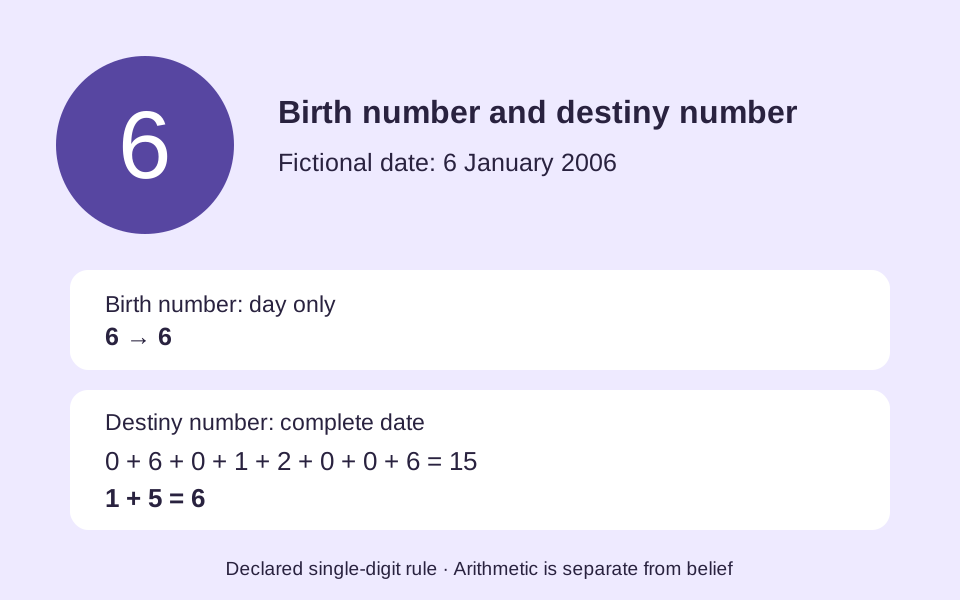
The calendar days that reduce to birth number 6 are 6, 15 and 24. The sixth needs no reduction. For the fifteenth, 1 + 5 = 6. The twenty-fourth gives 2 + 4 = 6. The month and year do not enter this particular operation. Write the original day alongside the reduced answer when explaining the calculation.
Other sources may interpret 15 and 24 as compound numbers as well. That is an additional convention, not a reason to hide the single-digit method. Sharing a reduced day does not mean people share the same experiences or responsibilities. A person born on the fifteenth of one month and another born on the same day elsewhere can differ in countless ways that the arithmetic does not describe.
A full-date example for destiny number 6
Take the fictional birth date 6 January 2006. In the form 06-01-2006, the digits give 0 + 6 + 0 + 1 + 2 + 0 + 0 + 6 = 15. Reduce once more: 1 + 5 = 6. Its date-based destiny number is 6. The birth number is also 6 because the day is the sixth.
Notice that the digit 6 appears twice in the full sum and must be included both times. Repeated values are separate parts of the recorded date. Retaining zeros also makes the example easier to check against the original notation. Correct addition is verifiable; a symbolic claim about a life path is a different kind of statement. Keep the distinction visible instead of treating a correct total as proof of a prediction.
A different destiny result from the same birth day
For the fictional date 6 February 2006, the birth number remains 6. The full-date sum becomes 0 + 6 + 0 + 2 + 2 + 0 + 0 + 6 = 16, then 1 + 6 = 7. The result is birth number 6 with destiny number 7. Use an unambiguous written month when sharing the example so that the input is clear.
A symbolic discussion might compare care with reflection or privacy. Those themes need not conflict. Someone can care deeply about others and also need time alone. Whether a particular arrangement works depends on communication and circumstances. The pair of digits does not establish a hidden problem, excuse ignoring a need or prove what the person must want. Ask them directly rather than interpreting their life from the calculation alone.
Which definition of destiny is being used?
Some numerology traditions use destiny or expression number for a result derived from a name. Other writers use destiny for the full-date Bhagyank, as this article does. A difference in the final answer may come from different questions rather than an error. Check the inputs, letter table if relevant and reduction rule before comparing interpretations.
This guide uses only the reduced day and reduced complete date. It does not derive these results from a name, birth time or place. Selected master numbers are not retained in its final single-digit result. These limits make the procedure reproducible. They do not mean that every numerology school follows the same practice. Keep each result with its method rather than mixing favourable claims from several unrelated systems.
Responsibility should have a clear boundary
Responsibility can mean knowing which part of a shared task you agreed to handle. It does not mean absorbing every unfinished task because you are described as caring. An arrangement becomes difficult when everyone assumes that one person will notice, organise and complete whatever remains. A number label should not justify that expectation.
Write down what is included in a responsibility and what depends on someone else. Ask whether the people involved understand the same agreement. If the workload changes, discuss it openly instead of relying on the most accommodating person to keep compensating. Number 6 symbolism can prompt this review, but the fairness of the arrangement must be assessed through actual work and consent rather than a chart.
Helping and asking what help is wanted
An offer of help may be thoughtful without matching the other person's need. Someone may want an explanation rather than a completed task, or company rather than suggestions. Asking first can prevent support from becoming an unwanted takeover. Numerology cannot identify the right kind of help without the person's own account.
For reflection, recall a recent offer you made. What did the other person request, and what did you assume? Did you allow them to decline or suggest something different? These questions focus on behaviour that can be examined. A generous intention matters, but it does not automatically make the action useful. A careful number 6 reading leaves room for the recipient's independence as well as the helper's desire to contribute.
Care is not control
It is possible to explain a rule as being for someone's benefit while giving them no meaningful choice. A caring label does not settle whether that rule is appropriate. The distinction depends on the relationship, the decision and the person's ability to express a different preference. A numerology profile cannot grant authority over someone else's ordinary choices.
Consider a fictional adult who reorganises another adult's workspace without asking. The intention may be to make it comfortable, but the change can make familiar information hard to find. The useful response is to acknowledge the effect and ask about the person's preferences. Describing the action as number 6 care should not prevent an apology or become a reason that the recipient must appreciate an unwanted intervention.
A fictional household example
Neha, a fictional resident in a shared home, usually remembers the household supplies. Others assume she enjoys managing everything because she is organised and attentive. She begins missing time for her own activities. Rather than treating this as a permanent family role, the residents list the tasks and agree on a clearer division.
The example illustrates a review of responsibility. It does not show that numerology caused the problem or solved it. A number 6 theme can make the discussion memorable, but the change comes from making invisible work visible and sharing it by agreement. The person who notices a need is not automatically obliged to own it indefinitely. Care can include asking others to participate and accepting their different ways of completing a task.
Receiving support without losing independence
A person who frequently helps others may find it awkward to ask for help. That pattern is not established by a birth number, but it can be explored if it fits actual experience. Receiving support does not cancel generosity or imply failure. It can make a shared arrangement more balanced by allowing information and effort to move in both directions.
Try making one clear request rather than waiting for someone to guess. Explain what is needed, what would be useful and whether there is a time constraint. The other person can then respond to an actual proposal. If they cannot help, the answer provides information for the next decision. A symbolic identity of being the dependable helper should not require pretending that your own needs never exist.
Beauty, comfort and actual use
Number 6 descriptions sometimes include an interest in attractive or harmonious surroundings. An appealing room can still be inconvenient for the people using it. Ask what comfort means to the occupants rather than assuming that one style serves everyone. A quiet reading place, clear work surface and room for a shared activity may require different arrangements.
If you enjoy improving a space, identify its purpose and ask who will use it. Try a reversible change and review the result. The useful part is the observed effect, such as a clearer path or easier storage. It is not proof that a birth-date digit produces taste or that a particular decoration controls the household's future. Preferences can differ without one person being less caring or less harmonious.
Career questions about support and responsibility
Searches for number 6 career often point toward helping professions or design-related work. A reduced date does not establish aptitude, training or readiness for responsibility. Many roles involve support, coordination and attention to users. Their actual duties and required skills should be understood before interpreting a symbolic match as a recommendation.
Look at tasks you have completed. Did you enjoy clarifying a need, maintaining an arrangement, explaining options or improving a space? Which tasks required more preparation or left you overextended? Use those observations when discussing training and opportunities. Numerology can offer a theme for reflection, but it should not replace evidence about competence or become the only reason to choose, reject or leave a role.
Standards, perfection and the fear of disappointing others
Wanting something to be good can gradually become a demand that it must never disappoint anyone. That demand is difficult to satisfy because people have different expectations. A number 6 profile should not turn every imperfect result into a failure of care. Ask which standard was actually agreed and whether the available resources matched it.
For a small task, define what is necessary, what would be useful and what is optional. Complete the necessary part before adding refinements. If someone wants more, discuss the additional work rather than assuming it must be absorbed silently. This makes quality a clear conversation. It also prevents a flattering identity of always doing everything beautifully from making an ordinary limit feel unacceptable.
Relationships and shared expectations
Affection does not tell two people automatically how responsibilities should be divided. They may have different habits, workloads or ideas about what support looks like. A number 6 label cannot determine who should organise, provide reassurance or compromise. Those roles should remain open to discussion rather than assigned as a matter of destiny.
Ask what each person considers a reasonable commitment and how changes should be raised. Check whether appreciation is accompanied by a fair division of work. A caring relationship includes room to say no and to ask for help. These are reflection prompts, not a test of compatibility. A reduced date cannot establish that a relationship is healthy or justify ignoring a person's stated concern because a chart sounds favourable.
Compatibility with numbers 1 through 9
There is no reliable relationship score derived from pairing number 6 with another digit. Symbolically, 1 can prompt discussion about independence, 2 about consultation, 3 about expression, 4 about routines and 5 about variety. With another 6, the question might concern how both people offer and receive support without competing to be indispensable.
With 7, 8 and 9, possible topics include privacy, responsibility and wider commitments. These themes are optional and are not exclusive to those numbers. Traditions also describe the digits differently. Look at actual behaviour, expectations and the response to a boundary. No pairing should pressure someone to accept a role they do not want or become a reason to dismiss a person before listening to them.
Family labels and the child expected to help
A child described as number 6 should not become the automatic helper for every adult or sibling. Being considerate does not mean taking on responsibilities beyond an appropriate role. Children need time to learn, play and express preferences that may not fit a story of constant care. A symbolic reading should not make their value depend on how useful they are to others.
If the family enjoys numerology, keep the meaning optional. Praise a particular helpful action without turning it into a permanent assignment. Ask what the child wants to try and share responsibilities clearly. Notice when a child is agreeing out of pressure rather than genuine willingness. Their actual needs and developing interests matter more than a favourable description attached to a birthday.
Venus as a traditional correspondence
Some Indian numerology practitioners associate number 6 with Venus. This is a symbolic correspondence within their framework, not evidence that a reduced date determines affection, appearance or a person's preferences. Other sources may use a different explanation. Identify the tradition before treating its vocabulary as a universal statement about people.
Understanding a correspondence does not require accepting every prediction attached to it. This article does not prescribe a purchase, gemstone or ritual as a way to guarantee harmony. It does not recommend changing official personal information. A cultural association can be studied while its limits remain clear. The calculation is transparent arithmetic; the further meaning is interpretation rather than a demonstrated causal explanation.
Colours, dates and optional reminders
A preferred colour or date can be personally meaningful. It may mark a celebration or remind someone of a quality they value. It does not prove that an arrangement will bring love, financial success or protection. Keep the choice optional and avoid making other people responsible for maintaining a symbolic rule they did not agree to follow.
For a number 6 reflection, a reminder might prompt a simple question: have I asked what kind of help is wanted? That action can be evaluated directly. Its usefulness does not depend on a particular colour or digit. Necessary appointments, deadlines and essential care should not be delayed to fit a preferred number. Symbolism can accompany thoughtful action without becoming a barrier to it.
Repeating sixes are a different subject
Noticing 66 or 666 is different from calculating a reduced day or full date. Various traditions attach meanings to repeated sequences, and some attach fearful meanings. Seeing the sequence does not change your recorded birth date or establish that something harmful is about to happen. This guide does not treat such observations as instructions or forecasts.
If a sequence attracts your attention, you may choose a neutral reflection prompt and then continue with the actual task. There is no need to search for further signs before making an ordinary decision. Keep the distinction between a meaning you voluntarily assign and a claim that the observation predicts events. The former can be a personal interest; the latter requires evidence that a coincidence by itself does not provide.
A practical support exercise
Choose one recent occasion when you helped someone. Write what they requested, what you offered, what was agreed and what happened. Include whether the help was useful to them and whether the arrangement was workable for you. Ask a willing person for feedback rather than assuming that silence means satisfaction.
Now identify one change you could make next time. It might be asking first, offering a smaller commitment or clarifying when you will be available. The exercise examines a real process rather than your fit with a personality profile. A result that contradicts the number 6 story is still useful information. Reflection should help you understand what happened, not force every outcome into proof that you are naturally destined to care for others.
Make invisible work visible
Some shared work is easy to count, while planning and remembering remain unnoticed. List the steps behind a recurring task, including checking supplies, arranging a time and explaining changes. Ask who currently handles each step and whether everyone understood that arrangement. The list is a starting point for discussion, not a score used to win an argument.
If a responsibility needs to move, discuss the information and authority needed to complete it. A handover is clearer when the new person can ask questions and make reasonable choices. This practical review can support fairness without relying on numerology. Number 6 symbolism may draw attention to care, but an actual arrangement becomes useful through explicit agreements and participation from the people involved.
Keep the examples that challenge the description
Words such as caring, artistic or responsible can fit many people in some circumstances. Recognising yourself in them does not demonstrate that your date uniquely predicted a trait. Record moments when the description fits and moments when it does not. You may enjoy supporting a group while disliking a particular family role, or prefer a practical space over a decorative one.
Those differences deserve explanation rather than dismissal. A useful reflection becomes more precise when new information appears. It does not interpret every disagreement as another hidden sign that the original profile is correct. You can value the cultural vocabulary while declining to use it as a fixed identity or a basis for judging someone else's needs.
Privacy and respectful interpretation
Use fictional dates to explain the calculation. You do not need to publish a friend's full birth date or describe their private responsibilities to demonstrate a number. If another person wants to discuss numerology, let them decide what information to share and whether the interpretation interests them.
Ask about their preferences directly instead of assuming that a caring number means they will welcome another request. They may enjoy helping and still be unavailable. Respect includes accepting that answer without turning it into a failure to live up to their chart. A symbolic interest should leave people more room to explain themselves, not less.
Questions for a balanced number 6 reading
Can you reproduce the birth-day reduction and complete-date sum separately? Does another source use destiny for a name or a date? Which responsibility in your life is clearly agreed, and which has grown through assumption? What kind of support do you want to offer or receive? These questions connect the reading with information that can actually be discussed.
Number 6 can be an image of care, but real care includes choice, limits and attention to the person affected. You may keep the symbolism as a cultural interest without accepting a permanent role. A thoughtful reading leaves room to help, ask, decline and revise an arrangement while respecting both your own needs and those of other people.
Further reading
Official resources and related guides for the concepts discussed above. Check the selected tool for current capabilities and terms.
Take the next idea into a conversation
Explore Didloo for personal chats, creative sharing and linked desktop messaging. Business messaging has its own approved API workflow.