Astrology
Numerology Number 9: Birth Number, Destiny Number and Meaningful Contribution
Numerology number 9 is often associated with completion, compassion and concern for a wider group. Those themes can support an interesting cultural reading, but they do not establish that a person must sacrifice their own needs or take responsibility for every problem. A reduced date cannot measure kindness, predict life events or determine what someone owes to others. A useful explanation keeps choice and circumstances visible. This original guide covers both birth number and destiny number. Birth number, or Mulank, uses the day of the month. Destiny number, or Bhagyank in the date-based convention used here, uses every digit of the complete date. Both results are reduced to one digit. The interpretations are variable beliefs; the fictional examples and reflection exercises are original editorial suggestions rather than observed numerology outcomes or promises about health, relationships, income or the future.
Completion is a symbolic theme, not a final verdict
Contemporary numerology descriptions often use number 9 to discuss finishing a cycle and considering what follows. An ordinary editorial example is completing a project, handing over its useful parts and deciding which questions remain open. The image can prompt a review, but it does not establish that a particular chapter of someone's life must end because a digit appears.
Completion also has different meanings. A draft may be finished enough for feedback while still needing revision. A responsibility may end for one person and continue for someone else. Ask what is actually complete and what remains agreed. The number 9 theme becomes useful when it makes that boundary clear. It becomes unhelpful when it turns a symbolic idea into a command to abandon a relationship, task or commitment without considering the real situation.
Birth number 9: days 9, 18 and 27
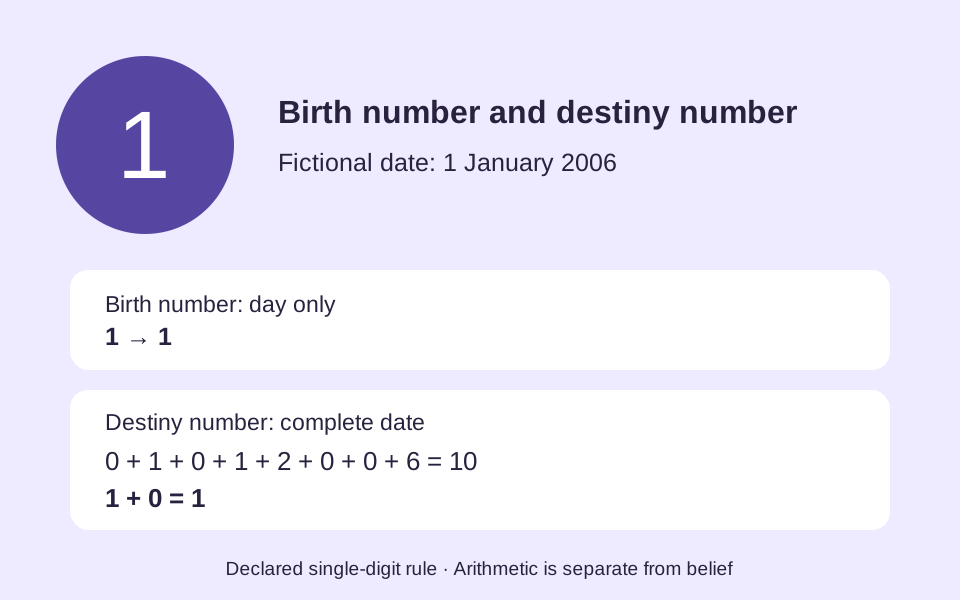
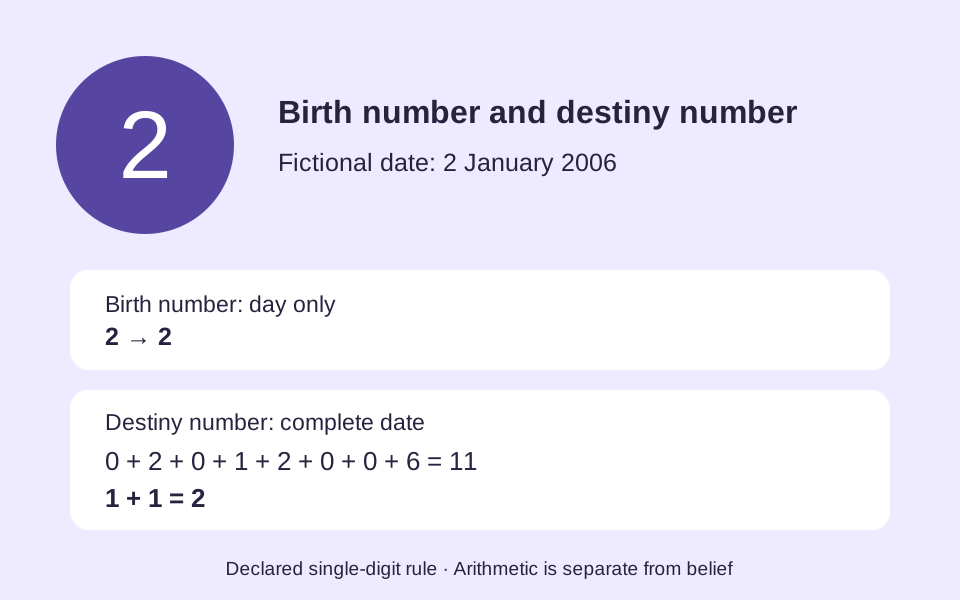
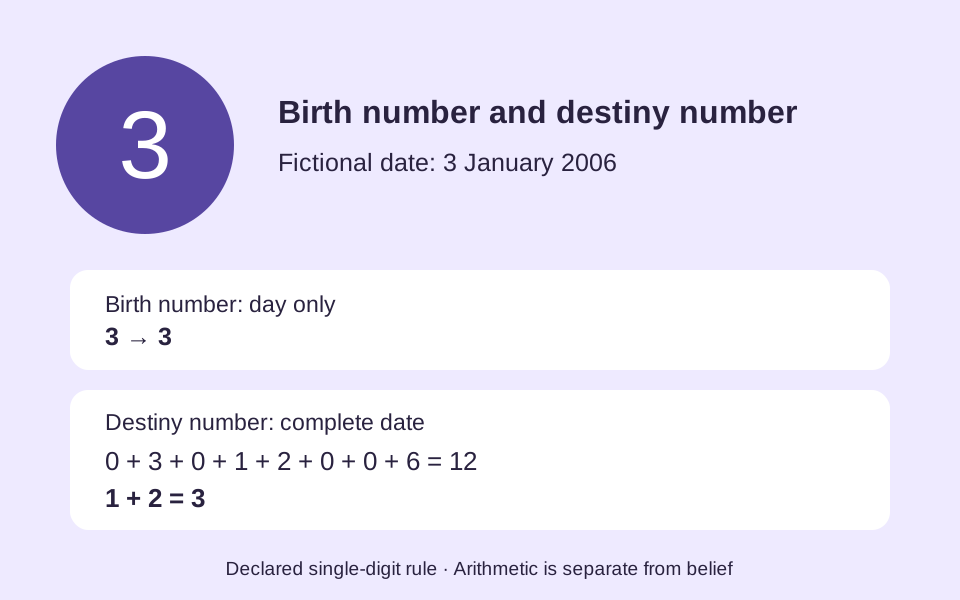
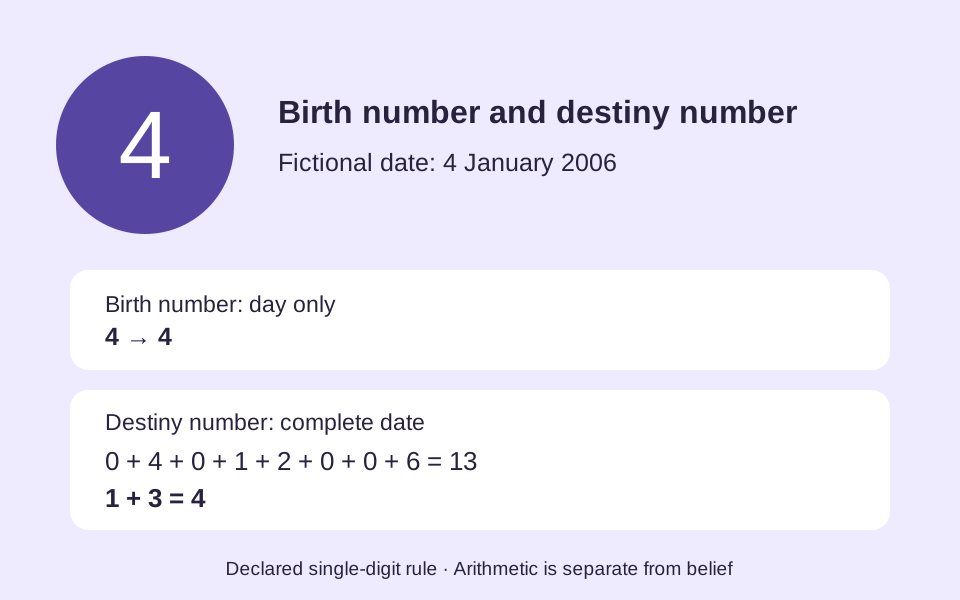
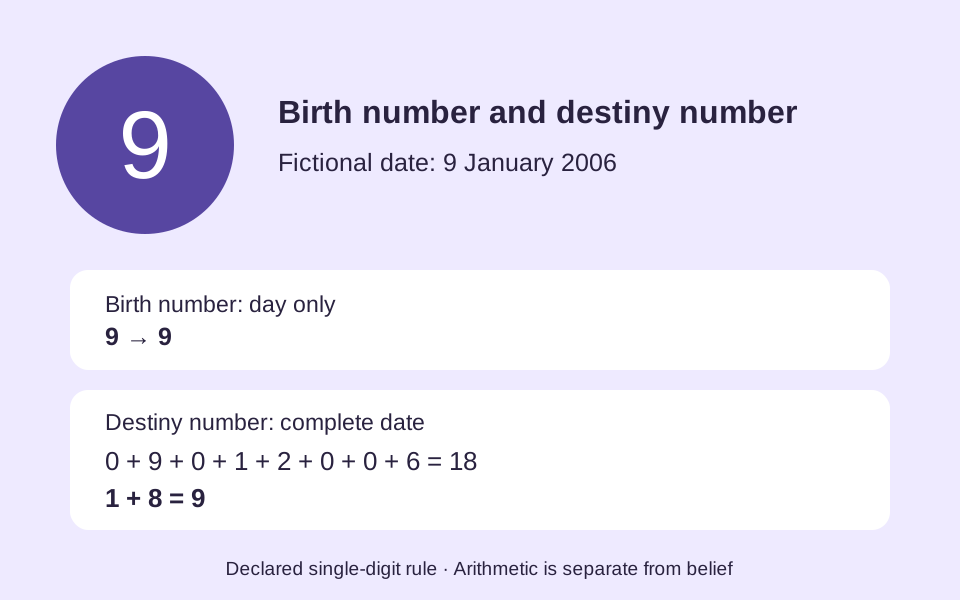
The calendar days that reduce to birth number 9 are 9, 18 and 27. The ninth is already one digit. For the eighteenth, 1 + 8 = 9. For the twenty-seventh, 2 + 7 = 9. Use only the day in this operation. Adding the month and year produces a different result and should not be labelled as the reduced birth day.
Some numerology sources discuss the compound numbers 18 and 27 separately. Keep those additional interpretations distinct from the simple reduction shown here. Sharing a final digit is an arithmetic category, not proof that people have the same character or obligations. Someone born on the eighteenth may prefer a different way of contributing than someone born on the twenty-seventh. Their own preferences and circumstances matter more than an assumed common destiny.
Destiny number 9 from a complete date
Take the fictional birth date 9 January 2006. In the form 09-01-2006, the digits give 0 + 9 + 0 + 1 + 2 + 0 + 0 + 6 = 18. Reduce the total through 1 + 8 = 9. The date-based destiny number is 9. In this example the birth number also gives 9, because the day is the ninth.
Write the whole date and the intermediate total when explaining the procedure. Leaving out a repeated value or the century digits changes the declared method. A correct calculation can be checked independently of the interpretation. It does not demonstrate that the person is unusually compassionate, has reached a spiritual stage or will experience a particular event. Those further ideas belong to a belief tradition and should not be disguised as arithmetic conclusions.
Birth number 9 with a different destiny result
For the fictional date 9 February 2006, the birth number remains 9. The full-date sum is 0 + 9 + 0 + 2 + 2 + 0 + 0 + 6 = 19. Reduce it through 1 + 9 = 10, then 1 + 0 = 1. This produces birth number 9 and destiny number 1 under the convention used here.
A symbolic conversation might compare completion with beginning. Those themes can coexist: finishing one task may create room for another, but no change is required simply to fit the story. Ask what is actually ending, what has been learned and whether a new commitment is wanted. The pair of digits cannot establish that an ending is inevitable or that a particular opportunity should be accepted without ordinary consideration.
Why destiny and life path need clear definitions
Some numerology systems use destiny or expression number for a result derived from letters in a name. Others use destiny for the full-date Bhagyank, as this guide does. Life path is another term often associated with a full-date calculation. The label alone is therefore not enough to identify the operation that produced the number.
This series consistently uses the reduced day and reduced full date. It does not use a name, birth time or place for those two results, and it does not preserve master-number totals in the final Bhagyank. If another calculator differs, inspect its inputs and rules before comparing interpretations. Clear definitions allow a reader to follow the method without requiring agreement with every symbolic claim attached to it.
Compassion begins with the other person's account
Compassion is often included in number 9 profiles. A practical question is whether you have asked what the person actually needs or assumed that you already know. Listening to their explanation can reveal a different problem from the one you imagined. A favourable label does not make your interpretation of someone else's experience automatically correct.
For reflection, recall a time when you offered support. What did the person request, what did you provide and how did they respond? They may have wanted information, company or space rather than a solution. The exercise examines the exchange rather than proving a trait. A useful reading leaves room for the person's independence and for the possibility that the most considerate response is to respect a refusal.
Contribution does not require unlimited sacrifice
A story of being naturally giving can become an expectation that a person should always take on more. Number 9 symbolism should not justify that pressure. Time, attention and responsibilities are limited, and an offer is more useful when its scope is honest. Declining an extra task does not establish a lack of compassion.
Describe what you can contribute and what you cannot. If the need is larger than your capacity, identify that fact rather than promising to cover the whole gap. Other people may participate, or the plan may need to become smaller. These decisions depend on the actual arrangement. A symbolic identity should not make one person responsible for solving every difficulty simply because they are described as humanitarian.
A wider perspective still needs specific facts
Thinking about a group can help reveal effects that an individual plan overlooks. It can also become vague if nobody asks who is included or what each person actually experiences. A phrase such as helping everyone may hide different needs and competing preferences. A number cannot determine the fair answer without that information.
For a small group task, ask who will use the result, who may find it inconvenient and whose input has not been heard. Keep assumptions separate from responses you have actually received. A wider perspective becomes practical when it improves the questions and makes overlooked effects visible. It is less useful when it becomes a claim that one person already knows what is best for an entire community.
A fictional community example
Leela, a fictional volunteer, proposes a shared noticeboard. She initially wants to fill it with all available information. After speaking with several users, she learns that the crowded arrangement makes urgent notices difficult to find. The group chooses a clear structure, removes outdated material and agrees who will maintain it.
The example illustrates contribution guided by users and ongoing responsibility. It is not a testimonial or evidence that a numerology result caused success. Number 9 symbolism can provide a memorable theme of service, but the practical improvement comes from asking, simplifying and agreeing on maintenance. A generous intention does not remove the need to check whether the result is actually useful to the people it is meant to help.
Endings need a clear handover
Finishing your part of a task may leave information that someone else needs. A useful ending states what has been completed, what remains and who has agreed to take responsibility next. Simply announcing that a chapter is closed does not transfer work or ensure that another person understands the arrangement.
For reflection, review a small project you recently left. Did others know where the useful material was, which decisions had been made and what was still uncertain? If not, a concise handover may help. Number 9 symbolism can prompt this review, but it should not be used to excuse disappearing from an agreement. Completion becomes more considerate when its practical effects are communicated rather than explained only through a personal story of moving on.
Letting go and avoiding a difficult conversation
Letting go can mean accepting that an approach no longer serves its purpose. It can also become a phrase used to avoid explaining a changed decision. The difference depends on the situation, what was agreed and who is affected. A birth number cannot establish which interpretation applies.
Ask what specifically you want to stop doing and what communication is still needed. You may decide to end a voluntary activity while providing a clear update and returning shared materials. That is different from treating a symbolic ending as permission to ignore obligations. A thoughtful number 9 reading leaves room for change without pretending that every practical responsibility disappears when someone feels ready for a new beginning.
Meaningful work and the right to choose a modest role
A desire to contribute does not require a public mission or a career described as humanitarian. Maintaining a useful record, explaining a process clearly and completing a shared task can all help others. A numerology profile should not make ordinary work feel insignificant because it lacks an impressive story.
Ask which effects of your work matter to you and what skills the task requires. You may value direct contact, careful preparation or making something easier for someone else. These preferences should be examined through experience rather than assigned by a date. Number 9 symbolism can inspire questions about purpose, but it cannot determine which role you must accept or how much of your life should be devoted to it.
Career questions without a prescribed destiny
Searches for number 9 career often produce lists connected with teaching, creative work or service. A reduced date does not establish qualifications, aptitude or the conditions in which someone will work well. The actual duties of a role can differ from its title and from the appealing image presented online.
Review tasks you have completed and the feedback you received. Which activities felt useful, which required more training and what responsibilities would you be prepared to accept? Discuss those observations with people familiar with the work. Numerology may supply a cultural theme, but practical information should remain central. A symbolic profile should not become the sole reason to pursue a profession, leave a role or reject an opportunity that otherwise suits you.
Boundaries when many people ask for help
When someone is known as helpful, requests can accumulate without any one person seeing the total. A number 9 reading should not turn that situation into proof that the person is destined to carry the burden. The practical issue is whether commitments are clear and capacity is understood.
List the tasks you have actually agreed to handle. Distinguish them from requests you have not accepted and assumptions made by others. If you need to revise an arrangement, explain the change and its effect rather than waiting until the work becomes impossible. A realistic boundary can make a contribution more reliable. It also leaves room for other people to participate instead of reinforcing a role in which one person must always rescue the group.
Appreciation without needing to be indispensable
It can feel good when others rely on your help. That feeling does not automatically mean the arrangement is balanced or useful. Someone may continue providing more than was requested because being needed has become part of their identity. Numerology cannot establish that motive, but a care-oriented theme can provide a reason to examine it honestly.
Ask whether the other person can decline, choose a different method or complete the task independently. Can you support that choice without treating it as rejection? A useful contribution may eventually make your continued involvement unnecessary. That can be a successful outcome. Number 9 symbolism should leave room for helping someone gain independence rather than requiring a permanent role as the person who provides the answer.
Relationships and the expectation of forgiveness
Some profiles connect number 9 with generosity or understanding. Those words should not pressure someone to dismiss a concern, forgive on demand or remain in an arrangement they do not want. A symbolic description does not decide what a person must accept. Their actual experience and boundaries matter.
In a relationship, discuss what happened, what each person understands and what would need to change. The willingness to listen does not require agreeing with every explanation. These are conversation prompts, not a relationship assessment or a prediction. A favourable chart cannot establish that a partnership is healthy, and a number associated with compassion should not be used to silence a refusal or minimise the effect of someone's behaviour.
Compatibility with numbers 1 through 9
There is no evidence-backed compatibility score obtained by pairing number 9 with another reduced digit. Symbolically, 1 may prompt discussion about beginning and completion, 2 about consultation, 3 about expression, 4 about structure and 5 about variety. These are optional themes rather than measured outcomes or rules for selecting a partner.
With 6, 7 and 8, one might discuss care, privacy and responsibility. With another 9, the question might concern balancing wider commitments with the needs of the relationship itself. The qualities occur across all number labels and vary between traditions. Actual treatment, shared expectations and the response to a boundary provide more direct information. No chart should pressure someone to accept a role or reject another person without listening.
Family roles and the child expected to understand everything
A child described as number 9 should not be required to be endlessly generous, mature or understanding. Children may need attention, want a turn or struggle to share. Those experiences should not be treated as failures to live up to a symbolic identity. A birth date does not assign a permanent role of family peacemaker.
If the family enjoys numerology, keep the description optional. Praise a specific considerate action without expecting the child to surrender every preference. Offer appropriate choices and support their actual interests. The child can care about others and still need care themselves. Their own account is more important than an adult interpretation that predicts they must always see the bigger picture.
Mars and differences between traditions
Some Indian numerology practitioners associate number 9 with Mars. Other contemporary descriptions emphasise completion or compassion through different symbolic frameworks. These meanings should be attributed rather than blended into a claim that every tradition teaches the same thing. A correspondence is not evidence that a reduced date determines aggression, courage or a person's future.
This guide does not prescribe gemstones, rituals, repeated purchases or changes to official personal details. A reader can study traditional associations while questioning predictions made in their name. Understanding the vocabulary does not require accepting a fixed verdict about character. The calculation remains transparent, while the symbolic meaning remains a cultural interpretation rather than an astronomical explanation of an individual's choices.
Colours, preferred dates and repeated nines
A colour or chosen date can carry personal or family meaning. Sequences such as 99 and 999 may also appear in repeating-number traditions. Noticing them does not change your birth-number calculation or prove that an ending is required. A repeated digit does not establish another person's intentions or predict an event.
If you choose to use a reminder, define its purpose voluntarily. It might prompt you to review whether a finished task needs a handover or whether a commitment remains useful. The answer should come from the actual arrangement. Do not delay necessary appointments, miss deadlines or abandon responsibilities because a sequence has been interpreted as a message. Symbolic interest can coexist with ordinary judgment without becoming an instruction that overrides it.
A contribution exercise with a clear question
Choose one small activity intended to help someone else. Ask a willing person what result would actually be useful and what form they prefer. Define the part you can reasonably complete. After doing it, ask whether the result met the need and what could be improved. You do not need their birth date or a chart to carry out the exercise.
Record both the intended effect and the observed response. A smaller contribution may be more useful than a larger unsolicited one. A person may prefer a different approach. These results are information, not a judgment about your generosity. The exercise is valuable when it improves understanding. It is not designed to prove that a number 9 person is naturally destined to serve others or that every offer must be accepted gratefully.
A completion review that includes unfinished parts
At the end of a small project, list what is finished, what remains uncertain and what you would do differently. Keep a separate note of material another person may need. This distinguishes an honest completion from an announcement that hides unresolved work. A useful ending can acknowledge limits without pretending that the entire subject has been settled.
If part of the plan changed, explain why and whether someone needs to agree to the new arrangement. A symbolic theme of completion should make the handover clearer, not create pressure to claim success prematurely. You can finish a defined contribution while accurately describing the work that remains for later. That distinction respects both your effort and the people relying on the result.
Keep the experiences that do not fit the profile
Broad words such as compassionate, idealistic or generous can describe many people at different times. Recognising yourself in them does not establish that your birth date uniquely predicted a trait. Note situations where the description fits and where it does not. You might enjoy helping a small group but prefer not to organise a public activity.
Those differences deserve attention. A useful reflection becomes more precise when new information appears instead of treating every exception as a hidden confirmation. You can enjoy the cultural story without making it a fixed identity. The same respect applies to other people: they may reject a label, prefer another interpretation or choose not to discuss numerology at all. Their disagreement is not evidence that the label must secretly be correct.
Privacy and respect for another person's story
Fictional dates are sufficient for every calculation in this guide. Do not publish a friend's full birth date or personal experiences to illustrate a profile without their agreement. An interest in compassion does not give you permission to tell someone else's story publicly or turn their difficulty into evidence for a symbolic claim.
Ask whether the person wants the conversation and what they wish to share. Listen to their description rather than assuming you know the meaning of their experience. Respect includes accepting a refusal and leaving private information private. A cultural interest can support conversation without requiring another person to become an example in a theory they did not choose.
Questions for a thoughtful number 9 reading
Can you reproduce the birth-day reduction and the complete-date sum separately? Does another source define destiny clearly? What is actually complete, whose needs have been heard and what responsibility remains agreed? Which contribution would be useful and workable rather than merely impressive? These questions make the reading specific enough to examine.
Number 9 can be used as an image of completion and wider concern, but real contribution includes consent, limits and accurate communication. You may help, ask for support, finish a task or choose not to accept another one. The symbol remains optional. Your decisions belong within real circumstances and relationships, with room to learn that a thoughtful ending can include unfinished questions and a clear account of what comes next.
Further reading
Official resources and related guides for the concepts discussed above. Check the selected tool for current capabilities and terms.
Take the next idea into a conversation
Explore Didloo for personal chats, creative sharing and linked desktop messaging. Business messaging has its own approved API workflow.