Physics
Time Dilation: How Two Accurate Clocks Can Record Different Journeys
A clock measures the time along its own journey. Relativity allows two clocks to leave one meeting, take different routes through spacetime and disagree when they meet again. Neither clock has to malfunction. This guide separates that physical difference from signal delays and explains why motion, gravity and the comparison procedure matter.
Begin with a comparison you could actually make
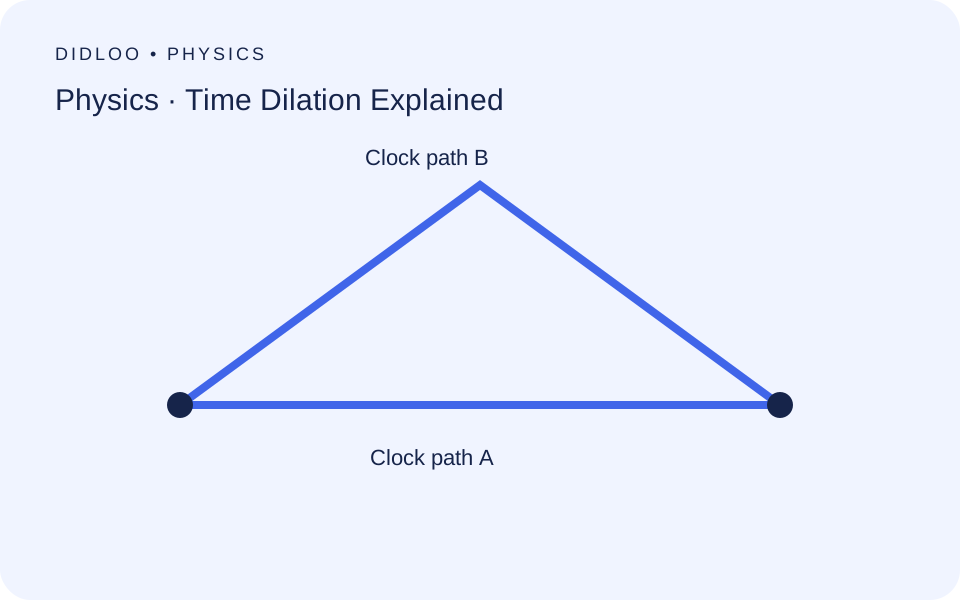
Imagine a laboratory clock and a travelling clock. Before departure, compare their readings in the same room. After the trip, bring them together again. The difference at reunion can be discussed without arguing about when a distant observer received a message. Each clock has counted a succession of physical events along its own route.
Physicists call this accumulated quantity proper time. Your wristwatch does not display an external observer's opinion about you. It records time locally. A person travelling with that watch experiences normal heartbeats, ordinary conversations and ordinary intervals between meals. The surprising result appears when different journeys are compared.
Motion changes the relationship between clock readings
In special relativity, consider an ideal clock moving at constant speed relative to an inertial laboratory. The laboratory assigns a longer interval between the moving clock's ticks than the clock measures locally. For this specific setup, elapsed laboratory time equals the moving clock's proper time multiplied by the Lorentz factor.
That factor is one divided by the square root of one minus the speed fraction squared, where the speed fraction is the relative speed divided by the vacuum speed of light. This expression is not a universal instruction to multiply every clock reading in every situation. It assumes the relevant inertial-frame comparison and does not by itself include gravitational effects.
An ideal numerical example
Choose a hypothetical speed equal to sixty percent of light speed. Its squared fraction is 0.36; subtracting from one gives 0.64, whose square root is 0.8. The factor is therefore 1.25. In the stated inertial comparison, eight hours on the moving clock correspond to ten laboratory hours.
This arithmetic is an illustration, not a claim that an available spacecraft can make that journey. It also does not describe a full out-and-back mission. A return trip requires a change of motion, and the complete paths must be considered before comparing reunited clocks.
Why receiving a slow video is a different question
A distant livestream can look slow or fast because successive signals take changing amounts of time to reach the viewer. That observation includes a propagation effect. A proper clock comparison accounts for how signals travel and how the observers assign coordinates.
For example, a craft moving away sends every update from farther away than the previous update. The receiver waits longer between arrivals even before the full relativistic analysis is explained. Simply counting arriving video frames cannot isolate time dilation. Specify the transmission schedule, movement and observation method before interpreting an apparent slowdown.
The travelling-twins problem needs the entire route
Two observers in uniform relative motion can each describe the other's clock as running slowly using their own inertial coordinates. That symmetry does not imply that a reunion must produce equal elapsed times. The familiar travelling-twins setup contains different worldlines, with the traveller changing inertial frames to return.
The useful calculation follows each worldline and totals its proper time. Acceleration identifies an important difference in the simple story, but describing acceleration as a substance that slows clocks misses the geometric comparison. Different arrangements of journeys can be analysed without reducing the explanation to a slogan about rockets.
Gravity also affects clock comparisons
General relativity adds gravitational differences. Near Earth, a stationary clock at a higher gravitational potential runs faster relative to a lower stationary clock, after other relevant effects are accounted for. The everyday difference over the height of a room is tiny, yet sufficiently precise optical clocks can resolve extraordinarily small differences.
NIST describes experiments that compare optical clocks at different elevations and speeds, while the JILA millimetre-scale experiment examines the gravitational effect across a very small separation. These are laboratory measurements. They should not be confused with claims that people can notice ordinary floor-to-floor ageing differences in daily life.
What satellite timing teaches us
Satellite navigation relies on comparing time information under carefully defined conditions. Satellites move relative to receivers and operate in a different gravitational environment. A useful explanation must account for both effects rather than saying vaguely that space makes clocks slow.
A phone receiving a timing signal is not independently discovering that an astronaut travelled into the future. It is using a system whose engineering includes clock models, orbital information and corrections. The broader lesson is practical: once measurement is precise enough, relativity becomes part of the design rather than an optional philosophical interpretation.
Common mistakes to avoid
Time dilation is not a broken mechanism, a feeling of boredom or a change in the legal definition of an hour. It affects physical clock comparisons. Nor does it supply a demonstrated method for sending messages to yesterday. A smaller accumulated proper time on one route does not establish backwards communication.
Avoid applying a flat-spacetime speed formula unchanged beside a black hole. Avoid treating every image of a distant clock as a corrected measurement. Finally, do not assume that because the effect is real it must be large in an ordinary commute. The scale depends on the situation.
A checklist for reading a claim
Ask which two clocks are being compared, whether they meet again, what motion each follows and whether gravity differs along their paths. Ask whether the quoted difference is measured locally, inferred from signals or predicted for an ideal model. These questions usually reveal what an impressive headline has left unspecified.
Time dilation sits primarily within relativity. Atomic clocks use quantum transitions as exceptionally stable references, but that does not make the entire explanation a quantum-mechanics effect. Keeping the measurement technology separate from the theory being tested makes the subject easier to understand.
Further reading
Official resources and related guides for the concepts discussed above. Check the selected tool for current capabilities and terms.
Take the next idea into a conversation
Explore Didloo for personal chats, creative sharing and linked desktop messaging. Business messaging has its own approved API workflow.