Information Technology
Twilio API Explained: Plan Messaging, Webhooks and Verification Before You Build
Twilio provides communications APIs that developers can use within their own applications. A useful evaluation begins with the customer task, the delivery channel and the evidence needed to know whether the task succeeded. This independent guide explains how to plan a messaging project, interpret asynchronous results and test operational assumptions. It does not describe a Twilio integration in Didloo or WeBot. The examples are fictional design exercises, not measured customer results.
Start with a customer action rather than an API call
Imagine a fictional repair workshop called Cedar Repairs. A customer books a collection slot and asks for a confirmation. The workshop wants to communicate three things: that the booking exists, when collection is expected and how the customer can change the arrangement. These are product requirements. Choosing a provider comes after deciding what those requirements mean.
Write the intended action in ordinary language before drawing the technical flow. Who asked for the communication? What information is necessary? When does it become stale? Who handles a reply? A successfully accepted API request cannot answer these questions for the workshop. The business still needs a truthful booking record and a sensible process for changes. This exercise keeps the technical implementation connected to a real customer need rather than the number of messages sent.
Understand where Twilio fits in the application
Twilio's documentation separates products such as Programmable Messaging, Voice and Verify. Their interfaces serve different communications tasks. Product availability, sender options and account requirements should be checked in the documentation for the intended destination and channel. A familiar company name does not make all of its products interchangeable.
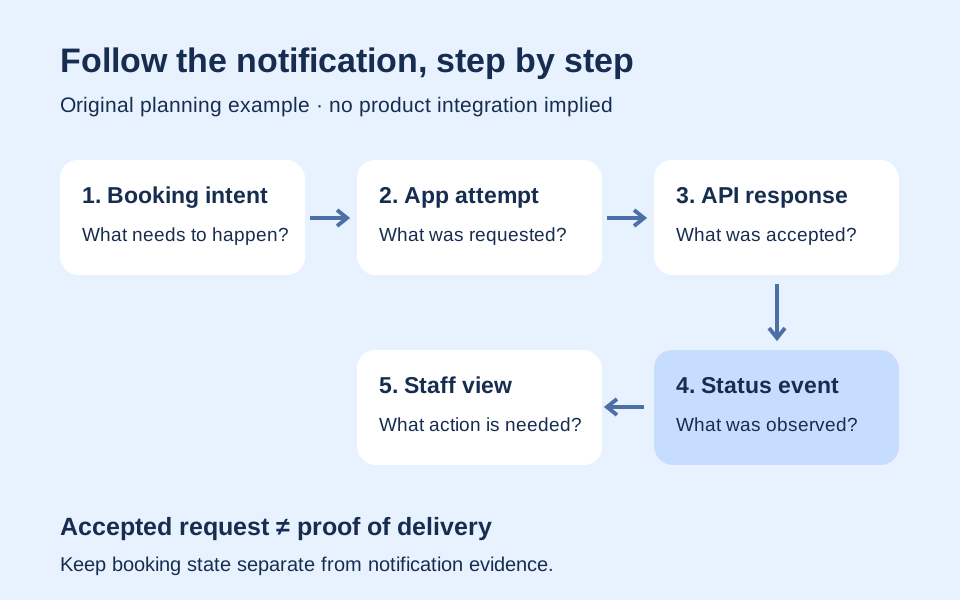
An application architecture should therefore name both the provider product and the responsibility retained by the application. In Cedar Repairs, the workshop's booking system decides whether a collection exists. A communications component attempts the notification. A support screen shows the outcome. Keeping these responsibilities explicit prevents a particularly confusing defect: displaying a booking as completed merely because a notification request was accepted. The booking and its notification have related records, but different meanings and different failure conditions.
Choose a channel by the conversation it supports
A booking confirmation, a verification challenge and an ongoing support conversation need different experiences. Compare the desired reply behaviour, the customer's access to the channel and the information that can safely fit in the message. Also ask what happens if the intended channel is unavailable for that recipient.
For the workshop, a short collection notice might direct the customer to an authenticated booking page. A lengthy troubleshooting discussion may require a support interface with history and staff ownership. Those choices can change the required application design before any provider configuration is created. Avoid writing a universal message and assuming every transport preserves its appearance, interaction model and delivery evidence. Evaluate the actual customer journey on the selected channel, using an example that includes both a successful response and an understandable failure.
Distinguish a sender from a customer identity
Twilio's scaling guidance describes sender choices and Messaging Services that group sender resources and configuration. Sender suitability depends on the use case and destination. Consult that guidance rather than assuming a number bought for one test is appropriate for every future audience. The relevant options can change with the channel and geography.
Within the workshop application, the sender is also different from the recipient's internal customer record. A phone number entered on a booking form should not become a database password or an unrestricted lookup key. Model the customer's authorised relationship with the booking independently. That way, changing a contact detail does not accidentally expose earlier conversations to another person. This is an application design recommendation; selecting a communications sender does not automatically implement the workshop's account ownership rules.
Make the first prototype deliberately narrow
A good first prototype has one fictional booking, one controlled recipient and a written expected result. Its purpose is to reveal misunderstandings while the state is still easy to inspect. Define the application's display before testing: an unsent notification, a request in progress and a recorded result should be distinguishable.
Cedar Repairs could prepare a test booking for tomorrow afternoon and check whether the confirmation contains the correct local date. It can then change that booking and confirm that the earlier draft is no longer used. This discovers an important class of error without sending a large batch: a communications system can deliver perfectly while carrying outdated business information. Keep a short test notebook with the intended input, observed outcome and the reason for any discrepancy. A prototype becomes useful when it answers a question, not simply when a screen shows a green badge.
Read current trial restrictions before treating a test as production
Twilio's trial documentation describes restrictions that can differ from a paid production setup and between console experiences. Read the current trial page for recipient verification, content, geography and expiry conditions. Do not base a rollout on an old tutorial's allowance or an assumed credit amount. This guide intentionally does not quote a permanent free quota.
A trial should demonstrate the specific capability being evaluated within its permitted scope. In the workshop example, record which restriction shaped the test and which production question remains unanswered. A successful message to a controlled recipient demonstrates that test route under those conditions. It does not establish sender readiness for an entire customer base. Keep the trial finding precise enough that another developer can repeat it without guessing which account state or console workflow was used.
Treat the send request as the start of a lifecycle
Twilio provides status callbacks for following outbound message progress. Its guide distinguishes stages across creation, sending and delivery, with read receipts available for supporting channels. That means an application must interpret the event and the channel together. A single generic success label throws away useful information.
For Cedar Repairs, use customer-facing wording that reflects available evidence. A staff member investigating a late notice should be able to distinguish an application that never attempted the request from one waiting for an outcome. Avoid claiming that a person read a notice solely because the server accepted its creation. Even a delivery indication and a customer's understanding are separate things. The software can report the evidence it has; the workshop may still need a different process for a genuinely time-sensitive change.
Give each notification an application record
Create a local record for the intended notification before relying on a remote result. Suggested fields include the booking reference, the notification purpose, the intended recipient reference, the content version and the attempt time. Retain the provider's resulting reference separately when one becomes available. These are proposed application fields, not a claim about mandatory Twilio database columns.
This structure gives a support person a concrete question to investigate: what happened to the collection-change notice for this booking? Without it, the investigation may become a search through raw phone numbers and unrelated messages. Do not make the message body the only connection to the business event. Bodies change with language and editorial improvements. A stable application relationship lets the team find the correct record without depending on punctuation or a customer's name appearing in a log.
Receive webhooks as external input
Twilio uses webhooks for event-driven interactions, including the outbound status updates described in its messaging guide. Plan a dedicated endpoint and a clear internal handler for the event type being received. An incoming customer message and an outbound status update have different purposes; they should not accidentally trigger the same business action.
Consider a fictional callback arriving while the workshop's staff screen is closed. The application should still be able to store the relevant event. Its behaviour should not depend on a person keeping a browser tab open. A useful design separates receiving the event from presenting it later. Document what the endpoint acknowledges, what it stores and which background work follows. These are architecture choices to verify in the application's environment rather than assumptions that a provider dashboard will make on the team's behalf.
Authenticate webhook requests before applying them
Twilio's webhook security documentation describes HTTPS and request signature validation. It recommends using its SDK validation helpers and accounting for the actual URL and received parameters. Follow the applicable current documentation for the endpoint's request format. Do not invent a substitute signature algorithm based on a copied screenshot.
In a workshop deployment, a reverse proxy may affect the public URL visible to the application. Include that actual arrangement in testing. First verify a legitimate request, then check that an invalid signature cannot update a booking notification. Transport security and application authorisation answer different questions: an authenticated provider event still needs to be matched to the correct local record. Never let a supplied customer identifier become an unrestricted instruction to modify an unrelated booking. Signature verification belongs before consequential processing, not after the staff interface has already changed.
Design event handling so repetition is harmless
As a general defensive engineering practice, make an event handler safe to run again. A repeated observation of a notification's status should not create a second booking, issue a second refund or send a fresh customer message. This recommendation does not assume a particular undocumented provider retry schedule.
An exercise for Cedar Repairs is to replay one saved, authorised test event inside an isolated test environment. Compare the business records before and after the second handling pass. The event history may record another receipt, but the workshop should not acquire another collection job. Decide explicitly which changes are append-only observations and which are business transitions. This distinction makes repetition easier to reason about and reduces the temptation to patch a duplicate by deleting an unexplained record after it appears in production.
Keep time and ordering visible during investigations
Distributed systems have several clocks worth distinguishing: when the workshop created an intention, when it attempted a request, when an external event occurred if supplied, and when the application received that event. Store the relevant timestamps with a documented time zone convention. Present local times to staff without destroying the original values needed for an investigation.
Suppose a notice appears late on the workshop screen. The team should ask whether the message attempt was delayed, the external outcome was delayed or the screen refreshed late. Those explanations require different repairs. An undifferentiated timestamp named updated does not provide enough context. Use an event history to explain how the displayed state was reached. This is especially helpful when a booking is edited near a notification attempt and staff need to identify which version was actually involved.
Plan retries around the business deadline
A timeout is an incomplete observation, not a universal instruction to send again immediately. Before retrying, determine whether the earlier attempt might have created a remote resource and whether the notification remains useful. Follow the API's current error handling guidance for the specific failure. Application retry policy must also consider the customer's experience.
For a fictional collection slot that has already passed, repeated reminders can be worse than a clear support task. Give notifications an expiry appropriate to their purpose. A workshop could stop automatic attempts once a replacement confirmation is issued, while retaining the history for staff. Document who can make that decision and how it is recorded. This prevents a background queue from treating every unfinished task as equally urgent forever, regardless of subsequent changes to the booking.
Separate verification from ordinary notifications
Twilio Verify is a dedicated product for user verification, with a documented workflow around a verification service, starting a verification and checking the result. Review its current channel and authentication documentation when evaluating that task. Sending ordinary text that happens to contain digits is not a complete description of a verification system.
For Cedar Repairs, proving access to a contact channel should have a narrow meaning. It need not establish a person's legal identity or grant access to every booking that ever used the same number. Bind the verification to the intended session and action in the application's design. Explain to the customer what completing the step enables. Good interface language avoids an ambiguous verified badge that staff later interpret as a guarantee much broader than the actual check performed.
Keep the verification result on the trusted side
In a proposed verification flow, the browser should display the form while the trusted application decides whether the action has been authorised. Do not let a client-supplied success flag become the only evidence that a check passed. The customer interface and the server should agree on which pending action the result completes.
Imagine two workshop tabs open at once, each editing a different contact detail. The team needs a deterministic answer about which change a verification approves. A narrowly scoped pending-action record makes that answer easier to test. Include expired, incorrect and already-completed cases in the design exercise. The useful question is whether the application makes the intended decision safely and clearly, not whether an attractive animation appears after the user presses the confirmation button.
Protect credentials throughout the development workflow
Use the credential model documented for the selected Twilio API. The Verify reference, for example, documents API key authentication. Put secrets in an appropriately protected server-side configuration system and ensure that client bundles, screenshots and support exports do not expose them. Credential setup should be reviewed as part of the deployment path, not improvised in a public example.
A practical team exercise is to trace one configuration value from its authorised source to the running process. Who can retrieve it, where can it be logged and how would it be replaced? Record the rotation procedure without recording the secret itself. Keep development and production responsibilities clear. A staff member investigating a failed booking notice should normally need the relevant outcome and reference, not unrestricted access to credentials capable of creating unrelated communications.
Treat abuse prevention as part of the product
Twilio's fraud guidance discusses SMS pumping and recommends measures including geographic restrictions, rate limits and delays between repeated requests. It also explains that provider controls cannot guarantee complete prevention. Review the current protection options for the product being used instead of assuming one account switch solves every abuse case.
For the workshop, ask which public form can cause expenditure and which customer action justifies that expense. A contact-verification button should not become an unrestricted message generator. Make repeated attempts understandable to legitimate users while limiting uncontrolled repetition. Monitor unusual request patterns against the application's normal behaviour. An alert is useful when it identifies an action the team can take, such as pausing a particular workflow while preserving genuine customer bookings and the evidence required to investigate.
Evaluate costs using a stated scenario
A sensible estimate names the destination, channel, sender arrangement, expected volume and the period being estimated. Retrieve current rates and relevant fees from the official pricing information for that scenario. Avoid applying a remembered headline price to an entire project. This article supplies no live quote and no claim that a provider is always the cheapest.
For an original planning exercise, Cedar Repairs might list normal confirmations, changed-slot notices and verification attempts separately. The exercise can then test how repeated customer actions or a booking reschedule affect volume. Keep assumed figures labelled as assumptions. A spreadsheet with clear inputs is more useful than a confident total whose units are unknown. Include the engineering and support work needed to maintain the workflow, because a low communications bill does not by itself make a confusing customer process economical.
Estimate capacity from the time window
Twilio's scaling documentation asks teams to consider sender choices, location and throughput needs. Consult the relevant current guidance for the intended market. A monthly message total alone does not describe a workload: the same number of notices spread across a month or concentrated into a short period creates different operational demands.
A hypothetical workshop could send routine confirmations throughout the day but face a sudden schedule change affecting many bookings. Ask how quickly those notices must become useful and which ones take priority. Treat throughput planning as a queue and deadline problem. Monitor the age of waiting tasks alongside their count. Twenty old notices may deserve more attention than a larger set just created. These application-level observations help explain the workload without inventing a universal provider capacity figure.
Write messages that survive real customer use
Draft the shortest message that supports the action accurately, then test its actual rendered form. Check names, local dates, reference numbers and the destination of any link. A communications API cannot repair a confusing appointment description or decide which customer detail should have been included.
For Cedar Repairs, compare a generic message saying that something changed with one identifying the collection booking and directing the customer to its current details. Review the text with the person who will answer replies. If customers will ask predictable questions, improve the booking page rather than adding endless clauses to the notification. Keep sensitive information out of examples and screenshots. An original test fixture should use fictional details and must not become a convenient way to distribute a real customer's history during development.
Test English and Hindi as complete experiences
When a service supports more than one interface language, evaluate the entire journey in the chosen language: the message, linked page, validation feedback and recovery instructions. A translated opening sentence followed by an incomprehensible error is not a complete experience. Technical identifiers may remain unchanged, but the customer should understand what to do next.
The workshop could ask reviewers to complete the same fictional booking change independently in English and Hindi. Compare the meaning of the date, the requested action and the failure explanation. This is a proposed usability exercise, not a claim of native-speaker certification. Keep semantic review separate from a character-count check. Text can fit on a screen and still reverse the intended instruction, especially around negatives, cancellation and the difference between an attempted action and a completed one.
Investigate failures through a small decision tree
Begin with the local intention: did the application create the right notification for the current booking version? Next inspect whether a request was attempted and whether a provider reference was recorded. Then examine the available outcome evidence and the event-handling history. Finally check what the staff screen displayed. This order avoids blaming the transport for a message the application never prepared.
Use one controlled example while investigating. Change one relevant variable at a time and write down the observed difference. If a callback was authenticated and stored correctly but the interface remained stale, focus on the display path. If the message carried an old collection date, focus on content generation and booking versioning. A precise incident explanation identifies which stage failed and what evidence supports that conclusion, instead of repeating that the API did not work.
Decide what the support team should see
A useful support view presents the business reference, notification purpose, relevant timestamps and the evidence behind its current label. It should let staff identify the next authorised action without requiring them to read raw request dumps. Define who may view the content and which parts of an investigation need restricted access.
Cedar Repairs might show that a changed-slot notice needs manual attention while keeping account credentials completely outside the screen. It could also display that the booking itself remains valid. This prevents an operational message failure from silently cancelling a real customer commitment. Design the support view alongside the customer flow. Otherwise, the engineering team may finish a successful demonstration while the people responsible for tomorrow's bookings still have no way to interpret an ordinary exception.
Use a written release decision
Before a production release, assemble evidence that the chosen workflow meets its stated requirements. Include a controlled successful case, a failure case, authenticated event handling, an expired notification and an understandable support outcome. Confirm the actual sender and account readiness using the current official guidance. The test record should say what was observed rather than merely declaring the project complete.
The final decision for Cedar Repairs is whether customers and staff can use this specific collection-notice workflow reliably enough for its purpose. It is not a claim that every channel, country or future campaign has been tested. A narrow release with explicit evidence creates a better foundation for expansion. Twilio can supply communications capabilities; the application team remains responsible for the business process, its permissions and the meaning presented to the people using it.
Further reading
Official resources and related guides for the concepts discussed above. Check the selected tool for current capabilities and terms.
Take the next idea into a conversation
Explore Didloo for personal chats, creative sharing and linked desktop messaging. Business messaging has its own approved API workflow.