Information Technology
WhatsApp Business API Guide: Templates, Customer Replies and Integration Planning
The WhatsApp Business Platform provides APIs for businesses building customer messaging into their own software. A useful integration needs more than a successful request: it needs the right business identity, expected messages, accurate order information and a way to understand what happened afterward. This independent guide follows a fictional furniture shop through those decisions. It explains planning rather than supplying a tested deployment or a universal eligibility checklist. Didloo is an independent messaging platform, not a WhatsApp API provider, Meta affiliate or bridge to WhatsApp conversations.
Define the customer task before the integration
Lantern Lane Furnishings is a fictional shop arranging collection of made-to-order shelves. Its immediate need is to tell a customer when a particular order is ready and provide a useful route for questions. That is a smaller, clearer project than announcing that the shop needs automation for every customer conversation.
Write one sentence describing the intended result. Include the order event, intended recipient and action the customer should understand. Then identify the shop record that establishes the information as true. A messaging integration cannot turn an unfinished shelf into a ready order. This original planning exercise gives the project a useful boundary: communicate a confirmed business fact and handle the response. Keep general promotions, staff discussion and future ideas outside that first workflow until each has its own purpose and evaluation.
Identify the product you are evaluating
WhatsApp's official Business Platform overview describes APIs, approved templates and conversational experiences. Its developer hub distinguishes a direct setup from working through a partner. Those public descriptions establish a product direction; they do not establish that a particular shop's account or intended feature is ready.
Lantern Lane should name the actual product and proposed setup in its project notes. A consumer chat screenshot, a Business App screen and a software integration proposal can describe different responsibilities. Avoid assuming that knowing how to send a personal message explains account onboarding, permissions or the shop's backend. This guide does not require a particular partner and does not claim that a partner is mandatory. Compare the chosen route with the team's capacity to manage its application, support arrangements and current documentation before beginning any real configuration.
Assign ownership to the business assets
An integration project needs a person responsible for the business account and another clearly identified responsibility for the software that uses it. They may be the same person in a small shop, but the responsibilities should still be understandable. Keep customer-facing identity, staff access and application operation distinct in the plan.
For the fictional shop, the owner could review the business information while a developer prepares the application. Record how authorised changes will be requested and who can investigate a problem. This is an original governance recommendation, not an assertion about a specific Meta role name or dashboard permission. A contractor's ability to demonstrate a request should not leave the shop uncertain about who owns the assets afterward. Use the actual account's available controls and official guidance when implementing access, rather than treating the planning document as authority to change someone else's account.
Review onboarding without guessing its outcome
The official developer hub links to setup resources and test facilities. The requirements visible in the real account and applicable documentation should determine the work needed for that business. A public article cannot promise approval, an exact waiting time or eligibility merely because a form can be opened.
Lantern Lane can prepare a list of information it needs to check before making commitments to customers. Keep the list descriptive: intended business identity, sending setup, application ownership and the people who will operate it. Mark each item as confirmed, awaiting review or not yet examined. That makes an onboarding conversation useful without inventing a universal click sequence. The example performs no signup, accepts no terms and changes no phone registration. A local planning milestone should remain distinguishable from an account that is actually authorised to send the intended production messages.
Establish which messages the customer expects
The current WhatsApp Business Messaging Policy requires recipient permission for subsequent contact and respecting requests to stop. Read that official policy for its precise scope and current requirements. A customer's presence in the shop's order system should not be used as a substitute for understanding the communication they agreed to receive.
For the fictional collection workflow, staff can record what the customer expects from the shop and how that expectation was established. Keep this business record understandable to the person preparing the update later. A useful review asks whether the planned message matches that expectation, rather than merely whether a number is present. This is an operational example, not a legal determination or a completed consent collection process. Local requirements and the platform's policy still need their own appropriate review before a real deployment.
Separate the order event from the message attempt
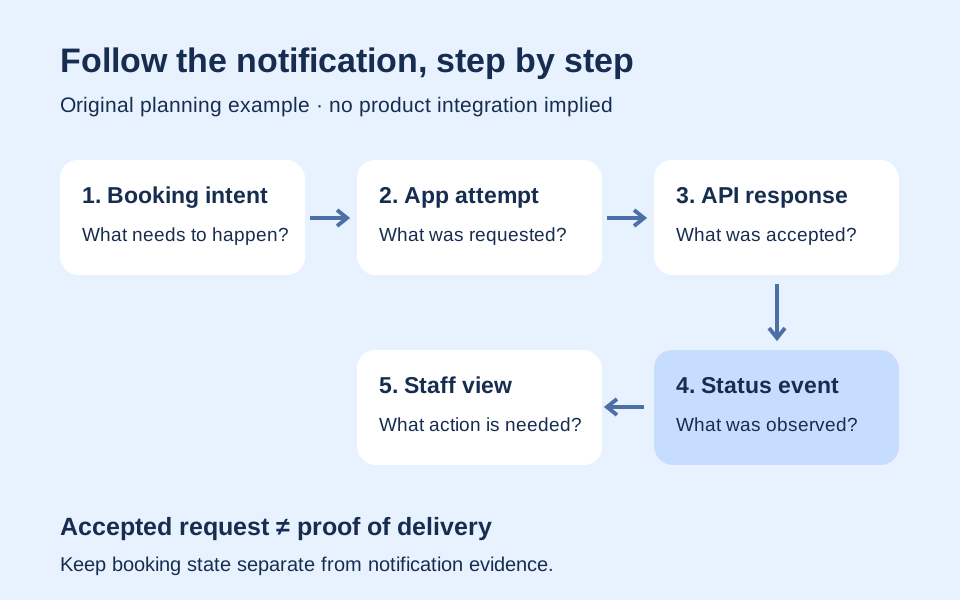
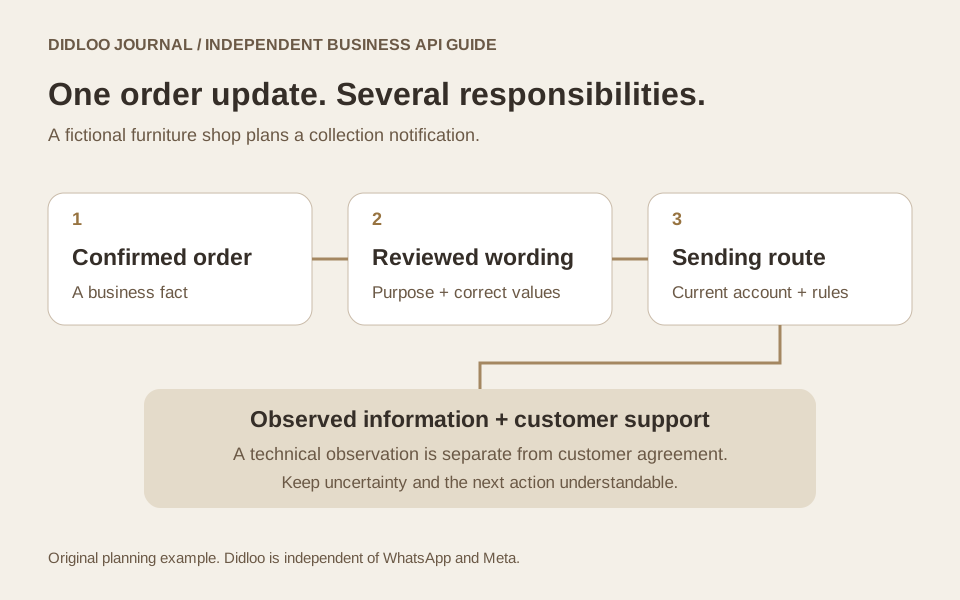
A shelf becoming ready is a business event. Preparing a notification, submitting a request and observing an outcome are separate activities. Treating them as one checkbox makes a later investigation much harder, particularly when someone changes the collection arrangements after a message has been prepared.
Lantern Lane could give the confirmed order event an internal reference and associate the intended notification with it. Keep a separate record of any actual sending attempt. This is a suggested application design, not a claim that WhatsApp supplies the shop's order management model. A staff member should be able to explain whether the order is ready even when the messaging system is unavailable. Likewise, a message-related failure should not silently rewrite the furniture production record. Clear ownership of each fact helps both customer support and technical troubleshooting.
Write a template around one clear purpose
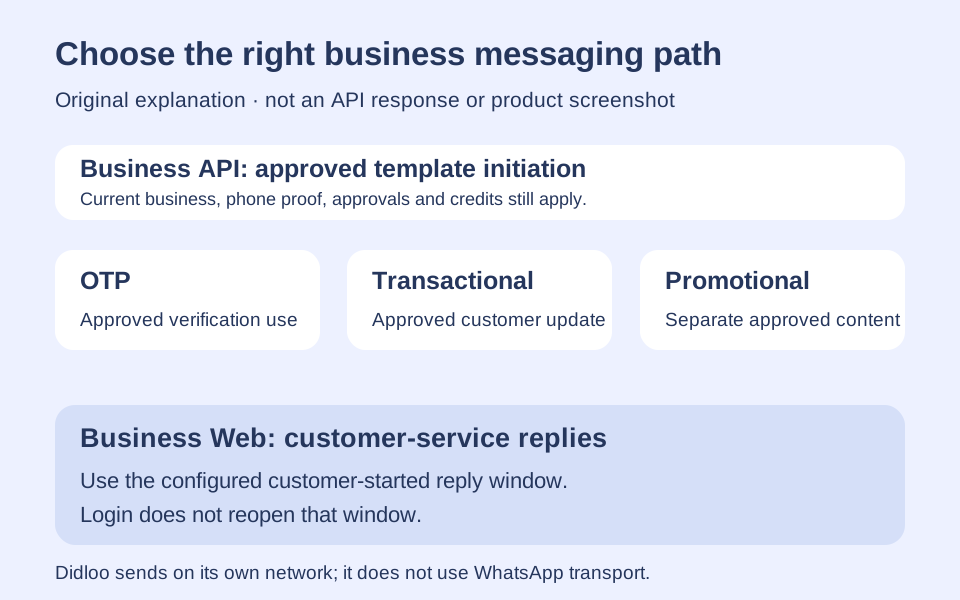
The official policy says business-initiated conversations use approved templates. The actual template must also fit its designated purpose and current platform rules. Approval is a platform state to confirm, rather than something a draft article can grant.
Start the shop's fictional wording with the customer question: which order is ready and what happens next? Remove background information that belongs in a different conversation. Keep a review copy of the intended fixed wording and describe the values that will change for each order. This is an editorial exercise, not a submitted or approved message. The shop should be able to read the completed example as the customer would receive it. A template-shaped sentence that omits the actual collection instruction is still an incomplete explanation, even if its variable positions look technically tidy.
Keep changing values connected to their meaning
A reusable message becomes misleading when the wrong order reference or collection detail is inserted. Review each changing value by its meaning, not just whether it fits an available position. The intended recipient must correspond to the same business record as the rest of the update.
For Lantern Lane, a test example might use a fictional shelf reference and a clearly labelled collection location. Compare the completed sentence with the approved business event. Check that the location is current and that a staff-only note has not been substituted for a customer instruction. This is an original data-quality recommendation, not a guessed API schema or a claim about supported variable syntax. Implement the actual payload against current official documentation. Keep the mapping readable enough that a reviewer can identify a swapped value without having to reverse-engineer the entire application.
Evaluate categories through the intended message
The official pricing page describes marketing, utility, authentication and service categories. Use the current category guidance for the actual proposed content. A label selected in a local spreadsheet does not decide how the platform will classify a message.
The shop's project can keep collection updates separate from offers about a different product. That makes its own intention easier to explain before it checks the applicable platform rules. Avoid placing unrelated promotional language into an operational draft just because both mention the same shop. This is a planning distinction, not a promise of a particular approval or rate. If the content changes, revisit its purpose and evaluation. A useful decision record identifies the actual wording being considered so that staff do not apply an old category assumption to a materially different message later.
Treat the customer-service window as a live condition
WhatsApp's current policy allows replies without a template within a 24-hour customer-service window that opens and resets with each user message. Outside it, approved templates are required. Check the applicable documentation when implementing this rule rather than substituting a staff login time or a local screen timer.
For Lantern Lane, a customer asking about collection can lead to a reply through the appropriate supported workflow. Staff still need accurate information and a clear responsibility for answering. The application should distinguish the customer's message from a note written internally by an employee. This is an original workflow recommendation, not a claim that this article opened a service window or tested a response. Keep the real platform condition authoritative when deciding how a later message may be sent.
Make a human support route understandable
The current policy requires clear escalation paths when automation is used during the service window. Consult its options and the real service setup. Do not claim that a bot can transfer to an employee, place a call or create a support record unless that capability is actually implemented.
Lantern Lane can decide who owns a question about an unusual collection arrangement. The customer should understand what the offered next step means and when it is available. A link to a contact destination does not by itself establish that someone is monitoring a queue. This is a proposed service design, not an assertion of a live staffing arrangement. Keep the automated explanation aligned with what the shop can really do so that an unresolved question does not become a loop of confident but unhelpful replies.
Protect application access deliberately
A software integration needs a controlled way to use whatever credentials and permissions its chosen setup requires. Follow the current official instructions for that environment. Do not copy real credentials into a public article, customer message, screenshot or shared test example.
The fictional developer can separate configuration from the customer-facing wording and make access ownership part of the handover. Describe how an authorised operator will recognise an access problem without displaying a secret value. This is a general application-security recommendation, not a tested token-lifetime claim or an instruction to create a particular credential. The shop should know who can make an authorised change and where the relevant operational documentation is kept. Convenience during a demonstration should not become the only explanation of how production access will be maintained or reviewed later.
Understand the role of incoming events
The official developer hub lists webhooks among its resources. In an integration plan, incoming notifications deserve their own processing and investigation path, separate from the code that requests an outgoing message. Use current technical documentation for the precise subscription and payload details.
Lantern Lane can sketch what should happen when its application receives new information about a conversation or an attempt. First identify the event, establish that it belongs to the intended application and connect it to the right local record. Then decide what business action, if any, should follow. These are original design questions, not a copied webhook implementation or a claim to have tested signature verification. Do not turn a publicly reachable receiver into automatic authority to change an order merely because a request contains a familiar-looking reference.
Keep technical observations separate from customer decisions
Meta's official Postman workspace distinguishes Cloud API, business-management and Flows resources. Consult the appropriate current reference for the operation being implemented. A notification about a messaging operation should be interpreted within its documented meaning, rather than used to invent a completed business outcome.
For the shop, a technical observation is not the same as the customer agreeing to collect a shelf on a particular day. Even a customer reply needs to be read in context before changing the order arrangements. This is an original interpretation rule, not a catalogue of guaranteed status events. Use precise labels in the shop's own interface: what was requested, what was observed and what remains uncertain. That helps staff explain a case without treating an attractive success indicator as proof of customer understanding or agreement.
Investigate uncertainty before making another attempt
An incomplete response or an unavailable local record leaves uncertainty. It does not automatically prove that an intended message never progressed. Before a real application submits another attempt, investigate what information is available through the actual supported workflow.
Lantern Lane can prepare an internal question sequence: which order event prompted the update, what attempt was recorded and what observations are associated with it? Keep any decision to contact the customer again explicit. This is a proposed investigation process, not a claim that the platform deduplicates identical text or offers an undocumented idempotency parameter. The aim is to avoid turning missing evidence into a chain of unnecessary messages. Keep the first attempt visible in the history, while recording why a further attempt was authorised and which current business facts it uses.
Make event handling safe to repeat locally
The application's own business actions should remain understandable if information is processed again during recovery or investigation. This is a local design concern even before selecting a particular platform-specific retry strategy. Follow the current reference for the actual event's identity and delivery behaviour.
In the fictional shop, processing a messaging observation should not create another furniture order or mark a collection completed without the relevant business evidence. Store enough context to recognise what has already been handled and make the intended action clear. This is an original resilience recommendation, not an assertion that a specific webhook is always repeated, arrives in a fixed order or uses a particular retry schedule. A useful test includes replaying synthetic local data and checking that the business record remains correct, without sending anything to a real customer.
Use media only when it helps the task
A picture or document can make a collection instruction easier to understand, but it can also introduce a second item to review. Evaluate the actual supported message format and its current requirements before implementing media. This guide does not promise a file type, size limit or permanent download lifetime.
Lantern Lane might prepare a simple collection-location image using fictional information for a test. Check the visible address, background details and whether the message still makes sense when the image is not immediately opened. This is an original communication recommendation, not a measured media-delivery result. Keep an ordinary text explanation of the essential next step where the chosen format permits it. A visually polished attachment should not hide an outdated instruction or become the only place where the customer can identify the order being discussed.
Budget using the current pricing source
The official pricing page describes delivered-message charging that depends on the recipient market and message category, with specific exceptions and tiers explained there. Check that source and any separate provider terms when preparing a real estimate. This guide does not freeze a rate or claim that all messages are charged equally.
For Lantern Lane, create a scenario based on expected business events rather than an arbitrary large contact list. Separate the estimated platform usage from application development, staff support and any partner charges. Keep the assumptions beside the estimate so that a changed category or workflow can be recognised later. This is a planning method, not a quotation, payment commitment or forecast of a guaranteed return. An attractive unit figure alone cannot establish the total cost of running a useful customer-service process.
Start with synthetic and authorised test material
The developer hub describes test resources. Use the actual documentation and account conditions to determine what is available for the selected setup. A successful test in one environment should remain labelled as a test rather than advertised as unrestricted production readiness.
The shop's fictional test pack can contain a made-up order, a clearly identified expected message and a customer question that needs staff review. Also include a wrong mapping, missing business fact and uncertain outcome. These are original test-design suggestions; this article creates no account, sends no message and registers no recipient. Record the expected result before examining the observation. That keeps the review from quietly redefining success after a failure and gives the shop evidence about its own workflow rather than a general claim that every possible feature has been checked.
Review English and Hindi as complete messages
For a bilingual workflow, check the completed English and Hindi examples against the same order brief. Verify the collection reference, place, timing and requested action. Preserve negatives and the difference between a suggestion and a confirmed arrangement even when natural sentence order changes.
Lantern Lane can ask a reviewer to explain the next step from each version without consulting the other. If the explanations differ, investigate the wording or inserted data. This is an original editorial exercise, not a native-speaker certification or a claim that a particular template language has been approved. Language quality, account availability and platform review are separate matters. Keep a reviewed local example distinguishable from an actual template that the selected account is currently permitted to use, and revisit both meaning and configuration when the wording changes.
Keep customer information within its purpose
A useful operational record explains the message workflow without reproducing every private detail everywhere. Decide which staff need access to the order information and which data is actually needed for investigation. Follow the relevant platform rules and the shop's applicable information-handling responsibilities.
The fictional support view could show an internal reference and a concise explanation of the problem while limiting unnecessary message content. This is an application design recommendation, not a claim about WhatsApp's default retention, a blanket encryption guarantee or a legal retention schedule. Do not infer that a successful messaging integration permits the shop to reuse customer information for unrelated purposes. Technical access and an appropriate business use remain different questions, and a public tutorial should never become a convenient place to expose real customer records while explaining an example.
Keep unsupported answers out of automation
A conversational interface can make a reply feel immediate, but the reply still needs a source for its business facts. Decide what information the application is allowed to use and what it should do when the source is missing or contradictory. Fluent wording does not establish that a shelf has been completed.
For Lantern Lane, an assistant could be designed to explain a confirmed collection instruction from the intended record. It should not invent opening hours, stock, refunds or a different pickup date to keep the conversation moving. This is an original proposed design, not a claim that the shop has deployed an assistant or that WhatsApp supplies its inventory system. Give uncertainty a useful next step through the real support arrangement, and make any action that changes the order distinguishable from merely explaining existing information.
Compare Didloo through its own network boundaries
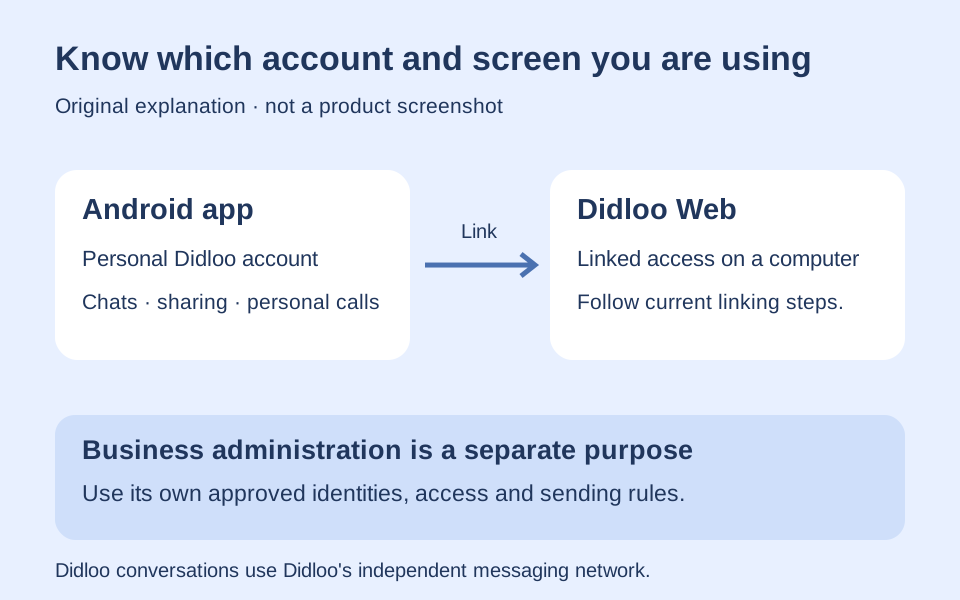
Didloo's public Business Messaging API overview identifies an independent platform for messaging Didloo users. It states that it is not a WhatsApp API provider and has no WhatsApp or Meta affiliation. Evaluate its own approved workflow instead of treating it as another credential for the same transport.
Lantern Lane considering both products should first identify where each intended customer conversation would occur. Do not assume that a message, template, business approval or chat history transfers between the services. This is an independent comparison boundary, not a ranking or an interoperability demonstration. Keep each product's account rules, message categories and response workflow attached to that product. The presence of familiar concepts can help a team ask better questions, but it cannot replace evidence that a particular capability exists in the actual chosen service.
Release one supported workflow with a useful record
A practical first release connects one confirmed business event to an expected customer message, a documented sending route and an understandable support process. Record what was actually checked, what remains conditional and who owns the next action when something fails. Keep that record concise enough for an operator to use.
Lantern Lane's useful result is a customer who can identify the ready order and understand collection, with staff able to resolve a question. It is not the largest possible number of automated messages. Future promotions, richer experiences or additional products need their own evaluation. This original planning model gives the team a repeatable way to assess those additions without invented approval guarantees, copied implementation snippets or a promise that one accepted API request completes the customer's underlying business task.
Further reading
Official resources and related guides for the concepts discussed above. Check the selected tool for current capabilities and terms.
Take the next idea into a conversation
Explore Didloo for personal chats, creative sharing and linked desktop messaging. Business messaging has its own approved API workflow.